
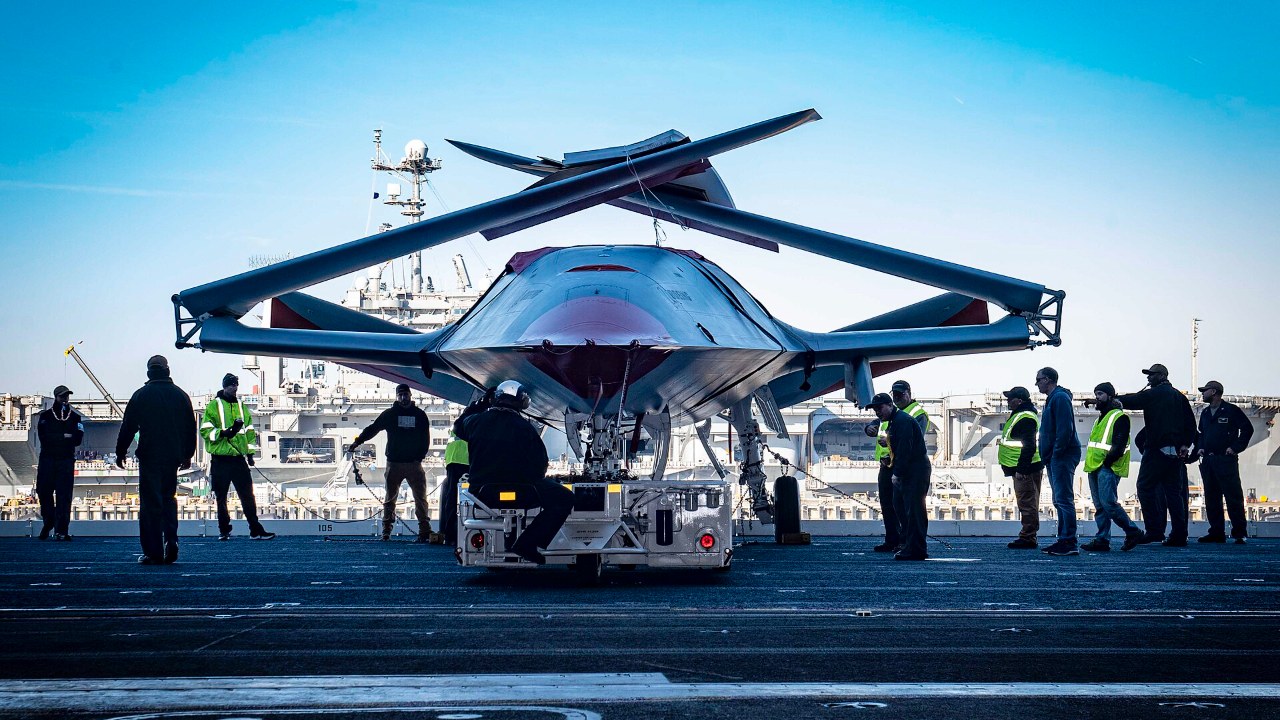
Two U.S. aircraft carriers now have an operational MD-5C ground control station for the MQ-25A Stingray unmanned tanker, according to Lockheed Martin, which builds the station’s command-and-control software. USS Theodore Roosevelt (CVN 71) received the first in March 2026. USS Ronald Reagan (CVN 76) received the second in August 2026.
The milestone is about the shipboard control room, not the aircraft. The MQ-25A was still in flight test and early production in 2026, and neither the company’s announcement nor the Navy’s 2026 program releases give a date for the Stingray to begin flying from a carrier.
Lockheed Martin made the announcement in a Sept. 30, 2026 release from Palmdale, California, saying the Navy had doubled its fleet capacity to operate the MQ-25A over five months by standing up the second station. The station runs on MDCX, an autonomy platform built by the company’s Skunk Works division, which Ben Tongue, Lockheed’s MDCX program manager, called “a ready-now, open-architecture command and control platform for the fleet.” Tongue went on:
“In five months, we’ve doubled the number of U.S. Navy carriers ready to fly the MQ-25A Stingray. Our team, in close coordination with the Navy, is establishing the command and control backbone for the Carrier Air Wing of the Future.”
What the MD-5C station does
Lockheed describes the MD-5C as a system of systems that combines the Navy’s C4I network, the company’s MDCX software and hardware, and other government-produced equipment. It sits in the Unmanned Air Warfare Center, the carrier’s onboard command center for unmanned aviation. “Within the GCS, MDCX is the mission planning and execution software that enables Navy operators to command and control the MQ-25A Stingray, extending carrier air wing reach and freeing manned aircraft for higher-priority missions,” the Sept. 30 release states.
The Navy’s program manager was quoted in the same release. Capt. Daniel Fucito, who runs the Unmanned Carrier Aviation program office, PMA-268, said the two centers aboard CVN 71 and CVN 76 “bring us closer to integrating unmanned carrier aviation into the fleet.” Those are the two ships that have them. Everything beyond that, including the “Carrier Air Wing of the Future,” is the company’s description of where the program is headed.
From a test room on USS George H.W. Bush
The control room itself was proven on a different ship first. U.S. Fleet Forces Command reported on Dec. 23, 2024 that the Navy had installed the first Unmanned Air Warfare Center aboard USS George H.W. Bush (CVN 77), a multi-year job spread across several ship availability periods. That release called the system the MD-5E ground control station and named Lockheed’s MDCX as the power behind it.
The Bush installation was set up for testing. Fleet Forces said CVN 77 would lead the first at-sea testing of the center’s operational networks in early 2025, with production systems being fabricated for installation on CVNs 70, 71 and 76 beginning in fiscal year 2025. Roosevelt and Reagan are two of those three hulls, and they are the two Lockheed now counts as operational.
Where the Stingray stands
The Navy announced the MQ-25A’s first flight in April 2026. According to a Navy news release dated April 27, 2026, the MQ-25A took off from Boeing’s facility at MidAmerica Airport in Mascoutah, Illinois, on April 25 and flew for about two hours. Navy and Boeing air vehicle pilots controlled it from an MD-5 ground control station that included MDCX. The Navy described the Stingray as “designed primarily to serve as an aerial refueling tanker.”
Fucito said in that release that the first flight “officially initiates the rigorous flight test program.” The Navy said the team would keep testing before a ferry flight to “Pax River” later in 2026.
Production approval followed a few weeks later. The Navy reported on May 19, 2026 that the MQ-25A had secured Milestone C approval, clearing low-rate initial production. The first production contract, Lot 1, covers three aircraft, with priced options for three more in Lot 2 and five in Lot 3, per the same release. With two carriers now fitted with operational control stations, the next step on the Navy’s published timeline is the flight test program that moves the Stingray toward the fleet.
Top image: Sailors and Boeing team members prepare to move the MQ-25 test aircraft into the hangar bay of USS George H.W. Bush (CVN 77) in 2021. Image Credit: U.S. Navy photo by Petty Officer 3rd Class Noah J. Eidson — Public domain / Wikimedia Commons
This article was produced with the assistance of AI and reviewed by Combat Rated editors prior to publication.