
Six tasks, a patrol route and a team of four soldiers: that was the test at the British Army’s inaugural Drone Wars competition at the Royal Military Academy Sandhurst. Twenty-three teams from across the Army entered, and a team from the 2nd and 4th Battalions of The Ranger Regiment won. The British Army announced the result on Sept. 30, 2026.
The tasks ran from striking a moving vehicle with a first-person-view drone to finding an enemy position and calling in artillery. The organizers said the point was tactics, not stick skills.
The Army’s Sept. 30, 2026, release says teams “followed a patrol route to complete six tasks testing their ability to fly different drones on different missions.” Entrants ranged “from armoured units to engineers,” the release says, and the event was run by 16 Air Assault Brigade, which it describes as “the Army’s lead formation for developing how to fight with and against drones.” The release does not give the dates the competition was held.
Six tasks, judged on speed and accuracy
According to the release, teams were “Judged on speed and accuracy.” The six tasks were:
- strike a moving vehicle using a First Person View (FPV) drone
- fly an FPV drone into a bunker to destroy it
- interpret video from a drone flown by someone else to hit a target with an FPV drone
- find friendly troops and deliver medical supplies by drone
- conduct a detailed aerial reconnaissance before an infantry assault
- locate an enemy position and call in an artillery strike
Forces News reporter Hannah King, who covered the event in a report published Sept. 18, 2026, wrote: “It’s a six-hour patrol route, with six missions in total.” The moving-vehicle target, she reported, was “a full scale mock-up of a BRDM – an old Soviet-era armoured scout car.” King quoted Brig. Ed Cartwright, who helped develop the concept: “There is nothing better to make people better at things than competition.”
What the organizer was testing
Maj. Callum Jones of 1st Battalion The Royal Gurkha Rifles organized the event. The Army’s release quotes him:
“What we are testing is how soldiers use drones tactically, not how well they can fly them. As well as striking targets, soldiers are using drones to gather information to inform other actions, such as calling in artillery or launching an infantry attack.”
Jones also said the mix of entrants mattered. “The teams taking part in this event are not just from combat units, with engineers and logistics troops competing as well, and that demonstrates how broad the adoption of drones is,” he said in the release. He called the event “a chance to learn from each other and share skills.”
A Skydio spotter and an FPV pilot
The release describes one pairing in detail. Trooper Darel Anderson of the Household Cavalry Regiment flew a Skydio drone to find targets, and Trooper Harvey Chilman flew an FPV drone to strike them, working as what the Army called a “hunter-killer” pair. “You need good observation skills to interpret what the drone is seeing, and then to clearly communicate that information to other soldiers,” Anderson said.
Chilman crews a Challenger 2 main battle tank with the Queen’s Royal Hussars. He told the Army he was the first in his regiment to qualify as an FPV pilot and had more than 170 flying hours, and that on the competition he flew two strike missions and hit both targets. “For me, there’s a similarity between flying drone missions and tank gunnery—both are about getting into the right position to line up on the target and hit it,” he said.
Drone racing on Sandhurst’s polo field
The tactical contest ran alongside the Military International Drone Racing Tournament, in which, per the release, “teams of troops from around the world race FPV drones around an obstacle course on Sandhurst’s polo field.” Sandhurst hosted the same tournament in 2025: Australia’s Department of Defence reported on Oct. 1, 2025 that 43 pilots from seven nations raced there Sept. 16–18, 2025, and that the Australian Defence Force team clinched “a fifth-straight championship.”
The Army’s own Soldier magazine, in its October 2025 issue, described 16 Air Assault Brigade Combat Team as “the army’s lead formation for developing the use of UAS,” or uncrewed aircraft systems. The Sept. 30, 2026, release does not say when the next Drone Wars competition will be held. The inaugural title, by the Army’s record, belongs to the team from the 2nd and 4th Battalions of The Ranger Regiment.
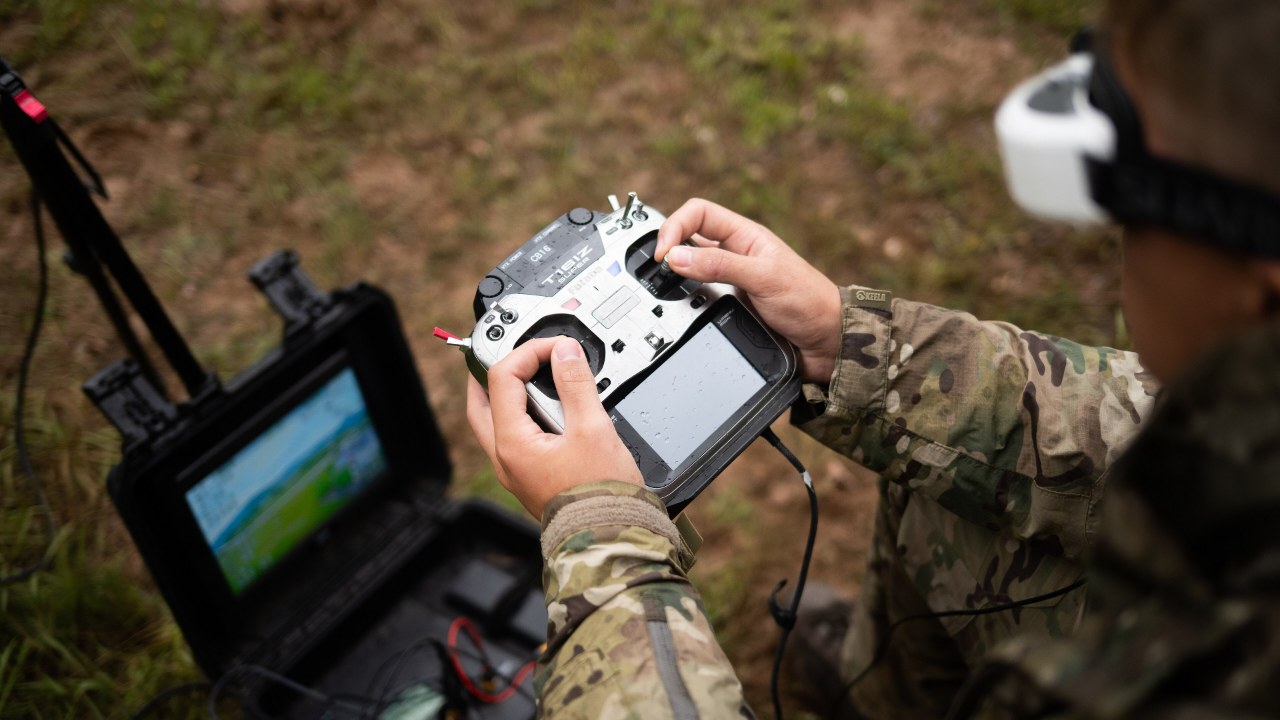
Top image: A British Army soldier of the 2nd Battalion, Royal Yorkshire Regiment, operates a drone during Project Flytrap training in Hohenfels, Germany, on June 8, 2025. It is not from the Drone Wars competition. Image Credit: U.S. Army photo by Spc. Elijah Magana — Public domain / Wikimedia Commons
This article was produced with the assistance of AI and reviewed by Combat Rated editors prior to publication.