
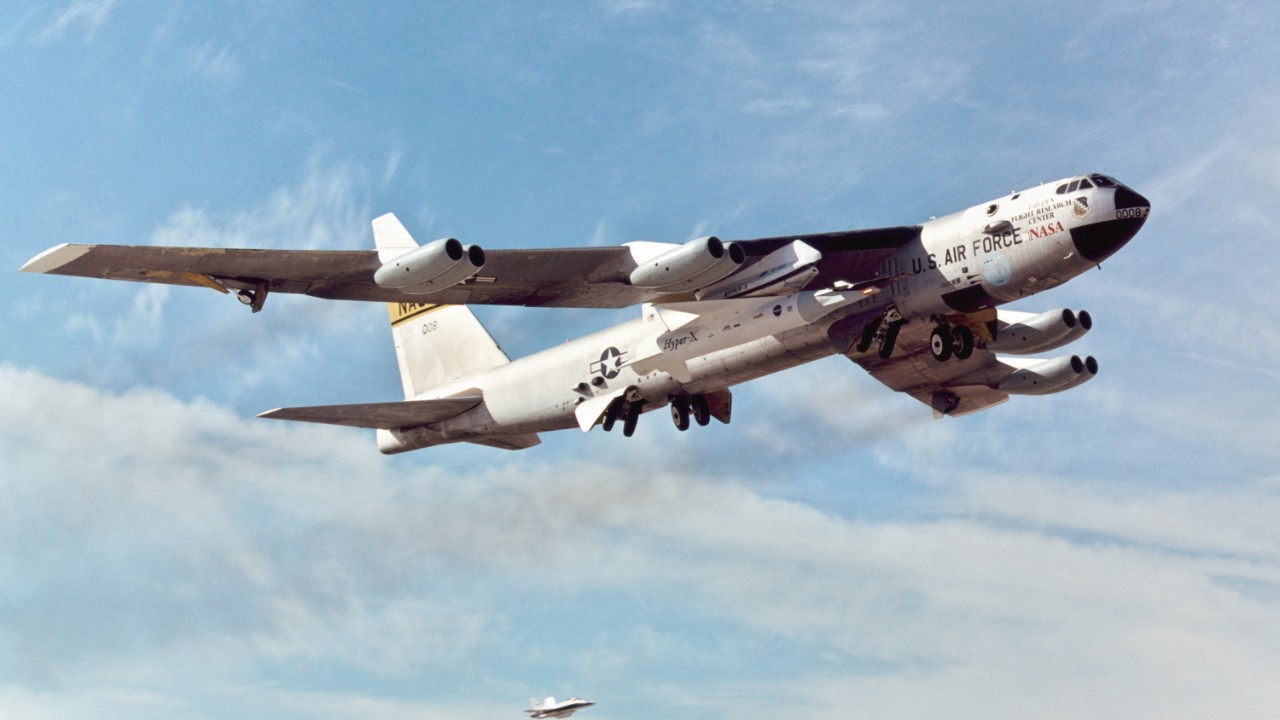
A 12-foot unpiloted lifting body, built to fly exactly once, went faster on its own engine than any jet-powered aircraft before it. NASA’s X-43A reached Mach 9.6 on Nov. 16, 2004, after a Pegasus rocket launched from beneath a B-52B carried it to 109,000 feet. Guinness World Records later recognized the flight as the world speed record for a jet-powered aircraft.
The record belongs to an air-breathing engine, not a rocket. The X-43A’s scramjet, short for supersonic-combustion ramjet, was the thing being tested. The Pegasus booster only delivered it to the starting line.
NASA’s release announcing the Guinness recognition quotes the record citation directly: “On 16 November, 2004, NASA’s unmanned Hyper-X (X-43A) aircraft reached Mach 9.6. The X-43A was boosted to an altitude of 33,223 m (109,000 ft) by a Pegasus rocket launched from beneath a B52-B aircraft.” The citation adds that the scramjet “then burned its engine for around 10 seconds during its flight over the Pacific Ocean.”
From Mach 9.8 on the first read to Mach 9.6 on the record
The first number NASA published was higher. In its post-flight release on the November 2004 test, the agency said preliminary data showed the engine “worked successfully at nearly Mach 9.8, or 7,000 mph, as it flew at about 110,000 feet.” The flight, originally scheduled for Nov. 15, took place in restricted airspace over the Pacific Ocean northwest of Los Angeles.
NASA later appended a correction to that release: “Later analysis of additional data indicated a Mach number of about 9.6 was achieved at about 109,000 feet.” The figure Guinness certified is the analyzed one, not the preliminary read.
Per the same release, the B-52B flew out of NASA’s Dryden Flight Research Center at Edwards Air Force Base, California. The booster was a modified first stage of a Pegasus rocket built by Orbital Sciences Corp. Once the stack reached its target altitude and speed, the X-43A separated and flew on its own engine.
Three vehicles, three flights
The Hyper-X program never planned a fleet. NASA’s X-43A reference page says three unpiloted research aircraft were built, each a 12-foot-long, 5-foot-wide lifting body designed to fly once. ATK GASL built the vehicles and their engines, Boeing Phantom Works designed the thermal protection and onboard systems, and Orbital Sciences supplied the boosters.
The first attempt, in June 2001, did not reach the test point; the booster failed and had to be destroyed early in the flight. A paper by the program’s chief engineer, archived on NASA’s Technical Reports Server, records the Mishap Investigation Board’s finding that the launch vehicle “failed because the vehicle control system design was deficient for the trajectory flown due to inaccurate analytical models.”
The second vehicle flew on March 27, 2004, and reached Mach 6.8. NASA’s Guinness release says that flight “easily shattered the previous, long-standing record,” and that both X-43A records would appear in the 2006 edition of Guinness World Records. The third flight, in November 2004, raised the mark to Mach 9.6.
What the X-43A proved, and what it did not
A NASA Langley fact sheet on the program fills in the launch profile: release altitude from the B-52B was 40,000 feet for both successful flights, and the scramjet operated for about 10 seconds on each. The fact sheet puts the program’s cost at approximately $230 million.
NASA’s November 2004 release summed up the tested result as a demonstration that an air-breathing engine can fly at nearly 10 times the speed of sound. The limits of that proof are in the same records: an unpiloted vehicle, built for one flight, with about 10 seconds of scramjet operation per flight. It was a test article, not an operational aircraft.
Paul Reukauf, deputy project manager for X-43A flight research and testing at Dryden, framed the result in NASA’s Guinness release.
“These demonstrations proved the viability of scramjet engine technology in a ‘real-world’ flight environment and were the result of over 40 years of high speed propulsion research within NASA.”
NASA’s Guinness release noted that the X-43A “more than doubled, then tripled, the top speed of the jet-powered SR-71.” The Mach 9.6 figure from Nov. 16, 2004, is the one the record book carries.
Top image: NASA’s B-52B climbs out with the X-43A and its Pegasus booster under its right wing on Nov. 16, 2004, the Mach 9.6 flight. Image Credit: NASA/Tony Landis — Public domain / Wikimedia Commons
This article was produced with the assistance of AI and reviewed by Combat Rated editors prior to publication.