
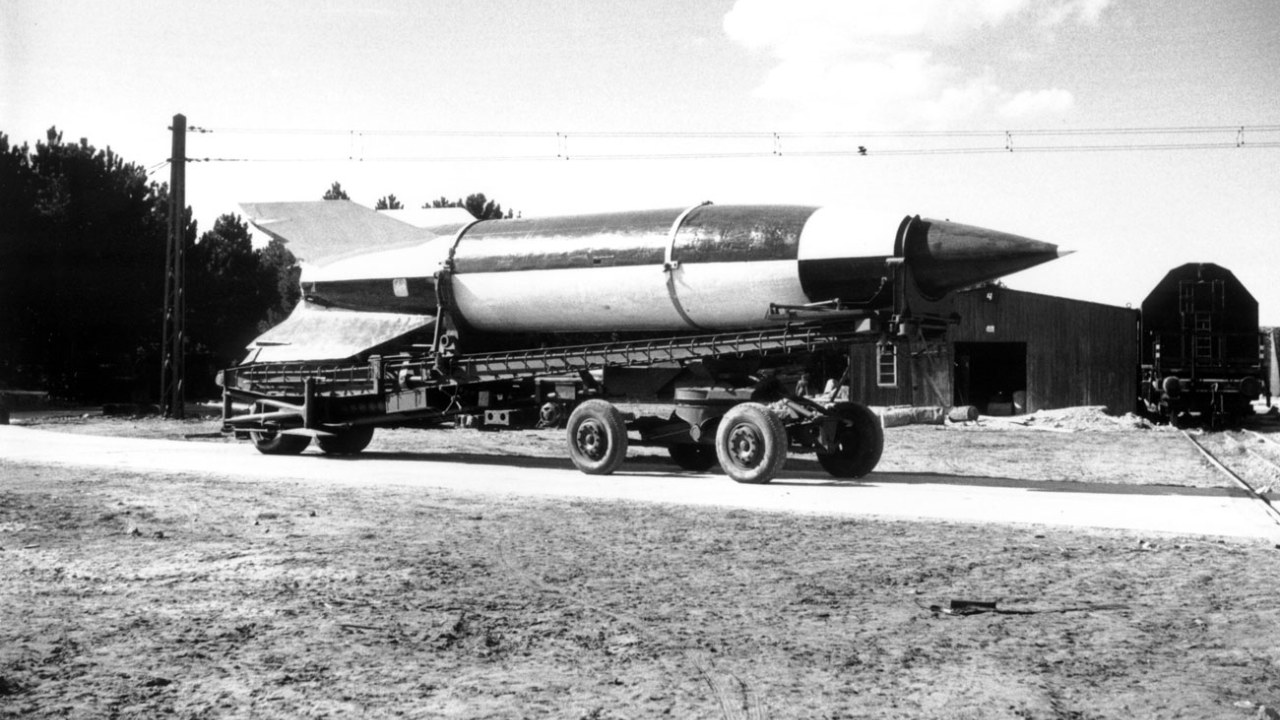
Peenemünde, on Germany’s Baltic coast, had already watched its new rocket fail twice when the fourth test vehicle lifted off on Oct. 3, 1942. That flight, of the missile German Army Ordnance called the A-4 and the world later knew as the V-2, reached an altitude of 60 miles and flew 125 miles downrange. Its peak speed was 3,300 mph.
It was the first successful flight of a large liquid-fueled ballistic missile. Within two years the weapon was in combat, and within four, captured examples were flying over New Mexico under U.S. Army control.
The figures come from the Smithsonian National Air and Space Museum’s catalog entry for its V-2, which states that “on 3 October 1942 Peenemünde launched its first successful A-4, the V4, or fourth test vehicle.” The museum records that “this rocket attained an altitude of 60 miles and range of 125 miles in a 296 second flight,” landing 2.5 miles from its aim point and “reaching a top speed of 3,300 mph.” Launches in June and August 1942 had failed.
How the A-4 worked
The museum calls the V-2 “the world’s first large-scale liquid-propellant rocket” and the first modern long-range ballistic missile. Liquid oxygen served as the oxidizer and a 75 percent alcohol-and-water mixture as the fuel, per the museum. The Australian War Memorial, which holds another surviving V-2, describes in a July 24, 2025 article by Duncan Beard a missile that “travelled at almost five times the speed of sound,” with about five minutes from launch to landing.
The airframe was large for its time. The National Air and Space Museum lists its example at 46 feet long and 5 feet 5 inches in diameter, with four clipped fins. In service, the nose carried a one-ton warhead, and the museum gives the operational missile a maximum range of about 200 miles.
The technical director at Peenemünde was Wernher von Braun, with Walter Dornberger leading the Army side of the program. The name “V-2,” for Vergeltungswaffe Zwei, or “Vengeance Weapon Two,” came from Nazi propaganda when the weapon was publicly announced in November 1944, according to the museum.
Production at Mittelwerk
After the Royal Air Force bombed Peenemünde in August 1943, “A-4 manufacturing was shifted to the underground plant of Mittelwerk at Nordhausen, in the Harz Mountains,” the museum records. The work there depended on concentration camp prisoners. The National Air and Space Museum states that “at least 10,000 concentration camp workers died in the process of manufacturing it.”
The United States Holocaust Memorial Museum’s Holocaust Encyclopedia entry on Dora-Mittelbau records that “in 1943, prisoners at Dora-Mittelbau began construction of large underground factories and development facilities for the V-2 missile program,” and that once full production began in fall 1944 the camp held “a standing prisoner population of at least 12,000.”
From combat to White Sands to Washington
The first successful operational launch came on Sept. 8, 1944, against Paris, and the missile was turned on England at 6:43 p.m. the same day, the National Air and Space Museum records. Britain’s Imperial War Museums notes that “the V2s were launched by mobile batteries which could operate from almost anywhere.” By the National Air and Space Museum’s count, “during the remainder of the war 3,200 to 3,600 were sent towards Allied targets,” with the last combat launch on March 29, 1945.
The rocket outlived the war that produced it. The museum records that the U.S. Army Ordnance Corps contracted General Electric under Project Hermes to prepare captured V-2s for flight, and “on 15 March 1946 the static firing of a V-2 took place at the White Sands Proving Grounds, New Mexico.” The first U.S. launch of a captured V-2 followed on April 16, 1946, the museum’s record shows.
The V-2 also put the first rocket into the air from Florida’s future spaceport. NASA’s history office recounts the Bumper program, which mounted a WAC Corporal on a V-2 as a second stage. On Feb. 24, 1949, that combination saw “the fully-fueled Corporal reaching a speed of 5,150 mph and an altitude of 244 miles,” NASA wrote, and Bumper 8, launched July 24, 1950, was “the first rocket ever launched from Cape Canaveral.”
“The U.S. Air Force officially transferred this V-2 to the Smithsonian on May 1, 1949,” the museum states. Restored in 1975–76 with missing parts supplied by Britain’s Royal Air Force Museum, “it now carries the black-and-white test-flight scheme similar to the one used on the rocket’s first successful flight,” the museum notes. It is “one of about twenty-one known examples” and stands in the museum’s space hall in Washington, painted to match the launch of Oct. 3, 1942.
Top image: A V-2 rocket on its Meillerwagen transporter during the postwar Operation Backfire tests near Cuxhaven, 1945. Image Credit: Ian Dunster (en.wikipedia) — Public domain / Wikimedia Commons
This article was produced with the assistance of AI and reviewed by Combat Rated editors prior to publication.