
Ukraine’s Ministry of Defence says a domestically developed amphibious uncrewed ground vehicle has driven more than 40 kilometers over land and water, with no one aboard, to carry rations and ammunition to front-line positions. The ministry calls it the first logistics mission of its kind.
The claim is the ministry’s own. The vehicle’s maker and model have not been named, and the run has not been independently verified, so the distance, the cargo and the “first” all rest on the Ukrainian government’s account.
The ministry published the account on Sept. 29, 2026, stating that “the amphibious UGV traveled more than 40 km over land and water, delivering provisions and ammunition to positions.” It said the vehicle was operated by personnel from one of the separate mechanized brigades of Ukraine’s Armed Forces, and that the platform can switch between driving and swimming within seconds.
Why a robot that swims
The ministry framed the machine as an answer to terrain rather than to firepower. As UK Defence Journal reported in its Sept. 29 account of the ministry’s statement, “rivers, canals and marshy ground along the front complicate or entirely block routes for ordinary uncrewed ground vehicles,” while resupply by air has complications of its own. A vehicle that handles both, the ministry argues, removes the need to move cargo from one system to another or to drive around water obstacles.
The same report quotes the ministry’s description of the vehicle as offering the “cross-country mobility of a conventional ground robot on land” while being able to “transition to water within seconds before continuing.” Neither the ministry nor the report gave a payload, a speed, a water-crossing distance or the time the 40-kilometer trip took.
According to the ministry, development ran for several months in cooperation with the troops who would use it, drawing on their operational experience and on the features of front-line terrain. That is a description of how the vehicle was refined, not a published test record.
Brave1 and an amphibious track
The project drew on Ukraine’s state-backed defense-technology program. The ministry stated that “the Brave1 defense innovation cluster supported the system’s development through grant funding, helping bring the solution into operational use,” and said Brave1 introduced a dedicated amphibious UGV track within its program in June 2026.
Ground robots by the numbers
The amphibious run sits inside a much larger shift toward uncrewed ground vehicles in Ukraine’s supply chain. In a Sept. 7, 2026 statement, the ministry said ground-robot missions rose from 7,511 in January to 25,143 in August, putting August at 3.3 times the January figure, and that about 112,000 logistics and evacuation missions had been recorded since the beginning of 2026. The ministry said the figures come from its DELTA combat system.
An earlier ministry release, dated July 31, 2026, said Ukrainian forces had contracted more than 22,000 uncrewed ground vehicles since January, nearly double the previous year’s total, and that the vehicles carry loads of 200 to 300 kilograms on their missions. Those are procurement and mission counts reported by the ministry, not independently audited figures.
What has and has not been shown
On the ministry’s account, the amphibious vehicle has done one thing: completed one supply run of more than 40 kilometers across mixed land and water. What remains unreported is how long the trip took, how much the vehicle carried and how often the run has been repeated. The ministry has not said how many of the vehicles exist or whether more are on order.
Until the ministry or Brave1 names the system and publishes its payload and mission count, the record consists of one first run, described by the government that fielded it.
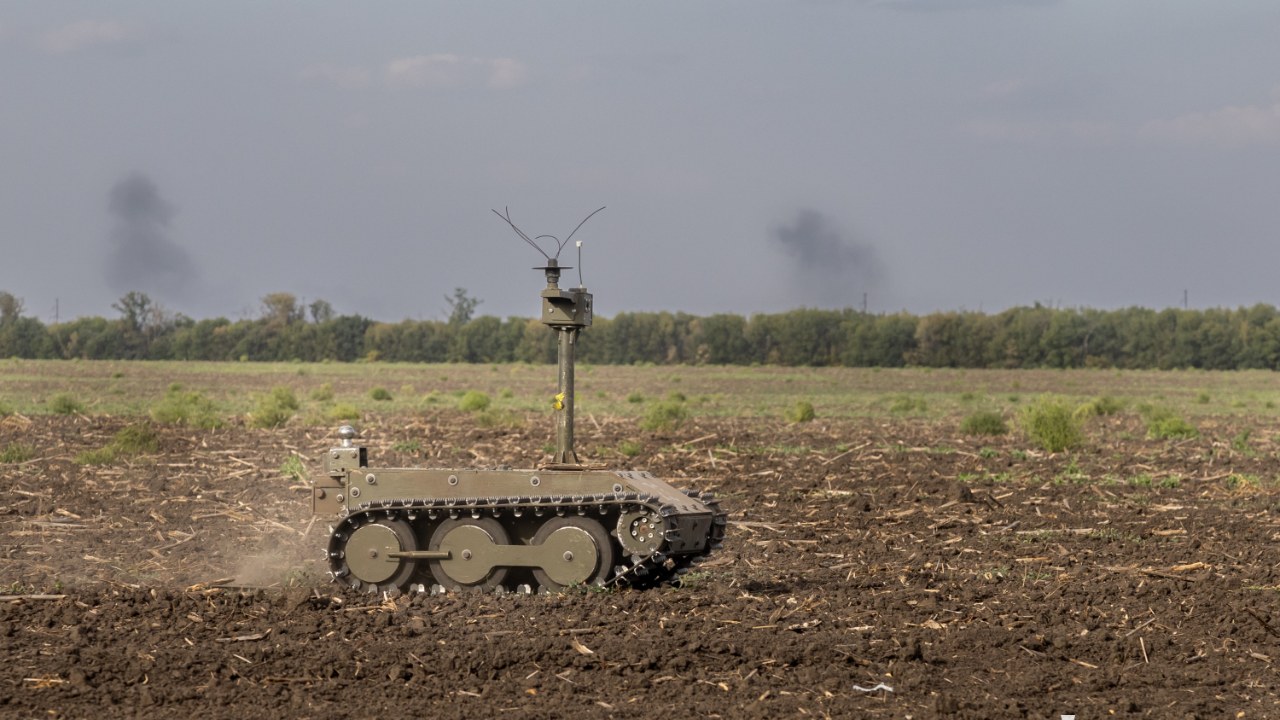
Top image: A Ukrainian uncrewed ground vehicle (the Vepr) in a field test. Not the amphibious vehicle in this report. Image Credit: ArmyInform — CC BY 4.0 / Wikimedia Commons
This article was produced with the assistance of AI and reviewed by Combat Rated editors prior to publication.