
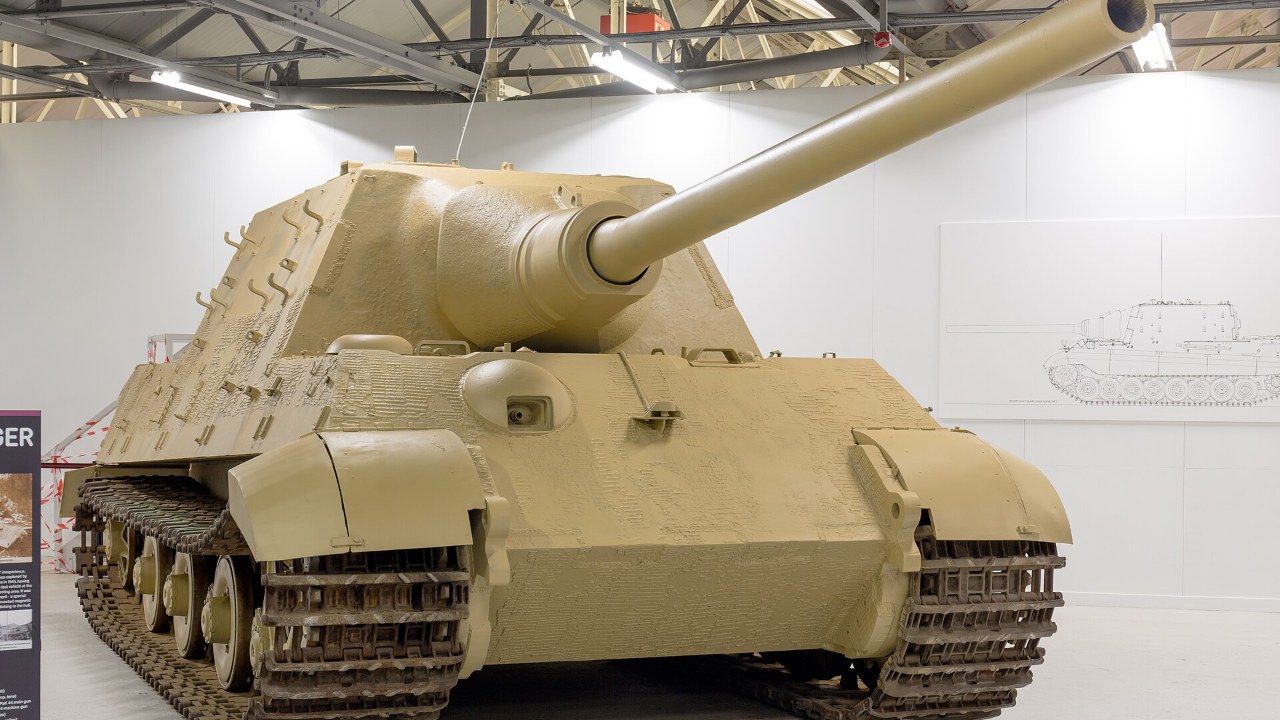
Germany ordered 150 Jagdtigers and got about 85. The tank destroyer, whose name translates as Hunting Tiger, carried a 128 mm gun behind frontal armour almost 20 centimetres thick, and it remains the largest and heaviest tracked vehicle to fight in the Second World War. One of the three that survive sits in The Tank Museum at Bovington, England.
That example is rarer still. It is the only survivor fitted with the Porsche suspension, a running gear fitted to only eleven Jagdtigers plus an unarmoured prototype. American troops captured it in April 1945 near Paderborn, and it has been in the museum’s hands since 1952.
The museum’s collection record for the Jagdtiger states that “only about 85 of the 150 Jagdtigers ordered were ever manufactured,” and its specification table lists 85 produced. The record calls the vehicle “the largest and, at over 70 tonnes, heaviest tracked vehicle to fight in the Second World War.” The same page’s specification table gives the weight as 69.8 tonnes, so the museum’s own figures sit on either side of 70; what does not change is the ranking as the heaviest tracked vehicle to see combat in the war.
A 128 mm gun on a lengthened Tiger II hull
The Jagdtiger was not a new chassis. In its history of the Tiger family, the museum explains that “the Jagdtiger used a lengthened Tiger II hull” and that, like other German tank destroyers, “it was fitted with heavier armour and a larger gun than could be carried by the tank it was based on.” The full designation in the museum’s record is Sd.Kfz. 186 Panzerjäger Tiger Ausf. B.
The difference shows plainly in the museum’s own numbers. Its Tiger II collection record lists an 88 mm KwK 43 L/71 gun, 180 mm of armour and a crew of five. The Jagdtiger record lists a 128 mm Pak 44, a single 7.92 mm MG 34 machine gun, 200 mm of armour, a crew of six and a top speed of 12.4 mph. The museum describes the front armour as “almost 20 cm (7.9 inches) thick and completely proof against all Allied tank and antitank guns.”
Reliability was another matter. “The tank was plagued by breakdowns and a number of losses resulted from crew members’ inexperience,” the collection record states.
Chassis 305004 and its Porsche suspension
The Bovington vehicle carries chassis number 305004. According to the museum’s account, “Capturing The Jagdtiger,” published March 3, 2017, it “was one of eleven (plus an unarmoured prototype) which were fitted with the Porsche suspension system.” The collection record adds that it is “now one of just three surviving Jagdtigers in the world, and the only surviving example with the Porsche suspension system.”
Porsche pushed its own running gear for the vehicle, based on the system used on the VK 45.01 (P) and the Elefant. The Tiger family history records that the company argued it was cheaper and quicker to manufacture than Henschel’s design, and that it “was again rejected, as it offered poorer track control.” The eleven Porsche-suspension hulls are what came of that dispute.
The hull is also coated in Zimmerit, which the museum describes as “a special paste which prevented magnetic charges from sticking to the hull.”
The museum’s 2017 account traces the vehicle’s war. It “was built in July 1944 and sent to the Sennelager testing ground just north of the city of Paderborn, where it was used for trials.” The collection record describes the same role as a test vehicle at the Haustenbeck testing area.
In the spring of 1945, units of the American XIX Corps, including the 3rd Armored Division and the 703rd Tank Destroyer Battalion, were advancing toward Paderborn. The defenders assembled an improvised unit, Panzergruppe Paderborn, from instructors and test vehicles. The museum says it is unclear whether the Jagdtiger was part of that force or took any part in the fighting. “By the 5th April it was clear that the forces left had to withdraw or risk being cut off,” the account reads. “The Museum’s Jagdtiger was abandoned and captured by the Americans the next day.”
British Ministry of Supply researchers saw the Jagdtiger and the museum’s pre-production King Tiger at Haustenbeck on Aug. 25, 1945. After testing at Sennelager, the vehicle went to the School of Tank Technology at Chertsey in Britain and arrived at The Tank Museum in 1952, where chassis 305004 remains on the museum’s collection list as the only surviving Porsche-suspension Jagdtiger.
Top image: The Jagdtiger on display at The Tank Museum, Bovington, in 2017. Image Credit: Morio — CC BY-SA 4.0 / Wikimedia Commons
This article was produced with the assistance of AI and reviewed by Combat Rated editors prior to publication.