
The U.S. Army’s M1 steel helmet started production in April 1941, according to the Army’s own history of the design, and more than 22 million were produced during World War II. The shell-and-liner helmet then outlasted the war by four decades, staying in service until the Kevlar helmet replaced it in the mid-1980s.
The M1 was two helmets in one. A steel outer shell provided the protection, and a separate inner liner carried the suspension that held it on a soldier’s head. That split kept the fit and the armor as separate problems, and it left the bare steel shell free for jobs its designers never listed.
The production date and the wartime total both come from an Oct. 24, 2019 Army article by Will Ravenstein. The article states that “the Army designed the M1 Helmet and started production in April 1941,” and quotes a museum source identified only as Smith: “Over 22 million of these helmets were produced during the Second World War.” The same source said the helmets went not only to the 1st Infantry Division but to “all of the other U.S. divisions both in the European and the Pacific Theater.”
Standardized April 30, 1941, from the M1917 pattern
The Army Medical Department’s World War II history of personnel protective armor gives the paperwork dates. Its chapter on helmets and body armor, hosted by the AMEDD Center of History and Heritage, records that “the Army M1 helmet was standardized on 30 April 1941 and was approved on 9 June 1941.” It describes “a two-piece design with an outer Hadfield steel shell and a separate inner liner containing the suspension system.”
The same chapter puts the complete helmet at approximately 3 pounds, with the steel shell at about 2.3 pounds and the liner at 0.7 pound. The suspension borrowed from sport: the chapter says the Riddell type of suspension used in football helmets “was modified for the inner liner.”
The M1 did not start from a blank sheet. According to the AMEDD history, the World War I M1917 model was considered suitable for protecting the top of the head, and the World War II helmet came into being by removing its brim, adding side and rear pieces, and moving the suspension into a separate liner. The chapter adds that the shell’s ballistic properties were improved so that it would resist penetration by a 230-grain caliber .45 bullet at 800 feet per second.
Sources differ on the adoption year. A 2014 National Academies report, Review of Department of Defense Test Protocols for Combat Helmets, states that “the U.S. military adopted helmets based on Hadfield steel, called the M1 ‘steel pot,’ in 1942.” The Army’s article and the AMEDD history both place production and standardization in 1941.
What soldiers did with the steel pot
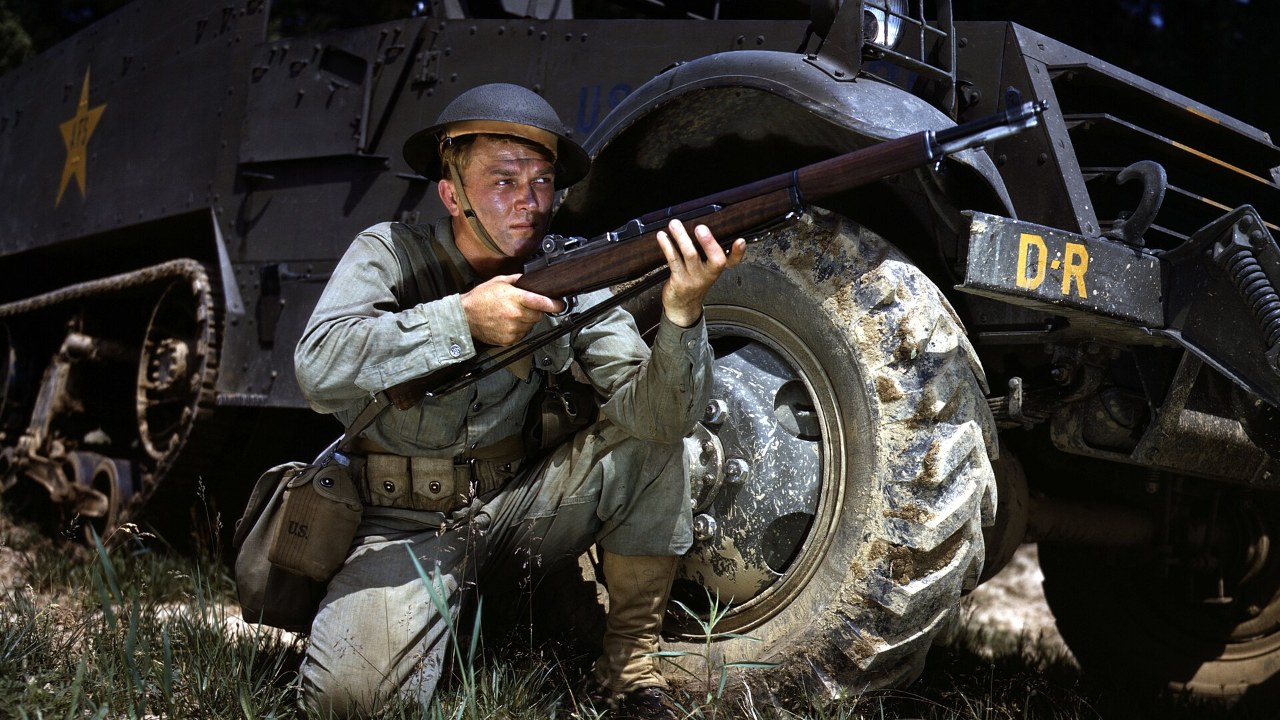
The Army’s 2019 article describes the shape in detail. The M1 had a slight brim at the front to keep precipitation off a soldier’s face and a slightly lipped rim all the way around, with sides covering half of the ears before dropping to cover the back of the skull. Inside, according to the article, “there was a lighter, plastic insert that Soldiers would use for ceremonies and parades.”
The steel shell also became a tool. The article says soldiers used it for digging and for making coffee, even though placing it over a fire was prohibited. It also records a drawback noticed in combat: “when they fired their weapon in a prone position, this helmet had a tendency to slide down to cover part of the eyes.” Soldiers also debated how tightly to fasten the chinstrap.
Units marked the steel as well. London’s Imperial War Museums hold an M1 helmet and liner worn in 1944 by 1st Lt. Benjamin Rugg, acting commander of E Company, 2nd Infantry Regiment. The museum describes it as a “standard US Army M1 Hadfields manganese steel helmet with liner,” painted with the 5th Infantry Division’s red diamond and a white rank bar in front and a white vertical officer identification bar on the back.
The AMEDD history attempted to measure what the helmet was worth. Its analysis concluded that “the helmet in World War II probably prevented wounds in more than 70,000 men,” an estimate built on its figures of 9.6 wounds to the cranium for every 100 men wounded while wearing helmets, against an expected 11.4 without them.
Replaced by Kevlar in the mid-1980s
The Smithsonian’s National Air and Space Museum holds one M1 with an unusual owner. Its catalog entry for a Type M1 protective helmet says the design was “adopted by the United States military in 1941 to replace the Type M1917” and “remained as standard issue for almost 45 years until it was replace by the light weight Kevlar Personnel Armor System for Ground Troops Helmet (PASGT) in the mid-1980s.” That particular olive drab steel helmet and liner, the museum says, was worn by Claire Chennault, commander of the 14th Air Force in China during World War II.
The National Academies report identifies PASGT as the first helmet to use Kevlar, used by all military services from the mid-1980s. The Army’s 2019 article reaches the same end point: “Overall, the Soldiers and the Army liked the helmet so much it wasn’t replaced until the mid-1980s when the Kevlar Helmet was introduced and issued to Soldiers.”
Chennault’s M1 remains in the National Air and Space Museum collection under inventory number A19720226000, listed as not on display.
Top image: A U.S. Army infantryman wearing the M1 steel helmet at Fort Knox, Kentucky, in 1942. Image Credit: Alfred T. Palmer — Public domain / Wikimedia Commons
This article was produced with the assistance of AI and reviewed by Combat Rated editors prior to publication.