
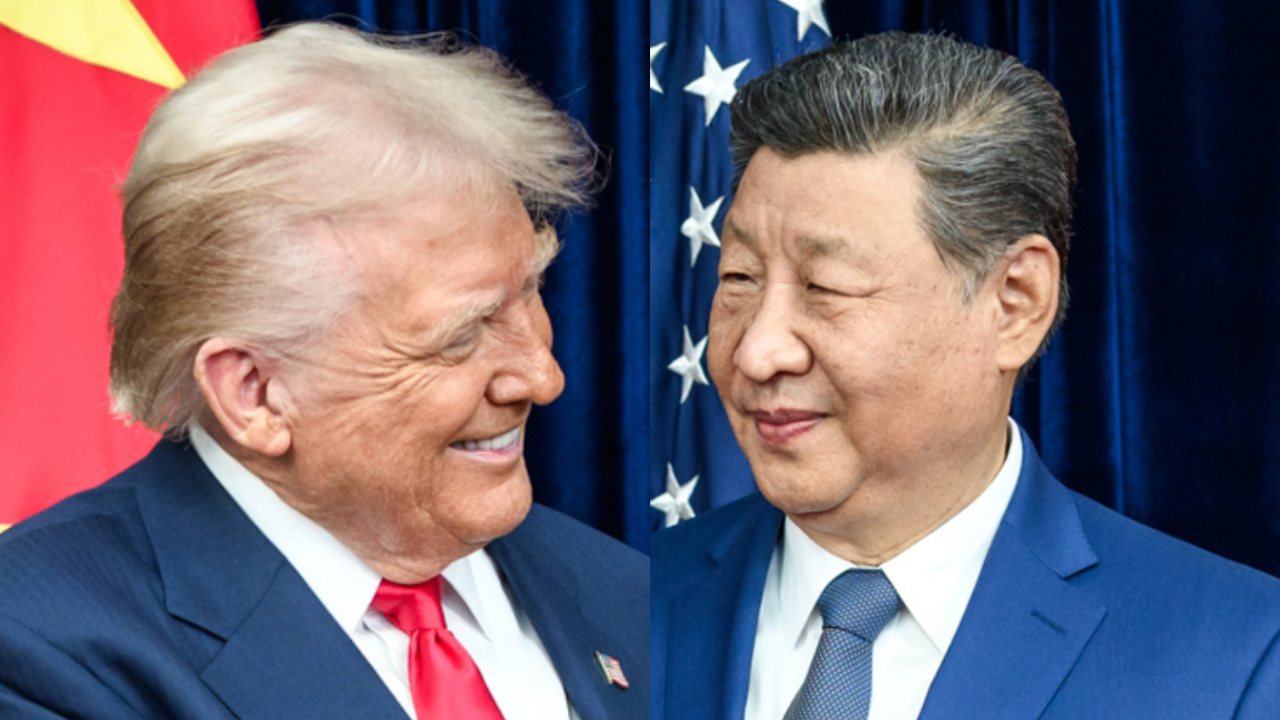
President Donald Trump asked Chinese leader Xi Jinping during his state visit to Washington last week whether Beijing would be interested in purchasing American weapons, U.S. Ambassador to China David Perdue said in a television interview on Sunday, an admission that stunned foreign policy observers given the decades-long U.S. arms embargo against China.
“President Trump continues to say, ‘Hey, we sell arms to other people around the world,'” Perdue said on “Fox News Sunday.” “He actually asked President Xi would he like to buy some at one point.” Perdue did not elaborate further on the exchange and did not disclose how Xi responded to the offer.
Selling arms to China would violate longstanding U.S. law. The arms embargo against Beijing has been in place for decades and was significantly tightened following the 1989 Tiananmen Square Massacre, making any prospective sale legally fraught regardless of the president’s private remarks.
The White House, responding through a U.S. official, said the United States had no plans to sell arms to China. The State Department reinforced that position in a formal statement, saying that U.S. law prohibits arms sales to China and that “there is no offer or plan to sell arms to China.” The Chinese Embassy in Washington did not immediately respond to a request for comment.
Backdrop of Rising Tension Over Taiwan
The disclosure comes as Trump has been withholding a $14 billion weapons package for Taiwan, even though U.S. law has required the government to provide defensive arms to the island since 1979. The package was assembled by State Department officials and approved by congressional leaders earlier this year, but it has since stalled inside the department.
Lawmakers from both parties have pressed the administration to release the package. A bipartisan group of senators sent a letter to Trump in May urging him to move forward, and just hours before Xi arrived in Washington last week, four Republican senators led by Sen. Mitch McConnell of Kentucky wrote to Secretary of State Marco Rubio and Defense Secretary Pete Hegseth making the same request. The senators also pushed for release of $300 million in previously approved arms aid for Taiwan and $1 billion for the Taiwan Security Cooperation Initiative.
When pressed by a Fox News interviewer on Sunday about the delayed Taiwan sales, Perdue noted that Trump had approved $11 billion in arms sales to Taiwan last year, the largest total of any president since 1979, and said “there are continuing conversations about other sales. He and President Xi talk about that every time they get together.” Perdue added that Washington’s underlying position on Taiwan has not shifted, saying, “We don’t support independence and we don’t support coercion.”
Diplomatic Fallout
Ryan Hass, a former career diplomat and White House national security official who now directs the China center at the Brookings Institution, wrote on social media that the disclosure removed any doubt about how Trump views Beijing. “If there was any ambiguity about whether President Trump views China as a security threat, this disclosure by @USAmbChina Perdue puts the question to rest,” Hass wrote, adding that “Trump’s offer to sell weapons to China will be unsettling to American partners at the pointy edge of China’s spear.”
Those partners include Japan, the Philippines and Taiwan, the self-governing democracy that the Chinese Communist Party claims as its own territory. Taiwan’s de facto ambassador to the United States, Alexander Yui, said on CBS News’s “Face the Nation” on Sunday that he felt confident, based on public remarks made by administration officials last week, that Washington’s position toward Taiwan had not changed. He added, however, that he hoped Taiwan could receive the withheld $14 billion arms package “as soon as possible.”
A Pattern of Private Assurances to Beijing
Chinese officials have said Xi has personally told Trump that he opposes American arms sales to Taiwan. In May, after departing a summit with Xi in Beijing, Trump told reporters he had discussed Taiwan arms sales with Xi “in great detail.” Conversations of that kind, which Perdue’s remarks on Sunday underscored still take place, run counter to a 1982 set of assurances in which the United States agreed that it “has not agreed to consult with” China on arms sales to Taiwan.
When asked in May about that 1982 commitment, Trump responded, “Well, I think the 1980s is a long way. That’s a big, far distance.” During a Fox News interview recorded that same month while he was in Beijing, Trump said he was holding back the Taiwan arms sales because doing so served as a “very good negotiating chip” in talks with China. Following last week’s Washington summit, Trump said he and Xi had not discussed Taiwan extensively, telling reporters, “Right now, it’s fine. It’s just moving along.”
Rubio was asked directly about the withheld Taiwan package by reporters in New York last Wednesday. He said the sale was under review as officials weighed “balancing our industrial capacity and our military-industrial base” and considered whether the United States might need the weapons systems for its own military. It remains unclear how that stated rationale squares with Trump’s separate offer to sell arms to China.
Iran and the Broader Security Picture
During their talks in Washington, Trump also pressed Xi on China’s continued support for Iran, according to Perdue, and received assurances that Beijing was adjusting its approach. “President Xi assured him that changes had been made, that they were looking into it, they had looked into it,” Perdue said. “And we see some improvement in that. But it’s an ongoing effort that we have to make sure that they stay out of that.”
Chinese defense companies, operating with the approval of the Chinese government, have supported adversaries of the United States, including Iran and Russia, by supplying dual-use equipment and satellite imagery, according to U.S. officials, who say some exports of weapons technology have been planned in secret. Washington has imposed sanctions on a number of Chinese companies over that activity, and Trump himself has previously warned that China would face serious consequences if it continued arms shipments tied to Iran.
The revelation of Trump’s offer also follows separate reporting that sensitive F-35 fighter jet components were diverted to Hong Kong earlier this year instead of reaching their intended U.S. repair destination. Australian Deputy Prime Minister and Defense Minister Richard Marles confirmed the diversion last week, after Politico first reported that an intermediary contractor working on behalf of Lockheed Martin had rerouted a shipment that reportedly included an F-35 canopy. State Department and Pentagon officials had briefed congressional staff on the matter since June, though Australian officials maintain no classified components were involved.
A Fading Military Edge in the Pacific
China possesses the world’s fastest-growing military, and U.S. officials across successive administrations, including the current one, have repeatedly warned of the potential for a military clash between the two nuclear-armed powers in the Asia-Pacific region — particularly over Taiwan or Beijing’s assertive actions in waters claimed by U.S. allies in the South and East China Seas.
The United States has long been the dominant military power in the region, but American officials acknowledge that edge is narrowing relative to China’s rapid buildup, a gap made more pronounced as the Trump administration diverts resources toward its ongoing war against Iran. The U.S. defense industrial base has also struggled in recent years to manufacture weapons systems at a pace officials consider adequate to meet global demand.
Trump said last week that he intends to meet Xi again in China in November during a regional leadership summit, with Xi expected to return to the United States in December for a separate multilateral gathering. Analysts following the relationship say it is unlikely Trump will approve any further arms sales to Taiwan before the end of the year, out of concern that doing so could unsettle Xi ahead of the two planned meetings.