
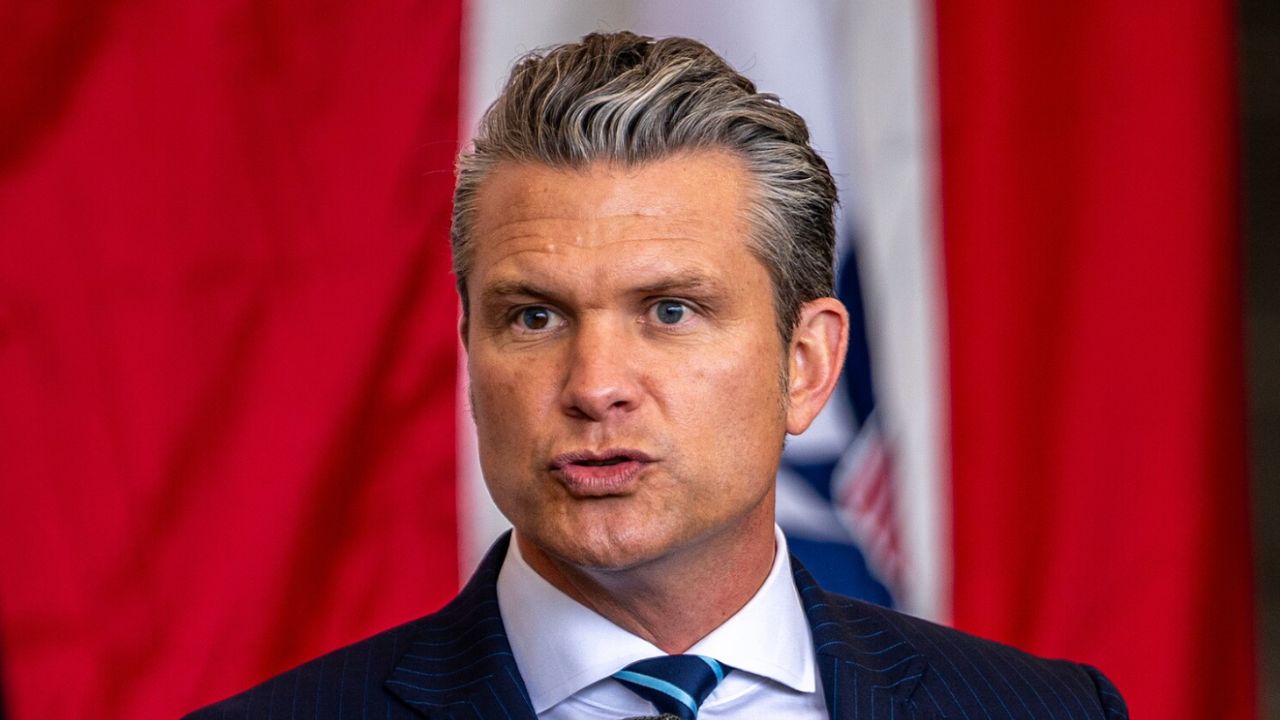
Secretary of War Pete Hegseth closed his remarks at the Pentagon’s 25th-anniversary commemoration of the September 11th attacks on Friday by turning from military history to Scripture, telling the assembled crowd of survivors, first responders and service members that American victory over its enemies rests not only on its warriors but on divine protection.
The ceremony, held in the Pentagon’s center courtyard on the morning of September 11, 2026, marked a quarter-century since 184 people were murdered at the building when hijackers crashed American Airlines Flight 77 into its western wall. President Donald Trump, First Lady Melania Trump, Chairman of the Joint Chiefs of Staff Gen. Dan Caine and former Secretary of State Condoleezza Rice were among the officials seated for the memorial, which included a reading of victims’ names and a flag placed for each of the dead.
Hegseth spoke shortly after Trump, using the closing lines of his address to shift from a recounting of that day’s events into a religious appeal. “We have faith in our warriors,” Hegseth said. “But we also have faith that there is one who keeps watch over us. And Scripture tells us that the Lord is our fortress and our shield. The Lord trains our arms for war and our hands for battle. Strengthened by faith in Almighty God, we will continue to defeat our enemies and protect this republic just as the heroes and the warriors of 9/11 did. Because in this nation, in God we trust, in this land, in this place, on that day and still today. And amen.”
The passage draws on Psalm 144, a psalm traditionally attributed to King David that opens with a soldier’s blessing: praise to “the Lord my Rock, who trains my hands for war, my fingers for battle.” Hegseth’s phrasing compresses that verse’s imagery — the Lord as fortress, shield and trainer of hands for combat — into a single closing statement tying the September 11th dead directly to the current U.S. military campaign against Iran.
This is not the first time Hegseth has reached for that specific psalm publicly during his tenure at the Pentagon. During a March 2026 press briefing on Operation Epic Fury, delivered shortly after returning from a dignified transfer of a fallen service member at Dover Air Force Base, Hegseth closed his remarks by reciting Psalm 144 almost verbatim, telling reporters, “Blessed be the Lord, my rock, who trains my hands for war and my fingers for battle. He is my loving God, and my fortress.” The recurrence of the same passage roughly six months apart signals it functions as something close to a personal touchstone Hegseth returns to when framing the war’s human and spiritual stakes.
The Pentagon chief’s habit of folding faith into official military messaging has also shown up regularly in his wartime briefings. According to NPR’s coverage of the Iran war press conferences, Hegseth has closed briefings with prayer as a matter of course, on one occasion asking that “his Almighty and eternal arms of providence stretch over them and protect them and bring them peace, in the name of Jesus Christ.” NPR’s national security correspondents noted this practice, paired with the administration’s use of striking-footage montages during briefings, marks a departure from the tone of Pentagon war briefings over the prior quarter-century.
Hegseth’s framing on Friday tied that faith directly to the ongoing military campaign against Iran, which he described elsewhere in the same speech as having “laid waste to the world’s most prolific state sponsor of terrorism” over the preceding six months. By closing on the promise that the U.S. will “continue to defeat our enemies,” Hegseth linked the religious conviction expressed in his closing prayer to the administration’s stated goal of finishing the fight against Tehran.
The ceremony’s religious tone did not end with Hegseth. It closed with a performance of “America the Beautiful” by the President’s Own Marine Band, followed by a benediction delivered by the military’s chief chaplain, Maj. Gen. Trent Davis, who prayed that attendees would “depart strong and courageous, united in purpose, and fiercely resolved to guard this land of liberty entrusted to our care.” Davis closed by invoking light overcoming darkness, echoing the same battle-between-good-and-evil framework Hegseth used in his own remarks.
Trump’s remarks, by contrast, stayed closer to a traditional commemorative tone. Trump’s portion of the speech focused largely on the victims of the attacks and the national unity that followed, rather than on the ongoing war, according to reporting on the ceremony. He nonetheless connected the war on terror to the Iran conflict at another point in his remarks, telling the crowd the country was working to ensure that “the world’s No. 1 sponsor of terror, the Islamic Republic of Iran, will never ever have a nuclear weapon.”
Trump’s decision to appear at the Pentagon ceremony rather than the traditional presidential visit to the Ground Zero memorial in New York marked a break from precedent. Vice President JD Vance attended the New York ceremony in Trump’s place, standing alongside every living former president, while Trump denied a report that he skipped the New York event specifically to be free to deliver a speech, since the nonpartisan Ground Zero ceremony maintains a longstanding no-speeches policy.
Hegseth’s book, “The War on Warriors,” and his public commentary over the years reflect a consistent worldview blending Christian conviction with military doctrine, including his past writing that a lean, “lethal” force stripped of what he calls excess bureaucracy is what wins wars. Friday’s remarks extended that worldview into a formal government ceremony honoring the dead of September 11th, presenting the Iran war as a continuation of the same struggle that began a quarter-century ago at the very site where he spoke.
The 184 names read aloud Friday belonged to the victims killed specifically at the Pentagon on September 11, 2001 — service members and civilians, officers and enlisted personnel, some of whose families sat in the same courtyard 25 years later to hear Hegseth’s closing invocation. For them, and for the currently serving troops in the crowd, Hegseth’s final words functioned as both elegy and marching order: a promise that faith, as much as firepower, would carry the country through its next fight.
As the ceremony closed and attendees dispersed across the Pentagon’s grounds, the message Hegseth left behind was unambiguous — that the war against Iran, like the war on terror before it, was being fought not just with warships and warplanes, but under what he described as the training and protection of “Almighty God.”