
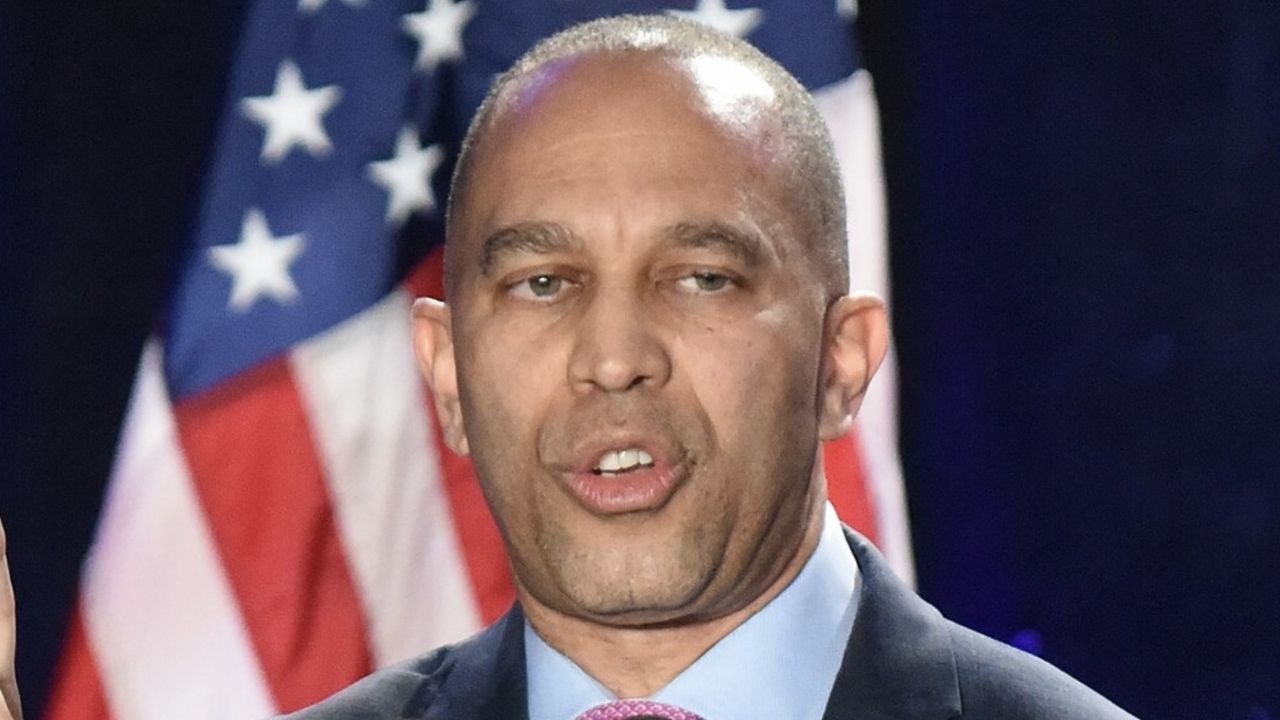
House Minority Leader Hakeem Jeffries renewed his condemnation of the Trump administration’s military campaign against Iran on Monday, declaring in a post on X that the conflict has been “an epic failure” that has driven up gas and food prices while leaving the United States “less safe.” Jeffries vowed that Republicans would be held accountable for what he called a “disastrous quagmire,” extending a line of attack the New York Democrat has sustained for months as the war’s economic and political fallout continues to unfold.
Jeffries posted the statement at 8:43 a.m. on August 31, 2026. The full post read:
“The reckless war of choice in Iran has been an epic failure. Gas prices have skyrocketed, food costs are out of control and America is less safe. We will hold Republican extremists accountable for this disastrous quagmire.”
The post arrived roughly six months after the Trump administration launched Operation Epic Fury against Iran on February 28, 2026, and comes amid a ceasefire and diplomatic framework that has not fully resolved the economic disruption the conflict set in motion. Jeffries did not cite specific figures in Monday’s post, but the statement fits a consistent pattern in his public messaging: attributing rising consumer costs directly to the war and casting the conflict’s price tag, in both dollars and safety, as a political liability for congressional Republicans.
A Recurring Line of Attack
Monday’s post is the latest in a series of statements Jeffries has made criticizing the Iran campaign since its early months. In June, following Senate passage of a War Powers Resolution aimed at ending the conflict, Jeffries told reporters at a press conference that “Donald Trump and Republicans have plunged America into a reckless and costly war of choice that has been a disaster,” adding that House Democrats had opposed the war “from the very beginning” and that the country had been left “weaker relative to Iran” than before the war began, while “Iran, unfortunately, is now stronger.”
In that same appearance, Jeffries said “the bottom line is that we shouldn’t spend another dime of taxpayer dollars on Operation Epic Failure that has been a disaster for the national security and the economic interests of the American people.”
The following day, Jeffries issued a formal statement opposing a Trump administration funding request tied to the war, writing that “after repeatedly promising to end foreign wars, Donald Trump and Pete Hegseth plunged America into Operation Epic Failure with no objective, strategy or support.” He said the conflict had “cost taxpayers billions, led to the deaths of 13 servicemembers, engulfed the entire region in conflict and skyrocketed the already high cost of living at home,” and argued that “the Trump administration cannot be trusted with another dime connected to the war.”
By mid-July, Jeffries again took to X to argue that the war had cost the American taxpayer “more than $100 billion” that had been “wasted in a reckless war of choice,” pointing to a national gas price increase that broke an eight-week streak of declines.
Later that month, as U.S. military casualties from the campaign continued to climb, Jeffries again labeled the operation an “epic failure” and directed criticism at both President Trump and Defense Secretary Pete Hegseth, holding both officials directly responsible for the mounting toll of the conflict.
The Economic Backdrop
Jeffries’ claim that gas prices have “skyrocketed” is borne out by federal and industry data tracking the market since Operation Epic Fury began. AAA reported that the national average for a gallon of regular gasoline held above $4 every single day in August 2026, making it the most expensive August at the pump on record, surpassing the previous record set in 2022. As of August 27, the national average stood at $4.09 per gallon, with crude oil prices remaining in the $80-per-barrel range amid continued volatility surrounding the Strait of Hormuz.
Separate data compiled by the Energy Information Administration showed the national average reaching $4.10 per gallon in early August, up 30 percent from a year earlier, though down roughly 8.5 percent from the recent peak of $4.48 per gallon recorded in May. Since Operation Epic Fury’s February 28 launch, the war has been linked to sharp swings in fuel costs nationwide, driven largely by disruptions to shipping through the Strait of Hormuz, which the International Energy Agency has characterized as among the most significant supply shocks in the history of the global oil market.
Food costs have followed a similar trajectory. The United Nations’ food price index climbed to its highest level in more than three years in the spring, with the Food and Agriculture Organization citing supply chain disruption tied to the war as a contributing factor. U.S. grocery prices climbed at their fastest pace in nearly four years in April, according to Bureau of Labor Statistics data, as rising fuel and fertilizer costs linked to the conflict began working their way into the cost of staples on supermarket shelves. Economists have since noted that the compounding effect of energy-price volatility on agriculture, from diesel-dependent transport to fertilizer production, has kept upward pressure on food prices with little sign of relief.
Congressional and Political Context
Jeffries’ Monday statement lands against the backdrop of a broader Democratic effort to tie the war’s economic consequences to Republican control of Congress and the White House ahead of the 2026 midterms. House and Senate Democrats have repeatedly pushed War Powers Resolutions aimed at ending U.S. involvement in the conflict, arguing that the campaign was launched without clear congressional authorization or a defined military objective. Those efforts have drawn mixed support across party lines, with some Republicans joining Democrats in past votes while the Trump administration has continued to defend the operation as necessary to neutralize what it has described as a long-standing regional threat.
The administration has separately sought additional funding from Congress to sustain military operations connected to the conflict, a request Jeffries and other Democratic leaders have opposed on the grounds that the war’s costs have already outpaced its stated benefits. Republican officials, including White House Press Secretary Karoline Leavitt during her tenure, have at times characterized rising fuel costs as a “short term” consequence of the conflict rather than a lasting economic burden.
What Comes Next
Monday’s post did not specify what form Democratic accountability efforts might take, but it follows a pattern established over recent months of using both formal statements and social media posts to keep pressure on Republican lawmakers over the war’s toll. With gas prices setting a monthly record in August and food costs continuing to climb amid a still-unresolved diplomatic framework in the region, the economic consequences of the six-month-old conflict remain a central point of contention on Capitol Hill as both parties look ahead to the midterm elections.