
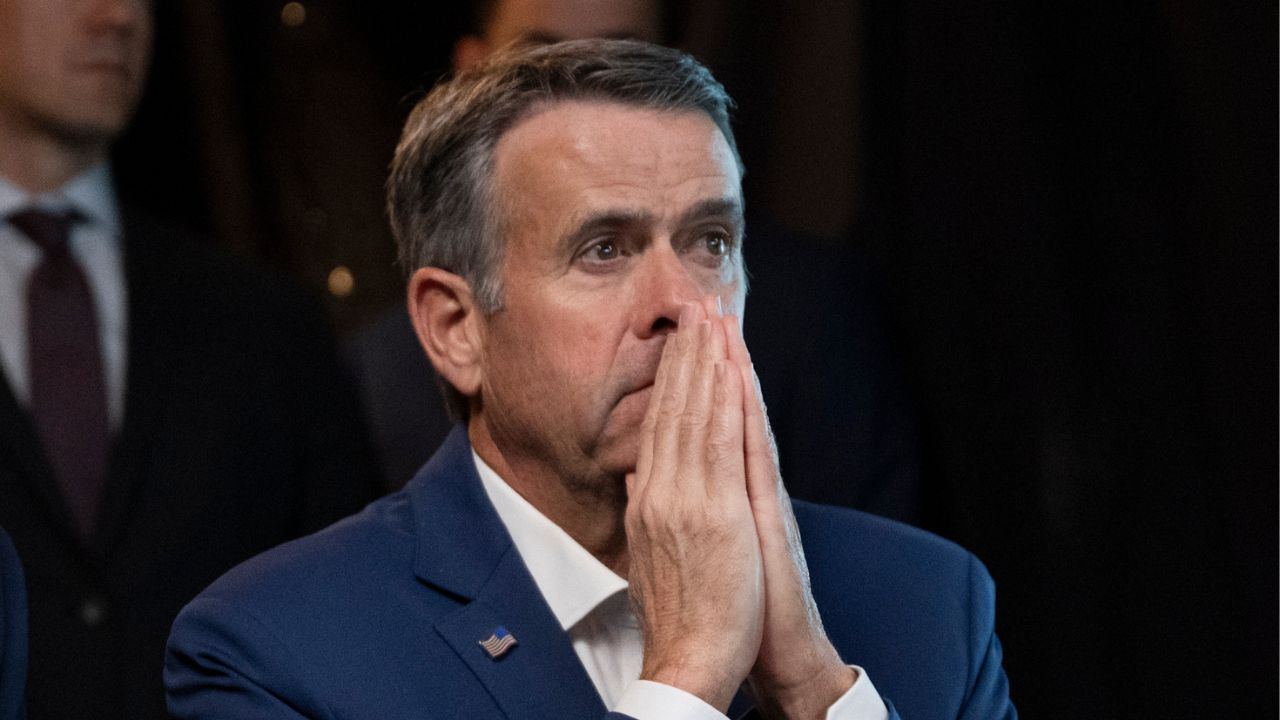
CIA Director John Ratcliffe traveled to Moscow this week on an unannounced trip aimed at delivering a stark warning to the Russian government: do not attack any NATO member state. The visit, confirmed by multiple people briefed on the matter, marks the first publicly known trip by a sitting CIA director to the Russian capital since 2021, and comes amid mounting U.S. and European intelligence assessments that Russian President Vladimir Putin may be preparing to test the alliance’s resolve with a limited strike on an allied nation in the coming years.
A Warning Delivered Without Meeting Putin Himself
Ratcliffe’s trip was first detected Tuesday, August 25, when a U.S. Air Force jet was spotted arriving at a Moscow airport alongside a diplomatic motorcade moving through the city. Kremlin spokesman Dmitry Peskov confirmed the visit to reporters the following day, stating that Ratcliffe held talks with Russian intelligence officials but did not meet directly with Putin. Peskov said Putin was nonetheless briefed on the substance of the discussions.
“Contacts between intelligence agencies are, in and of themselves, a positive phenomenon, a positive process,” Peskov told reporters, while cautioning that it remained premature to say “whether this will have an effect overall on the process of pulling our bilateral relations out of the deepest crisis they are currently in.”
Trump Downplays the Trip as “Semi-Routine”
President Trump addressed the visit publicly for the first time Wednesday during a phone interview with conservative radio host Glenn Beck, who pressed him on speculation that Ratcliffe had been dispatched to warn Putin against moving on NATO territory or to discuss new Iran-related sanctions. Trump rejected both explanations.
“He’s there, you know, very sort of semi-routine,” Trump told Beck. “I hate to disappoint people. We would like to see the war with Ukraine end.” He added, “John Ratcliffe is a fantastic guy. He’s the head of the CIA, and he is not in there for any of the things that you said. Now something may come out, you know, out of it. We’re working very hard to get that war ended, and frankly, they both want to see it ended at this point.”
A White House spokeswoman referred reporters back to Trump’s comments to Beck when asked for further detail. A CIA spokeswoman declined to comment on the record.
Intelligence Assessments Point to a Possible Test of NATO
The Moscow trip followed new U.S. intelligence assessments, first reported by The Wall Street Journal earlier in August, indicating that Putin — squeezed by continued fighting in Ukraine and under domestic pressure — could attempt to test NATO’s Article 5 commitment with a limited assault on an allied country within the next few years. U.S. officials have said the scenarios under consideration range from a cyberattack to a small-scale ground incursion, with a Baltic state such as Estonia, Latvia or Lithuania viewed as the most likely target given their shared Soviet-era history with Ukraine.
Separately, CBS News reported that recent assessments have described the likely Russian objective not as triggering open war, but as probing the unity of the alliance and testing the Trump administration’s willingness to defend a NATO member under attack through actions that fall short of conventional military action, including hybrid operations and cyberattacks.
A Pattern of Incidents Along NATO’s Eastern Flank
Officials cited to CBS News pointed to a string of recent incidents that have heightened concern inside the alliance, including drone incursions into Romanian airspace, a Russian missile that crossed into Polish territory last month, and a rise in suspected sabotage and cyberattacks across Europe.
Among the most alarming was an explosive drone discovered near an An-124 Ruslan cargo aircraft at Leipzig Airport in Germany earlier this month. A U.S. intelligence official briefed on the investigation told ABC News that the explosives and construction of the device were consistent with methods typically used by Russia’s military intelligence directorate, the GRU.
Depleted Munitions Stockpiles Add to the Calculus
U.S. officials have also expressed concern that a shortfall in critical Western munitions could factor into Putin’s decision-making. American stockpiles of certain weapons systems have been degraded following years of transfers to Ukraine after Russia’s 2022 invasion, compounded more recently by expenditures tied to the U.S. conflict with Iran. Officials briefed on the assessments told the Journal that a perceived weakening in the West’s ability to rapidly resupply an ally could embolden Moscow to move against NATO’s eastern members.
Iran and Sanctions Also Raised During the Visit
Beyond the NATO warning, people familiar with the matter told CBS News that Ratcliffe also raised the subject of Iran during his Moscow talks, warning Russian officials that the United States would impose additional economic penalties if the Strait of Hormuz does not reopen to shipping traffic. The visit came one day after Treasury Secretary Scott Bessent announced “Operation Economic Outcast,” a sanctions campaign designed to isolate Iran by targeting countries and entities that continue doing business with Tehran.
According to a senior Ukrainian official cited by the Financial Times, Kyiv was informed in advance that a U.S. delegation would travel to Moscow and was asked to pause long-range strikes on Moscow, St. Petersburg and northern Russian regions for the duration of Ratcliffe’s visit.
Ratcliffe’s Record as a Russia Hawk
Ratcliffe was sworn in as CIA director on January 23, 2025, three days after Trump began his second term, and was confirmed by the Senate on a vote of 74 to 25. He previously served as Director of National Intelligence during the final year of Trump’s first term and built a reputation in Congress for a hard line on both Russia and China. Analysts who track the agency note that Ratcliffe has personally advocated for keeping CIA advisers deployed in Ukraine to assist with intelligence and targeting, even as the Pentagon moved in the opposite direction to scale back its own advisory presence there.
“He has the ear of the president,” said Ben Howard, an analyst cited by RFE/RL, who pointed to that advocacy as evidence that Ratcliffe carries significant weight in shaping Trump’s Russia policy.
Earlier in his career, as a member of Congress, Ratcliffe worked closely with Bill Browder, an American-born businessman and longtime critic of Kremlin corruption who has spent over a decade campaigning against Russian human rights abuses — a history that stands in contrast to the low-profile diplomacy Ratcliffe undertook this week.
Echoes of a 2021 Warning That Went Unheeded
The trip marks a rare instance of direct U.S. spy-agency engagement with Moscow more than four and a half years into Russia’s war with Ukraine. The last known visit by a sitting CIA director to Russia came in November 2021, when William Burns, who led the agency under President Joe Biden, traveled to Moscow to warn Putin against invading Ukraine. That warning did not deter Moscow, which launched its full-scale invasion roughly three months later, in February 2022.
Ratcliffe’s visit also followed several prior trips to Moscow by Steve Witkoff, the Trump administration’s envoy for Ukraine-Russia peace talks, underscoring the administration’s continued, if strained, diplomatic channel with the Kremlin even as ceasefire negotiations have stalled.
What Comes Next
Neither Washington nor Moscow has publicly detailed the full substance of Ratcliffe’s meetings, and both the White House and the CIA have declined to elaborate beyond Trump’s characterization of the trip as “semi-routine.” Analysts remain divided on the visit’s true purpose, with some suggesting Ratcliffe may have presented elements of a broader peace framework for Ukraine, while others maintain the primary message was a deterrence warning aimed squarely at NATO’s eastern flank.
“POTUS doesn’t send the director of the CIA to Moscow unless for something serious,” John Foreman, a former U.K. defense attaché to Russia, told Newsweek.
Whether the visit produces any tangible shift in Moscow’s posture toward NATO or its stalled negotiations with Ukraine remains to be seen. For now, the episode has renewed scrutiny of how the Trump administration is managing an increasingly complex set of overlapping conflicts — in Ukraine, in Iran, and along NATO’s eastern border — with the CIA director himself now serving as one of the few visible lines of contact between Washington and the Kremlin.