
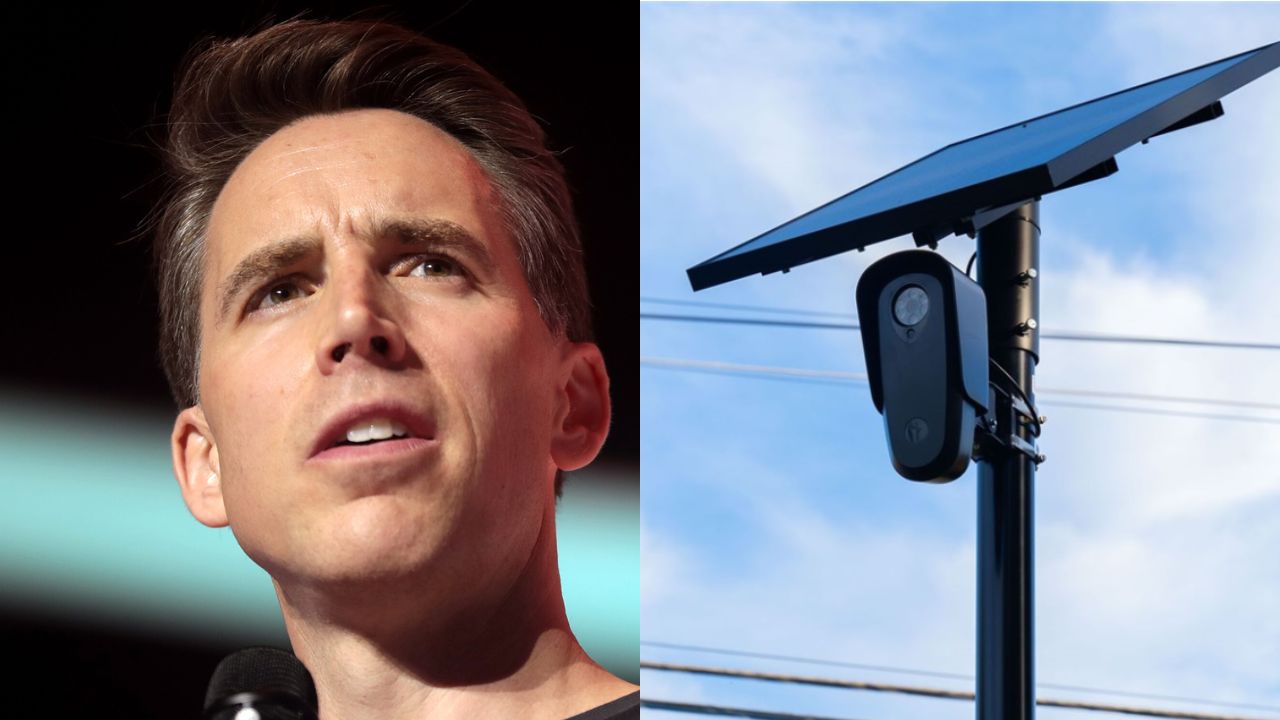
U.S. Senator Josh Hawley (R-Mo.) announced Wednesday, August 26, 2026, that he is opening a formal investigation into Flock Safety, the artificial intelligence surveillance company whose license plate reading cameras have spread to more than 120,000 locations across 49 states, demanding the company disclose who has access to the driving data of hundreds of millions of Americans and how that data is being used. Hawley, who chairs the Senate Judiciary Subcommittee on Crime and Counterterrorism, sent a letter to Flock Safety CEO Garrett Langley on Wednesday outlining a pattern of documented abuse, wrongful arrests, and unresolved questions about data sales, and gave the company until September 8, 2026, to turn over the requested documents.
Hawley posted the announcement to X on Wednesday afternoon, writing in full:
“Americans do not surrender their privacy rights when they drive to work, drop their kids off at school, or go to church. I’m investigating Flock cameras to determine WHO has access to hundreds of millions of Americans’ data – and what they’re doing with it.”
The post was published at 1:46 p.m. on August 26, 2026, and included both the full text of his letter to Langley and a link to a formal statement released on his Senate website.
The Letter to Flock Safety’s CEO
In his letter, addressed to Langley at Flock Safety’s Atlanta headquarters, Hawley identified himself as chairman of the Judiciary Subcommittee on Crime and Counterterrorism and stated that he is “investigating Flock Safety’s collection, retention, and dissemination of the data generated by its artificial intelligence surveillance cameras.” He wrote that “in a few short years, Flock has assembled an unprecedented national surveillance network,” noting that the company’s cameras conduct more than 20 billion vehicle scans every month. Hawley wrote that “the overwhelming majority of the Americans captured in those records did nothing wrong,” and argued that instead of serving discrete local investigations, “these camera networks harness artificial intelligence to pool what they capture into a national database that customers can search.”
Citing Cases of Police Misuse
Hawley’s letter cited several specific instances of alleged abuse to justify the investigation. He noted that in his home state of Missouri, the St. Charles County Police Department terminated its Flock contract this month after an audit found that a civilian employee had run searches on the system for personal reasons unrelated to law enforcement duties. He wrote that Missouri “is not an outlier,” pointing to Milwaukee, where prosecutors charged a police officer who allegedly searched his girlfriend’s license plate 124 times and her former boyfriend’s plate 55 times, listing “investigation” as his justification each time. Hawley emphasized that the officer “was not caught by the company’s audit systems,” and was instead identified after a private citizen looked up his own license plate on a public website.
Wrongful Arrests and False Positives
The letter also detailed cases in which Flock’s system produced errors with serious consequences. Hawley wrote that a Florida woman spent 13 days in jail and faced eight felony counts, including three counts of vehicular homicide, after investigators arrested her based on a Flock search for a vehicle matching a general description. He noted that prosecutors dismissed all charges seven months later once law enforcement discovered the mistake and arrested a different individual. Hawley also cited a California police department that found 71 percent of its Flock alerts were incorrect, and noted that the Los Angeles Police Department dropped its Flock contract entirely after an audit revealed officers had stopped 161 vehicles that had been wrongly flagged as stolen over the span of two months.
Questions Over Data Sales and Commercial Use
Beyond law enforcement misuse, Hawley’s letter raised concerns about how Flock Safety and its customers may be permitted to sell or otherwise commercialize the data its cameras collect. He wrote that “Flock’s $8.3 billion valuation comes with enormous pressure to find new commercial applications,” and stated that “Americans demand a full accounting for how their driver data is stored or sold.” Hawley acknowledged that law enforcement should have tools to catch offenders and keep the public safe, but reiterated that this did not extend to the mass collection of location data on citizens who are not suspected of any crime.
Invoking Supreme Court Precedent
Hawley grounded his argument in Supreme Court precedent, writing that “the Supreme Court has recognized that a comprehensive, retrospective record of a person’s movements is different in kind from ordinary observation in public.” He argued that “Congress never authorized the network your industry has built,” and that “your company’s internal policies are, in practice, the only safeguards for hundreds of millions of Americans.” He wrote that “people across the country are now discovering that fact and demanding answers from their elected officials,” and that his investigation would seek to determine “who has access to their personal data and how.”
The September 8 Deadline
Hawley’s letter closed with a formal document request, instructing Langley to “produce all documents and information specified in the attached annex no later than September 8, 2026,” and inviting the company to contact his office with questions about the scope of the request. The letter was signed by Hawley in his capacity as chairman of the Subcommittee on Crime and Counterterrorism within the Senate Judiciary Committee.
Part of a Broader Pattern on AI and Consumer Data
The Flock investigation is not Hawley’s first move this month against AI-driven data collection. His Senate office noted that the probe follows a subcommittee hearing he held just two weeks earlier examining what he called “exploitative practices of AI surveillance pricing and consumer data harvesting” by major corporations. At that August 4 hearing, titled “Your Data, Their Profit: The Consumer Cost of AI Surveillance Pricing,” Hawley criticized companies including Target, Lyft, Kroger, and Delta Air Lines for using AI systems to set individualized prices based on consumers’ personal data, calling the practice “one of the biggest scams in American history.” He has said he plans to introduce federal legislation targeting the practice.
What Flock Cameras Do
Flock Safety’s automated license plate reader (ALPR) cameras use infrared imaging paired with onboard artificial intelligence to log a vehicle’s plate number, timestamp, and location every time it passes a camera. Beyond reading plates, the system builds what the company calls a “Vehicle Fingerprint” — cataloging a car’s color, make, body style, and even distinguishing features like bumper stickers — allowing investigators to search for a vehicle even without a license plate number. More than 113,000 ALPRs now operate nationwide in hundreds of cities, the majority of them made by Flock Safety, though competitors including Axon and Motorola Solutions also manufacture similar devices. The data is pooled into a searchable network that participating law enforcement agencies across jurisdictions can access, a design that has drawn scrutiny for extending far beyond the scope of any single local investigation.
A Growing Fourth Amendment Fight
Hawley’s investigation lands amid an intensifying legal battle over whether Flock’s camera network violates the Fourth Amendment’s protection against unreasonable searches and seizures. The most prominent case, Schmidt v. City of Norfolk, was brought by Virginia residents with backing from the Institute for Justice, who argued that a citywide camera dragnet capturing their daily movements amounts to a warrantless search. In January 2026, a federal judge ruled in the city’s favor, finding that Norfolk’s system did not track the entirety of a person’s movements and relied largely on information observable on public roadways; that ruling is now under appeal. A similar class-action lawsuit was filed by three drivers in San Jose, California, over the deployment of nearly 500 Flock cameras in that city.
Legal experts say the outcome of these cases may hinge on a related Supreme Court ruling issued this summer. In Chatrie v. United States, the Court held 6-3 that police conduct a Fourth Amendment search when they obtain a person’s location data, reasoning that “an individual has a reasonable expectation of privacy in his cell-phone location information,” and rejecting arguments that a search is permissible simply because it pulls a narrow slice of a larger dataset. Some legal scholars argue Flock’s private-company status complicates the constitutional question, since the Fourth Amendment generally binds government actors rather than private companies — though plaintiffs contend that when private surveillance systems are deeply integrated with law enforcement and funded by taxpayer money, they may functionally operate as an arm of the government under the “state action” doctrine.
Civil Liberties Groups and Local Pushback
The American Civil Liberties Union has campaigned against Flock’s expansion for years, warning that automatic license plate reader companies are “quietly trying to build a nationwide mass surveillance system” that tracks, logs, and shares Americans’ movements without a warrant. The organization filed an amicus brief in April 2026 in a Fourth Circuit case arguing that ALPR systems give the government “unprecedented powers of surveillance” that upset traditional expectations of privacy. At least 82 jurisdictions have already canceled their ALPR contracts or removed the cameras, according to tracking by civil liberties advocates, reflecting a wave of local pushback that has run parallel to the ongoing federal litigation.
The Road Ahead
With Flock Safety facing an active congressional document request, multiple pending federal lawsuits, and mounting scrutiny from both civil liberties organizations and local governments, the company’s practices are likely to remain under sustained examination in the months ahead. Hawley’s subcommittee has set September 8, 2026, as the deadline for Flock to respond to his document request, a date that is expected to shape the next phase of the Senate’s inquiry into who, ultimately, controls access to one of the largest vehicle-tracking databases ever assembled in the United States.