
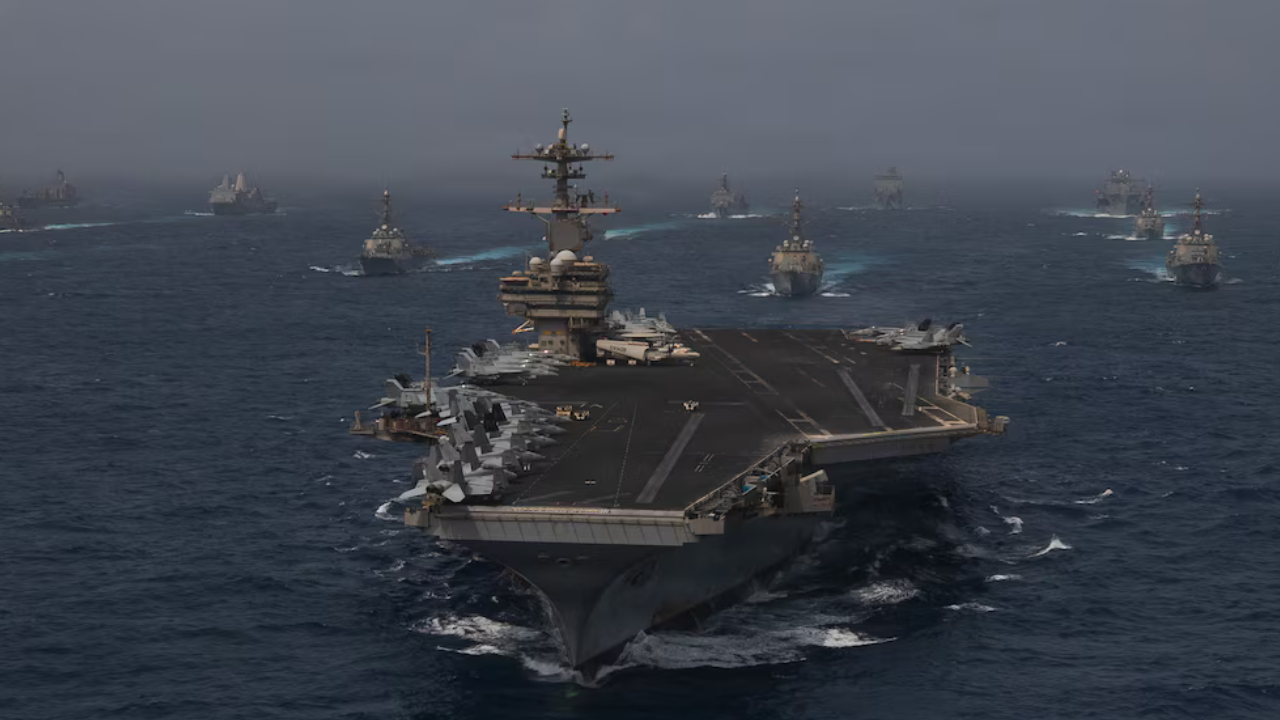
The United States is preparing to send the aircraft carrier USS George Washington to the Middle East to relieve the USS Abraham Lincoln, ending a deployment that has stretched past 250 days and become one of the longest and most scrutinized carrier rotations in recent Navy history. U.S. officials familiar with the matter told The Wall Street Journal the move is part of a previously scheduled rotation plan, arriving as lawmakers, sailors’ families, and Pentagon leadership remain locked in a public dispute over the conditions aboard the ship.
A Deployment Redirected Toward War
The Lincoln departed Naval Base San Diego on Nov. 21, 2025, on what was originally billed as a routine Pacific deployment. That plan changed in January, when the carrier and its strike group were redirected to the Middle East as the United States moved toward war with Iran. The Lincoln and its embarked air wing went on to serve as a centerpiece of Operation Epic Fury, the U.S. bombing campaign against Iran that began in late February, and the ship has since remained in theater supporting the U.S. blockade of Iranian ports.
What was expected to be a six- to seven-month deployment concluding around May 2026 has instead been extended repeatedly, with no return date publicly announced. The carrier has now logged more than 250 consecutive days at sea, including a stretch of roughly 200 days without a single port call — a record for a modern U.S. aircraft carrier deployment. By comparison, most carrier deployments include periodic port visits that allow crews to rest and resupply; the Lincoln’s roughly 5,000-member crew has had only two days on land during the entire deployment, one stop in Guam in December and another in Oman in July.
Lawmakers Demand Answers From the Pentagon
The intensity of the deployment has drawn direct scrutiny from Capitol Hill. Sen. Richard Blumenthal (D., Conn.) wrote to Secretary of War Pete Hegseth and Acting Secretary of the Navy Hung Cao citing the ship’s record-setting stretch at sea. “There have been widespread reports of shortages of basic supplies, water contamination, plumbing issues, deteriorating mental health, deck safety concerns, and disruptions in the mail system, which have caused many care packages in route to the ship to be lost in transit for months,” Blumenthal wrote.
Rep. Marlin Stutzman (R., Ind.) said he intended to seek an update directly from the Pentagon and the administration. “At the end of the day, we know that those who are serving have to have comfort knowing that they’re getting properly taken care of,” he told CNN.
Rep. Mike Levin (D., Calif.) has been among the most vocal members of Congress on the issue, describing conditions aboard the Lincoln on social media as including “moldy showers, broken toilets, laundry down for weeks, long stretches with no hot water, a meal that came down to half a cup of rice and two tortillas. No soap, deodorant, or toothpaste.” Rep. Jason Crow (D., Colo.), a former Army Ranger who served in Afghanistan and Iraq, warned that “the strain on our service members and their families” aboard the Lincoln “is building week by week.”
Overboard Incidents and a Growing Mental Health Toll
The congressional pressure follows reports that multiple sailors aboard the Lincoln have attempted to jump overboard during the deployment. CNN reported that a sailor went overboard last month but was quickly rescued and medically evaluated. Family members who spoke separately with Military Times and Stars and Stripes described additional incidents, including one sailor who was pulled back onto the deck by a shipmate who intervened before the individual went over the side.
At a town hall in San Diego attended by more than 200 family members, Acting Secretary of the Navy Hung Cao and Vice Adm. Joseph Cahill, commander of Naval Surface Forces, addressed concerns directly. “We hear you loud and clear [regarding] the impact this has on families, on service members and the long-term ability of us to stand, sustain our forces’ health,” Cahill said, pointing to deployment-resilience counselors, chaplains, and Human Factors Councils tasked with monitoring sailor welfare.
The Pentagon Pushes Back
Pentagon leadership has repeatedly disputed the characterization of conditions aboard the Lincoln. The dispute dates back to April, when reports and photographs of poor food quality, water shortages, and broken equipment aboard the ship first surfaced publicly; Hegseth dismissed those accounts at the time as “more fake news,” and the Office of the Chief of Naval Operations posted a statement on X calling reports of food shortages aboard the Lincoln and USS Tripoli “false.”
Levin responded directly to Hegseth’s April remark this week, writing that “these men and women signed up to serve their country. The least their country owes them is hot water, a working toilet, and a real meal. Hegseth cannot even manage that, and he has the nerve to look their families in the eye and call them liars.”
Hegseth addressed the matter again on Thursday, telling reporters during a visit to Panama that reports about conditions aboard the Lincoln were “completely misrepresented.” “We make sure every ship, every crew, every captain has everything we can provide them at every single moment,” Hegseth said. “Some deployments are longer than others, and I have more respect and gratitude for those sailors than anybody. What they do in those high seas in those austere conditions with less port calls — it’s incredible.” A U.S. official told the Journal the carrier rotation had been planned before concerns over living conditions were raised.
From the Pacific to the Persian Gulf
The USS George Washington, the Navy’s forward-deployed carrier permanently assigned to the Indo-Pacific and flagship of Carrier Strike Group 5, has been operating in the Pacific in recent weeks. The carrier strike group completed a port visit to Da Nang, Vietnam, on Aug. 5, followed by a joint search-and-rescue exercise with Vietnamese forces, before beginning its transit toward the Middle East.
This week, the George Washington transited the Singapore and Malacca Straits westbound alongside the Arleigh Burke-class guided-missile destroyer USS Shoup and the Ticonderoga-class guided-missile cruiser USS Robert Smalls, according to open-source vessel tracking. A U.S. official told CNN the carrier’s timeline for arrival in the Middle East has not been finalized.
No Timeline, but Relief in Motion
The Navy has not confirmed a specific figure for the number of overboard or self-harm incidents aboard the Lincoln during the deployment, saying only that the carrier’s leadership continuously assesses sailors’ psychological readiness and that counselors, chaplains, and medical professionals remain available to the crew. Cao told families at the San Diego town hall that the Navy is separately preparing the USS Theodore Roosevelt carrier strike group to eventually relieve the Lincoln, though officials have not released a public timeline for that handoff, citing operational security.
The rotation comes as Hegseth has said the U.S. can maintain its naval blockade of Iran indefinitely by cycling carrier strike groups in and out of the region, even as Iranian officials continue to dispute U.S. control of the Strait of Hormuz.
The Lincoln’s deployment now stands as one of the longest and most operationally intense in recent memory for a U.S. carrier strike group, driven by the sustained demands of Operation Epic Fury. With the George Washington now underway and no confirmed arrival date, families and lawmakers say the immediate question is no longer just when the Lincoln will finally return home, but what toll nine months of continuous combat operations will have taken on the sailors who serve aboard it.