
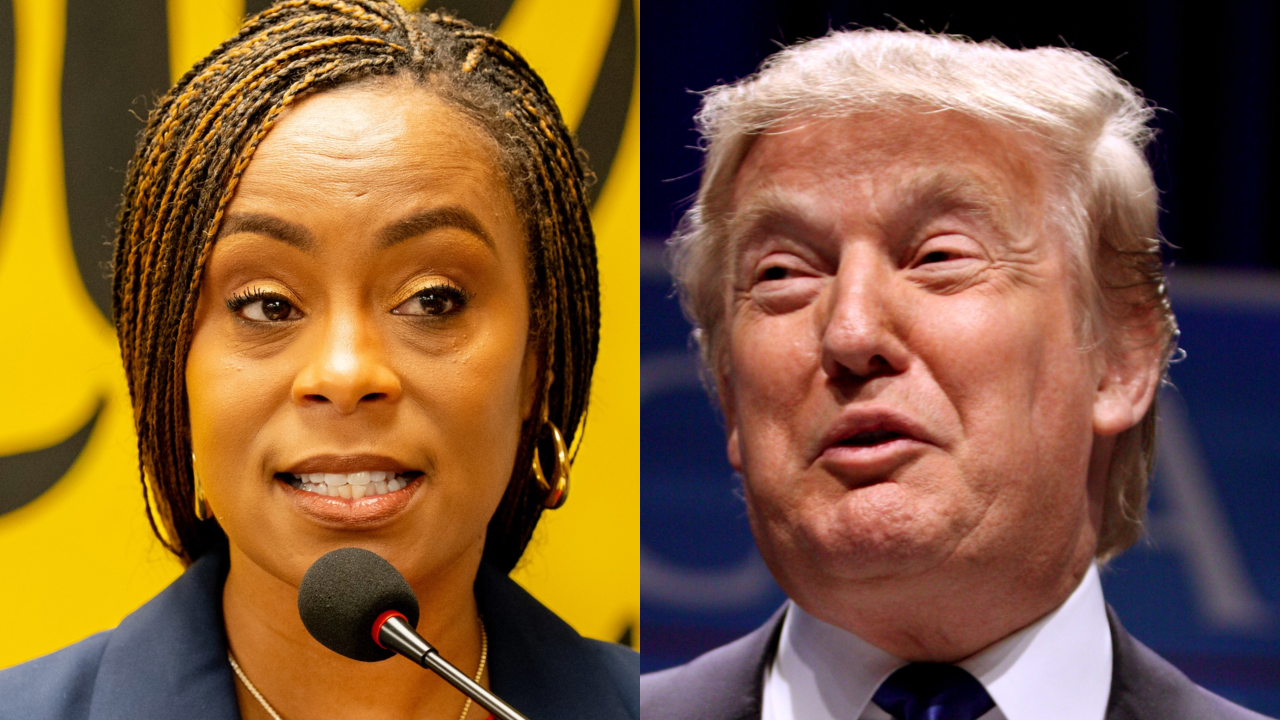
Rep. Shontel Brown said Tuesday that President Trump is using the White House to enrich himself, reacting to reporting that his media company has begun selling institutional traders early access to his Truth Social feed — including his real-time posts on the Iran war, which have repeatedly moved oil and equity markets over the course of the five-month conflict. “The most corrupt President ever,” Brown wrote on X. “Trump is using the White House to make money for himself, not to make anyone else’s life better.” She was amplifying a report that Trump is “selling early access to his Truth Social posts to trading firms for up to $100,000 a month.”
What the Product Actually Is
The product, called Truth API, launched August 1. According to a press release Trump Media & Technology Group filed as an exhibit to a Form 8-K with the Securities and Exchange Commission, the company describes it as “a new licensed data service for financial services partners that provides the fastest access to Truth Social’s most influential accounts.” Interim CEO Kevin McGurn said in the filing that “markets already move on Truth Social posts,” and that “Truth API delivers a direct, licensed, real-time feed of the platform’s most market-moving Truths while advancing our strategy to monetize proprietary assets through a high-margin, recurring revenue stream.” The company said it had already signed customers ahead of the launch, delivering posts to subscribers in milliseconds through industry-standard data feeds.
Warren and Schiff Ask the SEC to Investigate
Two days before launch, Sens. Elizabeth Warren and Adam Schiff formally asked federal regulators to examine the arrangement. In a letter posted to the Senate Banking Committee’s website, the senators — Warren is the committee’s ranking member — wrote to SEC Chair Paul Atkins that “Trump Media’s plan to disseminate market-moving information through the President’s own company, while charging insiders for access ahead of the public for the benefit of his company… represents a shocking abuse of the office of the President and the trust of the American public for his personal gain.” They noted that Trump owns roughly 41 percent of the company and “stands to profit from the launch of this service,” and asked the SEC to determine whether the arrangement violates federal securities law before the August 1 launch.
Raskin Opens a Separate Investigation
Rep. Jamie Raskin, ranking member of the House Judiciary Committee, launched his own probe the same week. In a letter posted to the committee’s official website, Raskin opened by asking Trump Media directly: “Are you helping the president sell people advance access to market-moving information?” He wrote that “this White House-Wall Street-Trump-Business feedback loop represents the depraved essence of insider trading,” and that because Trump controls roughly 41 percent of the company through a trust, “nearly half of each fee would go directly into the pocket of Donald Trump.” Raskin’s letter demanded records from CEO Kevin McGurn — including pricing details, marketing materials, communications with government officials, and the subscriber list — by August 13.
Whether This Is Actually Illegal
The legal question turns on a specific distinction under securities law. Renée Jones, a Boston College professor and former senior SEC official, told NPR that federal law prohibits schemes in which non-public information is misused to give traders an unfair advantage, and that sharing such information constitutes a breach of “a duty or trust of confidence.” “So if the president’s Truth Social posts are being monetized, and if some people get special access to them, that’s misappropriated information,” Jones said. “And by giving people his posts early, he is also violating his duty of trust and confidence.” She pointed to the 2012 STOCK Act, which explicitly states that the president and other executive-branch officials are not exempt from insider-trading laws.
The Company’s Defense
Trump Media has rejected the insider-trading framing outright. Spokeswoman Shannon Devine told NPR that “Truth API offers customers the fastest way to ingest publicly available Truth Social data. Critics must have invented a new theory of ‘insider trading’ based on publicly available information.” She dismissed the senators’ letter as partisan, saying “certain politicians falsely accuse us of anti-free-market behavior while pressuring businesses into boycotting a product, all in a coordinated effort to harm a publicly traded company.” Jones herself acknowledged this defense has some legal footing, telling NPR: “I could imagine Trump’s lawyers arguing that because they announced it out in the open, it’s not deceitful, it’s not fraudulent.”
Wall Street’s Quiet Reaction
Despite the product’s launch, financial industry reaction has been muted in public, even as it was reportedly blunt in private. One Wall Street executive, granted anonymity by NPR out of concern about “retaliation from the Trump administration,” called the product “insane,” saying: “I can say for myself and 200 of my friends in finance, we’re not getting anywhere near this. In another administration, this would be considered criminal.” NPR said it contacted 12 other major players in finance — brokers, hedge fund managers, and other investors — and none would speak publicly about the service.
How Trump Personally Benefits
The financial mechanics tie directly back to Trump himself. SEC Form 4 filings show the Donald J. Trump Revocable Trust holds approximately 114.75 million shares of Trump Media stock, or roughly 41 percent of the company. Donald Trump Jr. serves as sole trustee with voting and investment power, while Trump is the trust’s settlor and sole beneficiary. That structure means every dollar Truth API generates in subscription revenue increases the value of a stake held for Trump’s direct financial benefit, even as he holds the office whose statements are the product being sold.
A Third Lawmaker Weighs In With Legislation
Beyond the SEC letter and the Raskin investigation, Sen. Mark Warner has pursued a legislative response. After first urging financial industry trade groups to reject the product, Warner introduced the “No Preferential Release of Federal Information for Transactions Act” — the NO PROFIT Act — which would prohibit social media companies from selling prioritized access to government employees’ accounts when those accounts convey material, market-moving information, a direct legislative answer to the exact arrangement Truth API represents.
What Outside Ethics Experts Have Said
Virginia Canter, a former SEC lawyer now with the nonprofit Democracy Defenders Fund, told NPR the arrangement risks normalizing conduct securities law was designed to prevent. “Channeling nonpublic information to Trump’s media company for high-speed dissemination to his wealthy institutional investors is a step toward normalizing insider trading that undermines the integrity of U.S. markets and further erodes investor confidence,” Canter said, adding that the product “disadvantages regular investors who unfortunately may be on the losing sides of those trades because they do not have the same access to information.”
Why Iran War Posts Specifically Matter Here
The Iran war material is not incidental to the controversy — it’s a significant share of what makes Trump’s Truth Social feed valuable to traders in the first place. Over the course of the five-month conflict, Trump has repeatedly used Truth Social to announce or preview major developments: canceled strikes, claimed negotiations, ceasefire terms, and statements on the Strait of Hormuz, each of which has moved oil prices and equity markets within minutes, as documented throughout the war’s coverage. That pattern is precisely what the Warren-Schiff letter flagged when it cited Trump’s Iran-related posts alongside his corporate stock commentary as examples of “market-moving information” — meaning a trading firm paying for millisecond-early access to Trump’s feed isn’t just buying a jump on stock tips, but a jump on real-time war news with direct pricing implications for oil, defense stocks, and currency markets tied to the conflict.
The Specific Posts Lawmakers Pointed To
Warren and Schiff’s letter did not treat the market-moving concern abstractly — it cited specific examples. The senators pointed to Trump’s past Truth Social posts praising Citigroup, which they said corresponded with an immediate stock movement, along with a similar pattern following posts referencing Palantir, Intel, and Coinbase, as well as posts touching on tariff policy and the Iran war. Those examples, drawn directly from the senators’ own letter to the SEC, were offered as evidence that Trump’s posts already function as market-moving events even without a paid early-access product — meaning Truth API’s core innovation, in the senators’ framing, is monetizing a speed advantage over an information source that already reliably moves prices.
Where It Stands
As of Brown’s Tuesday post, the SEC had declined to comment on Warren and Schiff’s request and had not announced a formal investigation, while Raskin’s records demand to Trump Media remained outstanding with an August 13 deadline. Truth API itself remained live and operational, with the company maintaining publicly that the product is a legal, transparent monetization of already-public data rather than the insider-trading scheme its congressional critics have described.