
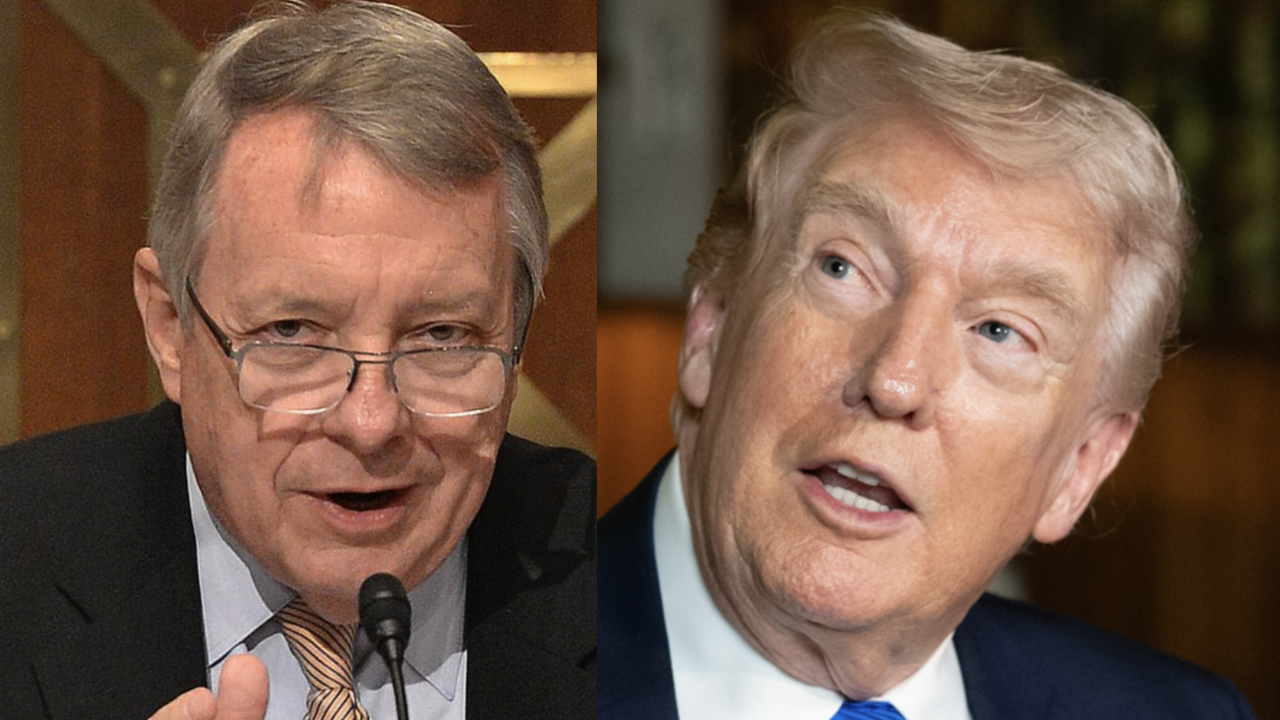
Sen. Dick Durbin of Illinois said President Trump bypassed Congress entirely in launching the war with Iran, arguing the Constitution gives only Congress the power to declare war and that Trump ignored that requirement at every step.
“Article I Section 8 of the Constitution makes clear that Congress, and ONLY Congress, has the power to declare war,” Durbin wrote on X. “Trump decided to go to war with Iran exclusively on his own, and we are all paying the price.”
Durbin shared video of remarks he delivered on the Senate floor. “We start with this little document called the United States Constitution,” Durbin said, according to video of the floor speech. “Every one of us is sworn to uphold and defend this document. And we go to Article 1, the first article in the Constitution, Section 8, and it spells out with clarity who declares war under this Constitution, the Congress of the United States.”
Durbin then walked through a series of steps he said Trump skipped. “We’re now engaged in a war in Iran. Did the Congress declare war on Iran? No. Did the president even ask Congress to declare war on Iran? No. Were there public hearings in Congress about this decision to invade Iran, to attack Iran? No. Did this president of the United States go to the allies of the United States, like the NATO allies, to discuss the invasion of Iran? No. This president decided that we would go to war on his own, strictly on his own, without regard for what the Constitution requires.”
Durbin delivered the remarks on the Senate floor on July 29, according to the chamber’s official daily floor record, which logged that “Senator Durbin spoke on Iran, Lindsey Graham, and temporary protected status for immigrants” at 11:20 a.m. that day.
The floor record shows Durbin’s remarks came amid a busy legislative day dominated by the Lindsey O. Graham Sanctioning Russia Act, formally H.R. 5334, which the Senate voted 84-12 to take up that afternoon, and a separate motion to discharge Sen. Kirsten Gillibrand’s Iran war powers resolution, S.J.Res. 181, from the Foreign Relations Committee, which was scheduled for a vote the following day. Senate Minority Leader Chuck Schumer also addressed the Iran war powers question that day, speaking on “public opinion polls regarding the Trump administration” before turning to “a proposed Iran war powers resolution,” according to the same record.
Durbin’s constitutional argument tracks closely with the official findings section of Gillibrand’s own resolution, S.J.Res. 181, which states plainly that “Congress has the sole power to declare war under article I, section 8, clause 11 of the United States Constitution,” according to the official bill text filed with Congress. The resolution’s findings also note that Trump ordered airstrikes inside Iranian territory on Feb. 28 “without congressional authorization or consultation,” and that more than 50,000 U.S. service members had participated in the operation as of early April.
The Senate voted on Gillibrand’s resolution on July 30, the day after Durbin’s floor speech, according to the chamber’s official roll call record, with Durbin among the senators voting in favor. Gillibrand had introduced the measure in April, and the House passed its own companion war powers resolution on July 23 in what NPR described as “a symbolic rebuke” of the administration’s handling of the war.
Durbin, the Senate Democratic Whip and Ranking Member of the Senate Judiciary Committee, has repeatedly criticized the administration’s conduct of the war since it began Feb. 28. He said following the deaths of American troops in Jordan and Iraq earlier this month that he feared “the Trump Administration has no clear plan” for ending the conflict.
Congress has made multiple attempts to force an end to the war through War Powers Resolutions since fighting began, including a concurrent resolution the Senate passed 50-48 in June and a joint resolution, S.J.Res. 180, that the Senate declined to discharge by a vote of 47-49 on July 23. Gillibrand’s separate resolution, S.J.Res. 181, was scheduled for its own discharge vote the day after Durbin’s floor speech.
Sen. John Sullivan and Sen. John Barrasso separately addressed the Russia sanctions bill and the National Defense Authorization Act on the floor that same morning, while Sen. Chris Van Hollen spoke on immigration and temporary protected status before Durbin’s remarks, according to the daily press record.
The Senate floor session that day also included tributes to the late Sen. Lindsey Graham from Sen. Susan Collins, and remarks from Sen. Jacky Rosen on Acting Attorney General Todd Blanche and the Epstein files, before the Senate later voted to invoke cloture on a package of 74 executive nominations by a party-line vote of 50-45.
Neither the White House nor Trump has issued a direct public response to Durbin’s remarks.