
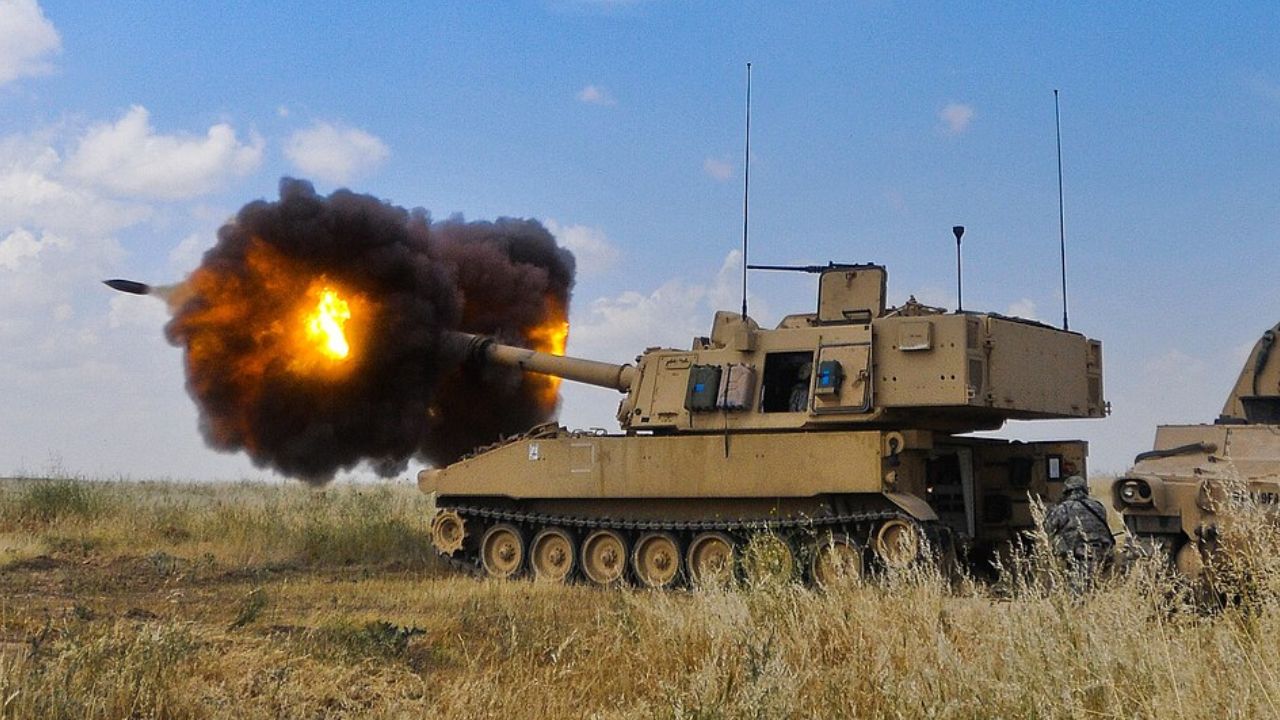
The U.S. Army’s modernization story for tube artillery isn’t about a brand-new cannon changing everything overnight. It’s about taking a proven workhorse—the M109 Paladin family of 155mm tracked self-propelled howitzers—and upgrading it so armored formations can respond faster, move with less delay, and reduce exposure in an environment where counter-battery fire and drones can punish artillery that stays in one place too long.
Much of that narrative centers on the M109A6 “Paladin” and the upgrade paths that followed, often discussed alongside the M109A7 “Paladin Integrated Management” effort. Because “modernized Paladin” can mean different variants in different conversations, the useful way to understand it is by its consistent goals: more digital support for fire missions, better crew protection, improved ability to operate with armored units, and a tighter “shoot-and-scoot” rhythm.
From legacy self-propelled guns to faster, more connected fires
Earlier M109 variants gave the Army a tracked 155mm gun that could accompany maneuver forces. Modern combat, however, increasingly rewards units that can take a call for fire, generate a firing solution, deliver rounds, and relocate quickly. Paladin modernization is aimed at shrinking that sequence and making the platform easier to plug into today’s command-and-control environment.
A key shift is the move toward digital fire control. Rather than depending as heavily on slower, manual steps, modernized Paladins are associated with more automated gunnery tasks and improved integration with networked targeting and command systems. That doesn’t eliminate friction or guarantee perfect speed, but it supports quicker responsiveness when time matters.
Why it matters: tempo and survivability in high-end fights
In peer or near-peer ground combat, artillery volume and speed can shape whether units hold terrain, maneuver successfully, or get pinned down. Tube artillery remains a day-to-day source of responsive fires in ways that rockets can’t always substitute for, particularly when commanders need sustained support over time rather than short, high-intensity salvos. A modernized Paladin force helps maintain that steady output while keeping pace with armored formations.
Survivability is inseparable from the fire mission. Recent conflicts have highlighted how counter-battery threats—enabled by radar, drones, and faster kill chains—can punish artillery that is slow to displace. Upgrades that improve protection and reduce time spent stationary support the basic requirement to fire and move. They don’t remove the risk, but they can improve a unit’s ability to keep operating under persistent observation.
Army requirements and an industrial base built around upgrades
The modernization effort is driven by U.S. Army operational priorities and enabled by an industrial ecosystem geared toward sustaining and improving legacy systems. BAE Systems is commonly associated in public reporting with major Paladin upgrade work as a prime contractor, supported by a network of U.S. subcontractors that can differ by contract and configuration.
This upgrade-centered approach matters operationally. Incremental improvements can preserve trained maintainers, parts pipelines, and production know-how while delivering usable capability without requiring an immediate, full-fleet replacement. In a period when artillery and ammunition readiness draw close attention, that continuity can be an advantage.
The paired system: why ammunition support belongs in the story
Self-propelled artillery operates as a system, not a single vehicle. The Paladin is frequently discussed alongside an ammunition support vehicle in the FAASV/M992 family, which helps keep the howitzer supplied and can reduce the time a gun is exposed during resupply.
The logic is straightforward: smoother resupply supports sustained firing and makes it easier to displace on time. It also reduces the need to keep large quantities of ammunition sitting at a firing position. When modernization improves the overall “gun plus ammo” workflow, tempo gains are more likely to show up in real operations.
Paladin compared with towed guns—and with rockets
Paladin’s value is not simply a larger gun on a tracked chassis. Compared with towed artillery, a self-propelled howitzer is designed to move with armored forces and deliver fires with less setup and teardown. That mobility and protection can matter when formations are maneuvering under observation and the battlefield is saturated with sensors.
At the same time, Paladin is not a replacement for rocket artillery such as HIMARS/MLRS. Tube and rocket artillery tend to serve different roles depending on mission needs and available munitions. Modernization is about keeping tube artillery effective within a combined fires portfolio, not treating one system as a universal solution.
Modernization as readiness: sustainment, training, and usability
Upgrading a legacy platform can be less dramatic than fielding a clean-sheet design, but it can align better with near-term readiness. A modernized Paladin fleet can build on existing training and operational familiarity while improving the areas that most directly affect combat effectiveness: responsiveness, digital integration, and survivability-related features. It can also reduce the disruption that comes with introducing an entirely new system across multiple brigades.
Specific features, timelines, and package contents vary by variant and upgrade lot, and public descriptions do not always draw clear lines between them. Even so, the direction is consistent: deliver practical improvements sooner rather than waiting on a future cannon program to mature.
How it fits with longer-range efforts
Paladin modernization is often mentioned alongside longer-range cannon initiatives, but those efforts are best understood as parallel lines of work rather than immediate replacements. The Army needs credible fires in the near term while also pursuing options that extend reach over time. A modernized Paladin force helps bridge that gap by keeping armored brigades equipped with responsive tube artillery as future concepts develop.
The main point of confusion is usually terminology. When someone says “modernized Paladin,” they may mean the A6-era changes, the subsequent A7/“Paladin Integrated Management” path, or a broader set of updates tied to digital integration and sustainment. Keeping that distinction straight helps set realistic expectations about what a given unit fielded and when.
The strategic consequence in plain terms
A modernized Paladin makes it harder for an adversary to treat U.S. Army tube artillery as a slow-moving, predictable target. It supports quicker execution of fire missions, improves the ability to operate with armored formations, and reduces time spent exposed during key moments like firing and resupply. None of that guarantees safety from counter-battery fire, but it can improve a unit’s odds of firing, moving, and continuing to fight under modern surveillance.
That is why the M109 Paladin’s evolution is best understood as practical modernization. Instead of waiting for a perfect future system, the Army improved a proven platform in increments—and, in doing so, kept tube artillery positioned as a daily, decisive combat capability rather than a legacy holdover.