
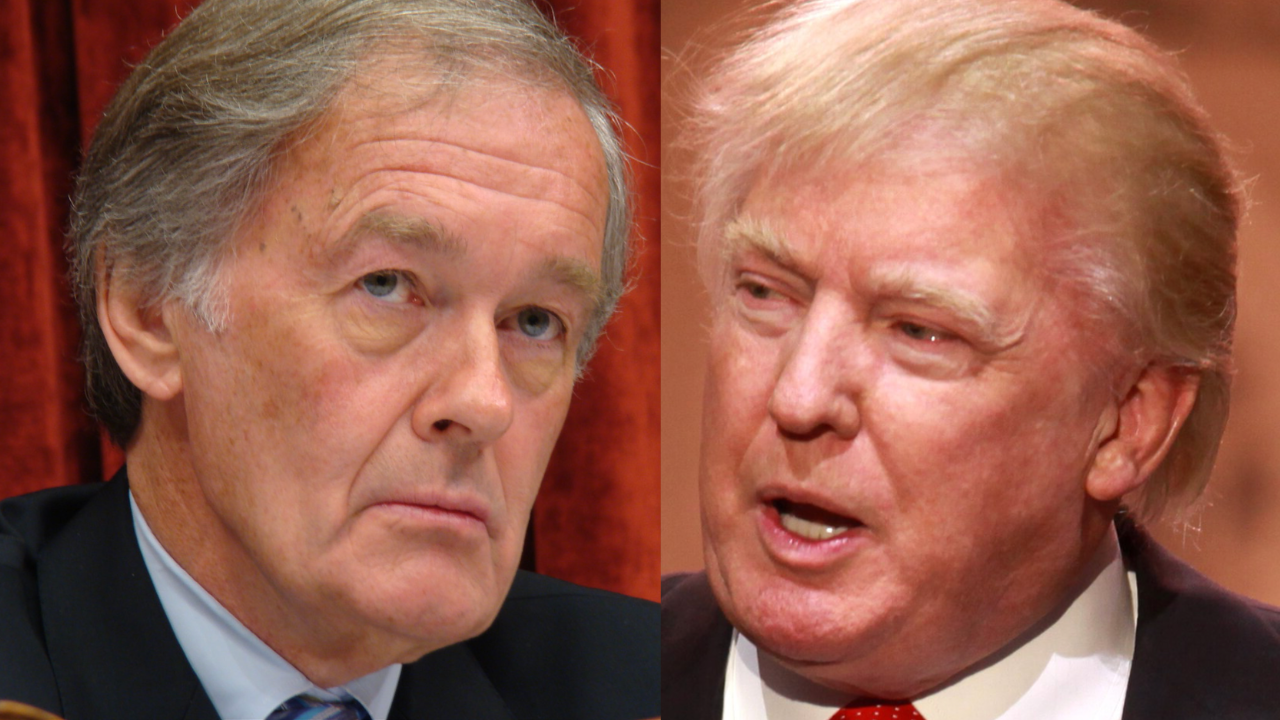
Sen. Ed Markey of Massachusetts called for President Trump’s removal from office after Trump threatened to bomb an Iranian bridge or power plant every time Iran fires on a ship in the Strait of Hormuz, saying the threat amounted to a war crime.
“Attacking civilian targets is a war crime, and Donald Trump is a war criminal,” Markey wrote on X. “Impeachment. 25th amendment. Remove Trump from office now and end this war.”
Markey was responding to a White House post quoting Trump’s own Truth Social statement. “From this point forward, any time the Islamic Republic of Iran shoots at a ship in the Strait of Hormuz, whether it be by Missile, Rocket, Drone, or any other device or weapon, the United States will bomb and destroy ONE BRIDGE OR POWER PLANT, including those located next to, or in, the Capital City of Tehran,” Trump wrote. “Thank you for your attention to this matter!”
Markey, a member of the Senate Foreign Relations Committee and Ranking Member of the Small Business and Entrepreneurship Committee, has long focused on nuclear nonproliferation and international law issues through his committee work.
Legal experts have said Trump’s threat, if carried out as described, would likely violate the laws of war. Bridges and power plants are generally protected civilian infrastructure under international humanitarian law unless they make a direct and significant contribution to military action, and even then any strike must be proportional and minimize harm to civilians.
Retired Lt. Col. Rachel VanLandingham, a military law expert, said in an interview following a similar threat earlier this year that broadly threatening to destroy civilian infrastructure without regard to its military relevance constitutes “an indiscriminate attack,” which she described as a war crime in itself, separate from any strikes that might follow. “The law of war prohibits measures of intimidation against a civilian population, including threats of violence whose primary purpose is to sow terror amongst that civilian population,” VanLandingham said, according to a PBS NewsHour interview.
The threat is not the first time Trump has raised the prospect of striking Iranian civilian infrastructure. In early April, he threatened to “hit and obliterate” Iran’s power plants and warned of “Power Plant Day, and Bridge Day, all wrapped up in one” if Iran did not reopen the Strait of Hormuz by a deadline he set. That same month, U.S. forces struck a bridge under construction in Karaj, northwest of Tehran, with Trump sharing footage of its collapse on social media and promising “more to come.” At the time, more than 100 international law experts signed an open letter warning that U.S. strikes on Iran “raise serious concerns about violations of international law.”
A spokesperson for United Nations Secretary-General António Guterres warned during a similar threat in April that attacks on such infrastructure are banned under international law. “We were alarmed by the rhetoric seen in that social media post that threatened American attacks on power plants, bridges, and other infrastructure, should Iran not agree to a deal,” Stéphane Dujarric, the Secretary-General’s spokesperson, said at the time, according to the official United Nations press briefing record.
Iran responded to Trump’s latest threat by warning it would strike U.S.-linked infrastructure and energy facilities across the region if Washington followed through, according to reporting on the exchange. Secretary of State Marco Rubio, speaking at the ASEAN Post-Ministerial Conference in Manila, said the United States remained willing to negotiate but that Iran was not living up to its commitments. “So far, even though we have reached agreements, they have not kept their commitments,” Rubio said, according to an official State Department transcript of his remarks. “The problem we’re having right now is that they’re not serious about talks. If they’re serious, we’re serious. If they’re not, then we will do what is necessary to protect our interests, and also the interests of our allies.”
The threat came as the U.S. carried out its eleventh consecutive night of strikes against Iran. CENTCOM said the strikes targeted “Iranian military operation centers, maritime capabilities, aircraft hangars, drone storage facilities, and military logistics infrastructure” to further degrade Iran’s ability to threaten commercial shipping in the Strait of Hormuz, according to the command’s official public release. CENTCOM has also reported firing on vessels attempting to breach its naval blockade of Iranian ports in recent weeks, including a Curaçao-flagged oil tanker the command said had ignored multiple warnings while attempting to reach Iran’s Kharg Island.
Trump’s post came the same day he attended a dignified transfer ceremony at Dover Air Force Base for four American service members killed in the war over the past week: 1st Lt. Tyler James Feehan, 25, of Ewa Beach, Hawaii; Pvt. Isabella Gonzales, 19, of Carrollton, Texas; Sgt. Angel S. Rampersad, 28, of Ozone Park, New York; and Sgt. Michael Emmanuel Swinton, 30, of Fayetteville, North Carolina. Feehan and Gonzales were killed in the July 17 Iranian missile and drone attack on Muwaffaq Salti Air Base in Jordan, while Rampersad, previously listed as missing following that attack, was confirmed killed in the assault. Swinton was killed during a controlled detonation of a downed Iranian drone at Erbil Air Base in Iraq. Speaking to reporters beforehand, Trump said Iran wanted “to meet desperately to try and end it because they’re getting decimated,” though he did not describe any clear path toward renewed talks.
Neither the White House nor Trump has issued a direct public response to Markey’s call for his removal from office.