
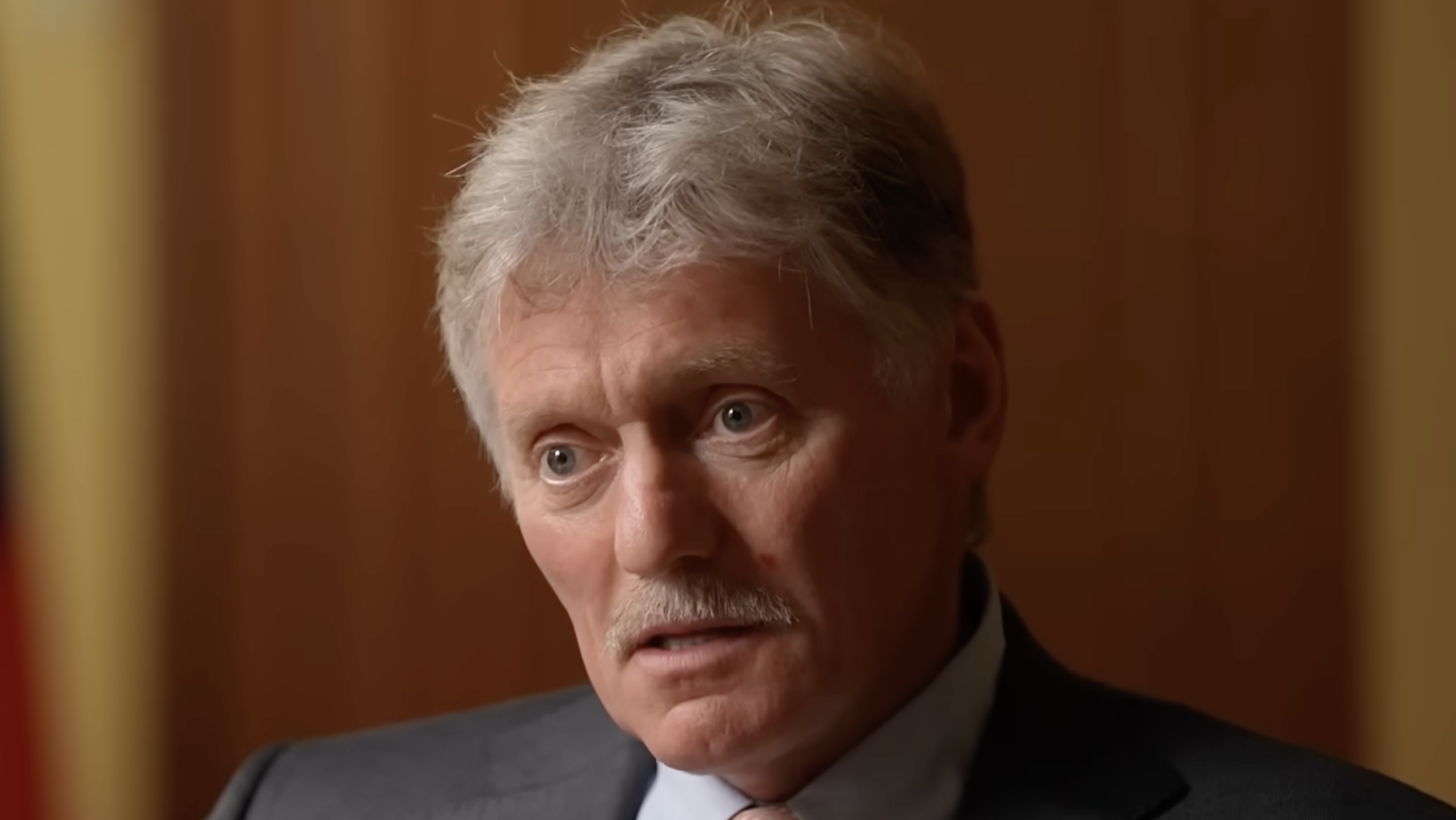
Kremlin spokesman Dmitry Peskov told Swiss magazine Die Weltwoche on Tuesday that Russia’s nuclear doctrine leaves no ambiguity about when Moscow would resort to nuclear weapons, delivering the warning in a wide-ranging interview that also touched on drone warfare, the state of the front lines in Ukraine, and what he described as Europe’s “brainwashing” of its own taxpayers. Asked directly whether Russian military officers were right to believe that Moscow should eventually turn to tactical nuclear weapons, or whether President Vladimir Putin could keep achieving his goals without such an escalation, Peskov declined to split the difference. Russia’s nuclear doctrine, he said, “stipulates the conditions for the usage of nuclear weapons. It’s very bold. It’s very understandable and it’s very simple. If something endangers the idea of existence of Russian state then nuclear weapons will be used, otherwise no, otherwise no. It’s very important to understand that, so the rest of the statements are speculations.”
A Doctrine Framed as Simple and Fixed
The question put to Peskov was pointed. The interviewer noted that some people in Moscow, in conversations with military officers, had come away with the impression that Russia would sooner or later use tactical nuclear weapons — rhetoric the interviewer attributed to Russian foreign policy analyst Sergei Karaganov, who has long argued for lowering Russia’s nuclear threshold. Others, the interviewer said, believed no such escalation was necessary because Putin was already achieving his battlefield objectives without it, and that expanding the war in that direction would “open the Pandora’s box” of unforeseen consequences. Peskov’s answer sidestepped the framing of the question entirely. Rather than weighing in on which camp was correct, he pointed to the doctrine itself as the only relevant fact, describing the criteria for nuclear use as narrow and existential rather than tied to battlefield conditions, tactical setbacks, or foreign pressure. Everything outside that threshold, he said, amounts to speculation.
Drone Strikes on Moscow Described as Manageable
The nuclear question followed a discussion of escalation more broadly, including strikes reaching Russian territory. Asked what escalation — specifically drone strikes on Moscow — means for the Russian government, Peskov characterized the attacks as an “initial burden” that Russia is equipped to withstand. He said Russia has “adapted ourselves to the new conditions of this war with our economy, with our way of taking decisions,” and argued that the country can “afford continuation” of the conflict given what he called optimism about the situation on the front lines. He framed the drone strikes as part of a broader shift in the character of modern warfare, noting that “every second month you see new technologies on this war and it’s a different economy of the war.” He drew a contrast between drones costing a few thousand dollars and tanks costing tens of millions, calling it “a huge difference,” and acknowledged that the drone technology reaching Kyiv originates across Europe. Despite what he called “a very harsh competition,” he said Russia is “in a position to compete” and pointed to what he described as expanding Russian positions on the front as evidence that things are going well for Moscow.
Konstantinovka and the Push Toward Kramatorsk and Sloviansk
Peskov used the interview to highlight recent Russian military gains, saying that “only a couple of days ago our military reported about taking a very important city in Donbas — Konstantinovka.” He noted that the city had been treated as an “untakable fortress” since 2014, and said Russian forces are now moving toward two other significant cities, Kramatorsk and Sloviansk, after which he said the entirety of what Russia calls the Donetsk Republic would be under its control. Russian state media outlet TASS reported the same claim regarding Konstantinovka’s capture in its own coverage of the interview, describing it as one of the interview’s central battlefield claims, though the report did not include independent verification of the city’s status.
The Interview’s Broader Arc
The nuclear and battlefield comments came roughly midway through a much longer conversation, one that ranged across the origins of the conflict, Peskov’s account of failed 2022 peace talks in Istanbul, and his assessment of Europe’s political leadership. Peskov, who has served as Putin’s press secretary since 2012 after working as press secretary to then-Prime Minister Putin starting in 2008, opened the interview by defending an earlier remark of his own — that what Russia calls its “special military operation” is beginning to resemble a full-scale war. He traced that shift to the increasing involvement of European governments and the United States in arming and advising Ukraine, arguing that supplying weapons, ammunition, military advisors, satellite surveillance, and artificial intelligence support to Kyiv had moved the conflict beyond the scope of the term “operation.” “It’s not operation anymore,” he said. “It’s a war. It’s a full-scale war.”
Peskov’s Account of the 2022 Istanbul Talks
A significant portion of the interview was devoted to Peskov’s version of events surrounding the April 2022 negotiations in Istanbul, which he described as having produced a draft agreement that both sides had verified page by page. He claimed that the United Kingdom intervened at that point, saying “London interfered” and that then-Prime Minister Boris Johnson “called Zelensky and asked him not to sign the paper.” According to Peskov, Kyiv then asked Russia to make “a step of goodwill” before signing by withdrawing troops from the Kyiv region, a request Putin granted. Peskov characterized that moment as the first instance of a European country acting, in his words, as “a supporter of war, not a supporter of peace.” This account of the Istanbul talks and Western involvement in their collapse has been disputed by Ukrainian officials and Western governments, who have said the talks broke down over Russian demands and continued Russian military pressure rather than outside interference, though Peskov’s version has been repeated by Russian officials in other settings.
“The Greatest Mistake Ever”
Peskov returned repeatedly to the idea that European governments have miscalculated by continuing to believe Russia can be strategically defeated. “They still think European countries that they can strategically defeat Russia,” he said. “This is the greatest mistake ever.” He argued that European taxpayers are being misled into funding the war, saying, “It’s a brainwash of European taxpayers. They’re paying billions and billions and billions of euros for purposes of defense, for purposes of supplying Kyiv regime to continue the war.” He suggested that European governments have manufactured a sense of threat from Russia in order to justify military spending that might otherwise go toward healthcare, schools, and hospitals, and pointed to rising European defense budgets — including Germany’s, which he noted has grown well beyond the 2% NATO benchmark Donald Trump pushed for during his first term — as evidence of what he called the militarization of Europe.
No Interest in a Third World War, Peskov Says
On the question of broader escalation, Peskov rejected the idea that Russia has any intention of initiating a global conflict. “Russia is too big and too responsible a country to be an initiator of a third world war,” he said, adding that the United States understands the consequences such a war would bring and that Moscow and Washington maintain what he called “relatively good dialogue” despite stalled bilateral relations. He was more pointed about Europe, saying that “there are lots of crazy things in the heads of European politicians,” particularly around the idea that Russia should be strategically weakened, and warned that Russia would respond to any NATO military infrastructure moving closer to its borders. “Will any country tolerate that? No,” he said. “We’re going to do the same. We’re going to ensure our security, but we will never start a third world war.”
Conditions for Ending the War
Asked what it would take for Russia to agree to peace, Peskov tied the answer to what he described as a need for a “buffer zone” along Russia’s border with Ukraine, one that he said would expand in proportion to further Ukrainian strikes on Russian territory. He said Ukrainian President Volodymyr Zelensky could end the war by withdrawing troops from Donbas and formally acknowledging Russian control over the regions Moscow claims, stating that “the next day the war will be over” if that decision were made. He also questioned Zelensky’s legitimacy as Ukraine’s president, a claim Ukrainian officials and Western governments have rejected, noting that Ukraine’s constitution suspends elections during martial law, which has been in effect since Russia’s 2022 invasion.
Peskov’s Message to Europe
Toward the end of the interview, Peskov was asked to summarize his message to European audiences directly. He offered what he called four points: that Russia is not a source of danger to Europe, that Europe needs to listen to Russia’s concerns, that ignoring those concerns will create problems, and that Europe should renew dialogue with Russia “as soon as possible,” describing Moscow as “open,” “flexible,” and “ready.” He contrasted the current generation of European leaders unfavorably with Trump, whom he described as someone who “prefers to solve problems and to solve problems by talking,” a trait he said aligns with Russia’s own approach even when the two sides disagree.
Independent Verification and Context
Die Weltwoche, the Swiss outlet that conducted the interview, published it on July 7, 2026. Russian state news agency TASS separately reported on the interview’s contents the same day, framing Peskov’s remarks around Europe’s “worst mistake,” the Konstantinovka claim, and the nuclear escalation comments as the central takeaways, which aligns with the sections of the interview Peskov himself appeared to emphasize. None of Peskov’s claims regarding the 2022 Istanbul negotiations, the battlefield situation in Donbas, or Zelensky’s legitimacy have been independently verified by Western governments, and Ukrainian officials have consistently disputed the Kremlin’s characterization of the war’s origins and the status of Russian-occupied territory. Russia’s formal nuclear doctrine, updated in 2024, sets out conditions for nuclear use tied to threats against the sovereignty and territorial integrity of Russia and its ally Belarus, a broader formulation than the strictly existential threshold Peskov described in the interview.
What Comes Next
Peskov’s comments arrive against the backdrop of intensifying drone warfare reaching deep into Russian territory, continued Russian advances in eastern Ukraine, and a NATO summit in Ankara where European governments have been discussing further increases to defense spending and joint arms production with the United States. Whether Peskov’s remarks reflect an actual shift in Russian nuclear posture or a restatement of long-standing doctrine delivered for a European audience remains a matter of interpretation. What is clear from the interview itself is that the Kremlin is continuing to frame nuclear use as a response reserved strictly for threats to the Russian state’s existence, while simultaneously describing the war in Ukraine, and the broader confrontation with Europe, in increasingly expansive terms.