
Modern armored fighting vehicles are not built to be “invulnerable.” They’re built to stay usable after contact—ideally remaining mission-capable, and at minimum keeping the crew alive and the vehicle recoverable—after the kinds of hits that are common in high-intensity combat: anti-tank guided missiles (ATGMs), tank rounds, loitering munitions, and frequent blast and fragmentation from artillery. The current news hook is less about a single new platform and more about a visible shift in priorities as ongoing wars generate more combat footage, after-action learning, and renewed interest in survivability upgrades and retrofits.
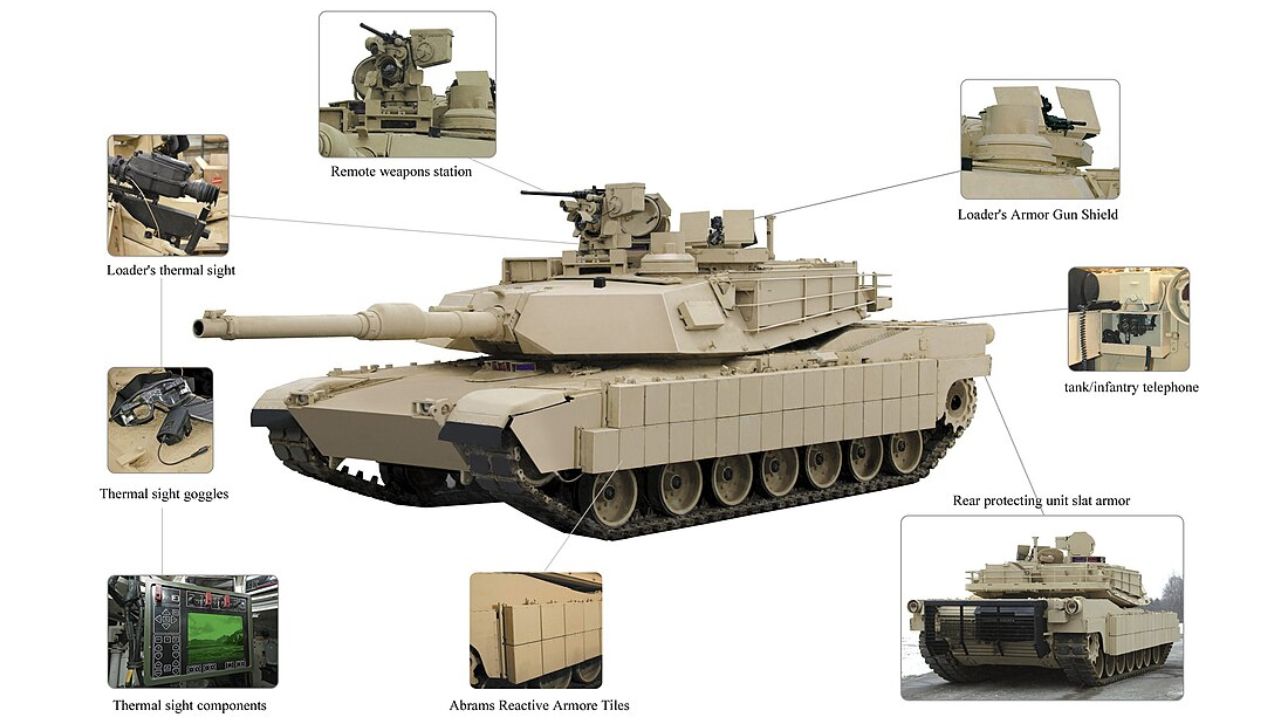
That shift is showing up in what forces buy and field: layered protection, safer ammunition stowage, active protection systems (APS), fire suppression, and redundancy. The aim is less cinematic than “tank vs missile” clips suggest. It’s to preserve combat power by reducing catastrophic losses, keeping crews alive, and getting damaged vehicles repaired and back in service. Shown above: US M1A2 Abrams tank equipped with TUSK (Tank Urban Survival Kit) for urban battle.
What “surviving a direct hit” really means
“Direct hit” can mean very different things. A vehicle might be struck by a kinetic penetrator, a shaped-charge jet, a top-attack munition, or blast and fragments that damage external systems. Outcomes depend heavily on the threat, angle, range, and where the impact lands. Any assessment that treats “direct hit” as a single, consistent event risks overstating what armor can do.
Even when the crew survives, a vehicle may be “mission-killed” rather than destroyed—immobilized by track or suspension damage, forced to withdraw by fire, or degraded by damage to optics, sensors, or communications. The survivability question is therefore twofold: can it keep fighting in the moment, and can it be recovered, repaired, and returned to the line soon enough to matter?
Survivability is a system, not a single armor number
Survivability is best understood as a system-of-systems outcome. Passive protection (composite armor, explosive reactive armor where appropriate, spall liners), internal layout choices, fire suppression, and redundancy all contribute—but so do tactics, electronic warfare (EW), dispersion, combined arms, and maintenance. In environments saturated with drones and indirect fire, many “kills” come from repeated targeting, top-attack effects, or sensor and mobility damage, not just a clean penetration through the thickest armor.
Recent battlefield lessons have pushed a pragmatic focus: assume vehicles will be hit and design them so that damage is less likely to cascade into catastrophic loss. Public discussions often contrast Western and Israeli approaches with older Soviet/Russian patterns, particularly around ammunition stowage and crew survival. The broader point is not that any design is immune, but that some layouts and safety measures are more forgiving when something goes wrong.
How vehicles stay usable after being hit
One pillar is layered protection. Modern tanks and infantry fighting vehicles often combine multiple protective elements intended to disrupt different threat mechanisms—reducing the chances that an impact becomes a lethal internal event and limiting spall and fragmentation inside the crew compartment.
A second pillar is internal layout, especially ammunition management. Designs that separate ammunition from the crew and control blast pathways—commonly associated with blow-off panels on some Western tanks—aim to turn what could be a catastrophic kill into a survivable incident. Crew survival also preserves trained manpower and helps units regenerate combat power faster.
A third pillar is active protection. Trophy-type APS, as a broad example, is designed to defeat or disrupt certain incoming anti-armor threats before they strike the vehicle. Part of today’s procurement push is driven by the appeal of adding protection without the full weight penalty of additional passive armor, while better addressing threats that have become more common.
A fourth pillar is damage control and resilience: automatic fire suppression, protected fuel arrangements, and redundancy in critical systems. These features don’t guarantee a vehicle will keep fighting, but they can buy time—enough to break contact, prevent a fire from spreading, maintain communications, and make recovery possible rather than writing the vehicle off.
Where these ideas show up
A range of well-known platforms reflect this survivability direction, though outcomes in combat still depend on configuration, employment, and the threats encountered. Examples often cited in public discussion include the US M1 Abrams (General Dynamics), Germany’s Leopard 2 (KMW/Rheinmetall), the UK’s Challenger 2/3 (BAE/Rheinmetall), and Israeli designs such as Merkava and Namer. On the infantry fighting vehicle side, platforms like Bradley, CV90, and Puma are frequently discussed in terms of protection packages, internal safety measures, and upgrade paths.
None of these vehicles should be framed as “direct-hit proof.” The more defensible claim is that they represent a broad engineering approach: prioritize crew survival, reduce catastrophic losses, and increase the likelihood that damage results in a recoverable vehicle rather than a total loss. In a high-attrition environment, the difference between a mobility kill and a catastrophic kill can be strategically significant.
Why it matters: readiness and the math of attrition
Survivability shapes force generation because it affects replacement rates. If a force loses fewer crews and can recover more damaged vehicles, it can sustain combat power without waiting on new production. That logic underpins the emphasis on “survive, withdraw, repair, return” as an operational goal rather than a slogan.
There are tradeoffs. Adding protection—especially APS and related integration—can raise cost, complexity, and weight, with consequences for mobility and maintenance. But the alternative can be worse: replacing destroyed vehicles and rebuilding trained crews is often slower and more disruptive than repairing battle damage and returning a platform to service.
Just as important, survivability is inseparable from support. The vehicles that remain relevant are not only the ones with strong protection packages, but the ones backed by reliable recovery assets, spare parts, maintenance capacity, and crews trained in damage control and emergency procedures.
What changes next: APS, retrofit speed, and doctrine catching up
The next wave of emphasis is already visible in priorities: more APS procurement, incremental armor and liner upgrades, and survivability retrofits shaped by the threats dominating current battle footage—ATGMs, drones, and artillery fragmentation. At the same time, doctrine is adapting toward dispersion, stronger EW and counter-UAS measures, and combined-arms tactics that reduce exposure time and prevent vehicles from being isolated and repeatedly targeted.
An equally important question is speed and scale. How quickly can militaries integrate upgrades, train crews, and field changes across large fleets? Weight growth, integration challenges, and training burdens can slow down even urgent efforts. The most consequential improvements may be the ones that are practical enough to deploy broadly and quickly, rather than ideal solutions that arrive late.
Ongoing wars have also made simplistic narratives harder to sustain. The real benchmark for armored vehicles built to stay mission-capable after direct hits is measurable resilience: fewer catastrophic losses, more recoverable damage, more crews surviving, and more vehicles returning to the fight—because in an attrition-heavy contest, that is what preserves options and keeps formations intact.