
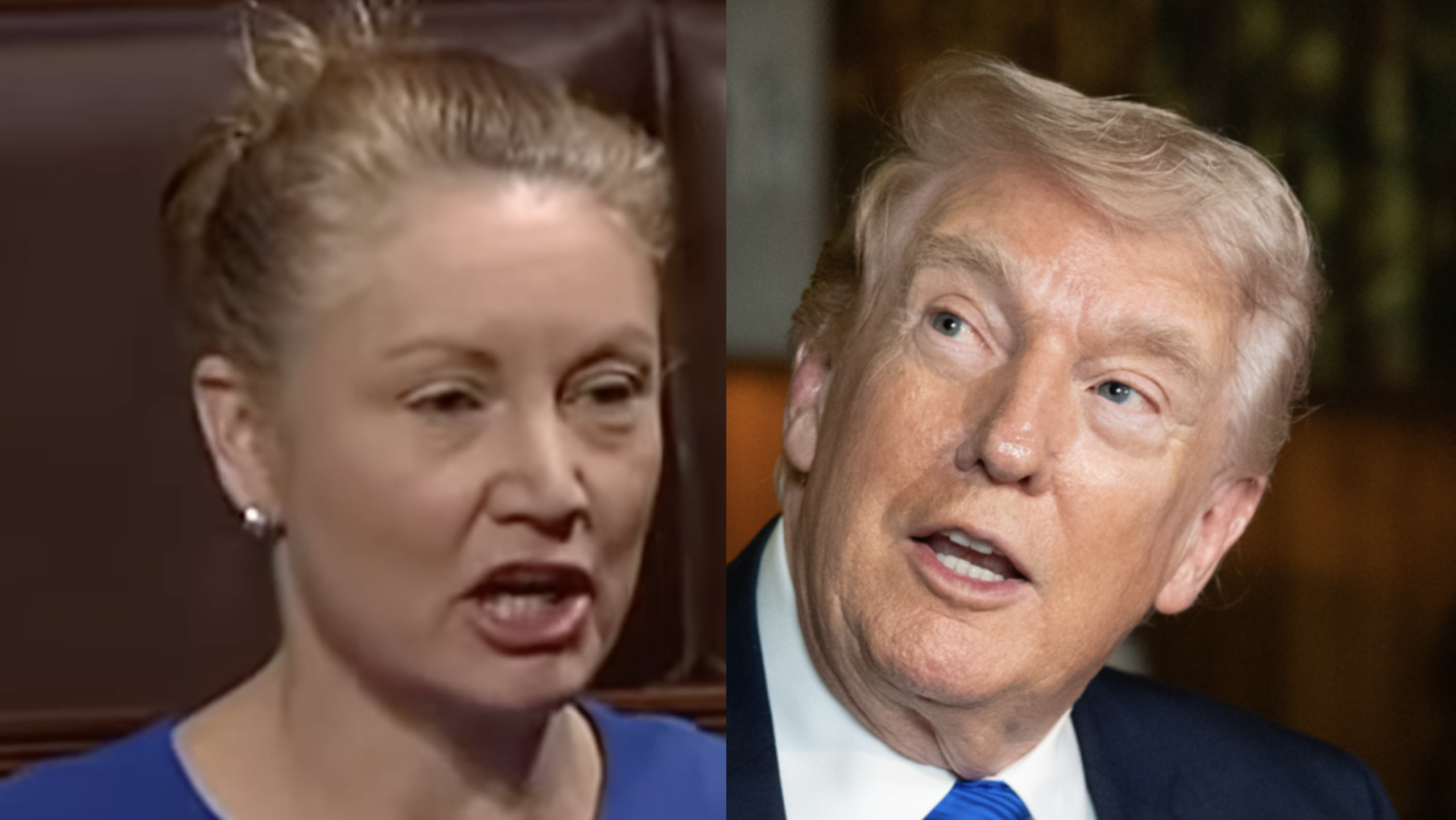
Representative Melanie Stansbury (D-N.M.) said Tuesday that the question of birthright citizenship “should never have even been up for debate” in the first place, reacting to the Supreme Court’s ruling striking down President Donald Trump’s executive order seeking to deny automatic citizenship to children born in the United States to undocumented or temporarily present parents.
The Supreme Court ruled 6 to 3 on Tuesday to block the order, which Trump signed on his first day back in office under the title “Protecting the Meaning and Value of American Citizenship.” Chief Justice John G. Roberts Jr., writing for the majority, held that children born on U.S. soil to undocumented or temporarily present parents are citizens at birth under the Fourteenth Amendment, writing that the framers of the amendment “extended that promise to ‘every free-born person in this land.'”
Stansbury responded on X Tuesday morning with a brief, direct statement. “This should never have even been up for debate,” she wrote. “If you are born in America, you’re an American. Period.”
Stansbury’s statement reflects a broader stance on immigration and constitutional rights she has maintained throughout her time representing New Mexico’s 1st Congressional District. Her office maintains a “Know Your Rights” resource page in English, Spanish and Vietnamese, intended to help constituents understand their legal rights “regardless of immigration status,” and stating that “It is crucial for everyone to understand these rights so that they can navigate their interactions with authorities confidently and safely.”
The legal fight that ended Tuesday began the day Trump signed the order, when civil rights organizations, immigrant advocacy groups and expectant parents filed suit to block its enforcement. The order sought to deny citizenship to babies born on U.S. soil to parents who had entered the country illegally, as well as to children born to parents present on lawful but temporary visas, such as student, work or tourist visas. It never took effect, blocked by a series of federal court injunctions beginning in New Hampshire in February 2025, with additional injunctions following in Washington, Maryland and Massachusetts.
The case ultimately decided Tuesday, Trump v. Barbara, stemmed from a nationwide class-action lawsuit filed after the Supreme Court’s June 2025 ruling in Trump v. CASA, Inc., which limited the use of so-called universal injunctions nationwide but left lower courts to determine whether broad relief remained justified specifically in birthright citizenship litigation. The ACLU and its partners responded with a new class-action suit on behalf of all children born on U.S. soil to undocumented or temporarily present parents, which became the basis for Tuesday’s ruling.
Oral arguments took place April 1, with Trump becoming the first sitting president to attend Supreme Court arguments in person, remaining in the courtroom for more than an hour before leaving shortly after attorneys opposing his order began their presentation. He wrote afterward on Truth Social that the United States was “the only Country in the World STUPID enough to allow ‘Birthright’ Citizenship!” During arguments, Roberts directly challenged the administration’s solicitor general over his reading of the Fourteenth Amendment’s “subject to the jurisdiction” clause, telling him that several examples used to support a narrower interpretation “strike me as very quirky.”
In his opinion, Roberts wrote that the administration’s position represented “a dramatically revisionist view” of the Fourteenth Amendment, for which there was “scant evidence,” pointing to the 1898 case United States v. Wong Kim Ark, in which the court held that a man born in San Francisco to Chinese immigrant parents who had not naturalized was nonetheless a U.S. citizen. Roberts was joined in the majority by Justices Sonia Sotomayor, Elena Kagan, Ketanji Brown Jackson, Amy Coney Barrett and Brett Kavanaugh. Justices Clarence Thomas, Samuel Alito and Neil Gorsuch dissented, with Alito writing that the ruling would leave the United States, alongside Canada, as the only affluent nation where birth alone establishes citizenship.
A Reuters/Ipsos poll conducted in April, around the time of oral arguments, found that 64 percent of adults disapproved of Trump’s executive order, including 91 percent of Democrats, while 64 percent of Republicans approved of it — underscoring the deep partisan divide that had surrounded the issue even as the legal question moved toward resolution at the Supreme Court.
Stansbury’s two-sentence statement was notably more terse than some of the more elaborate reactions issued by fellow House Democrats on Tuesday, but it conveyed the same underlying argument: that the constitutional question at the center of the 18-month legal battle had a clear answer from the outset. Her framing — that the issue “should never have even been up for debate” — positioned the ruling not as a close call resolved by the courts, but as confirmation of a settled constitutional principle that Trump’s executive order had attempted to unsettle.
With Tuesday’s ruling, the citizenship guarantee tied to birth on U.S. soil, rooted in the Fourteenth Amendment’s ratification after the Civil War, remains intact nationwide. For Stansbury, the decision closed out a legal fight she had signaled opposition to since the order’s earliest days, delivered Tuesday in the same plain, declarative terms used by several of her House colleagues: if you are born in America, you are an American.