
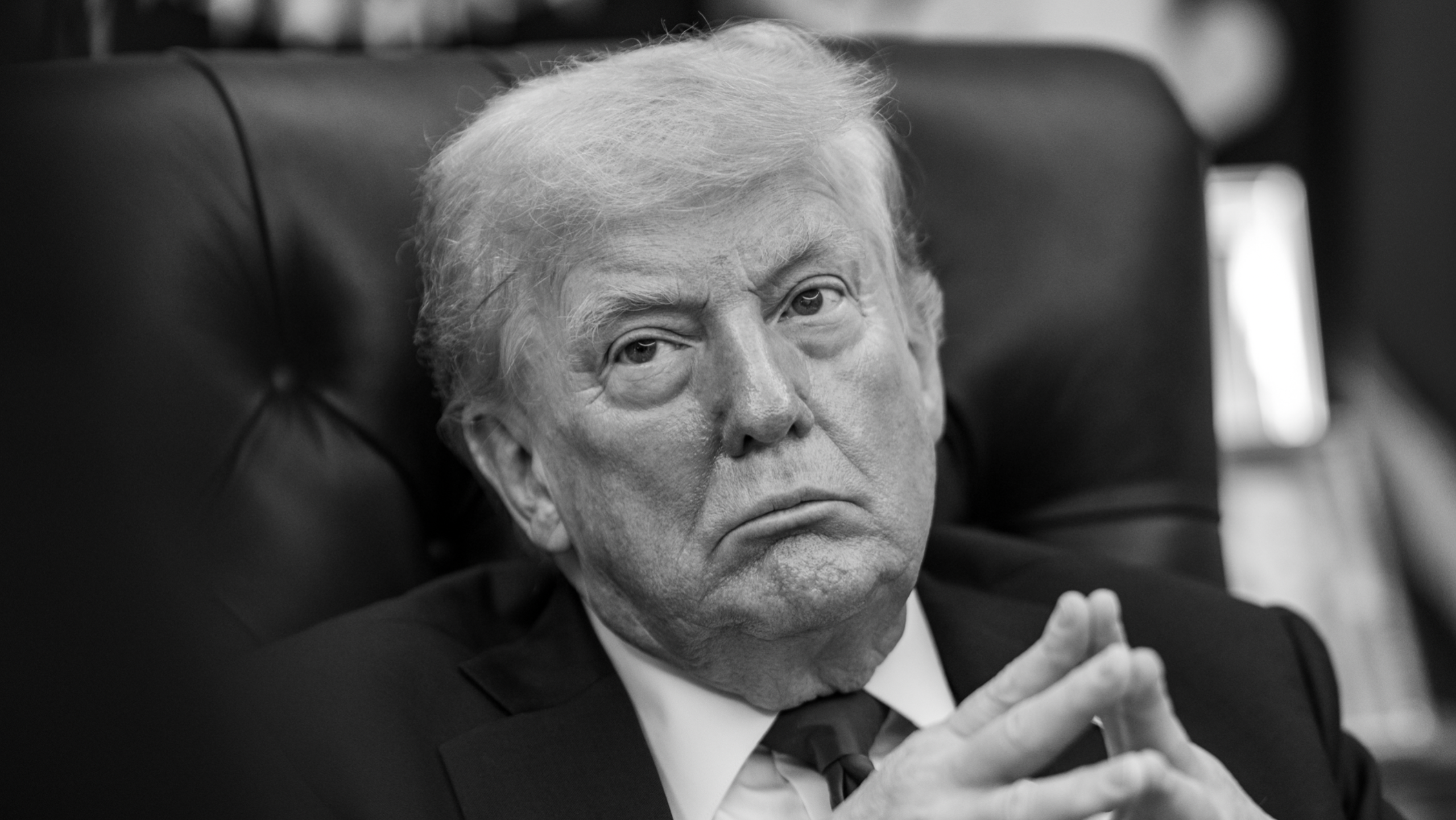
President Donald Trump said Monday he is prepared to risk a worldwide economic depression to strike Iran again if Tehran fails to abide by the terms of the Islamabad Memorandum of Understanding, reiterating a warning he issued a day earlier on Truth Social threatening to “hit Iran very hard again” over its proxy forces in Lebanon. Trump made the comments in the Oval Office while signing two executive orders on quantum technology, fielding questions from reporters about the durability of the ceasefire framework reached with Iran earlier this month.
Asked directly whether renewed strikes on Iran could trigger a worldwide depression and whether he was willing to risk that outcome, Trump did not back away from the possibility. “Well, not the way I’m doing it. It’s not going to cause depression,” he said, before adding a caveat. “But if uh they don’t abide by the memorandum supersedes depression, depression is real bad. Nuclear weapon will cause depression much more quickly.” He argued that current economic indicators contradict any narrative of instability, telling reporters that “the way we’re doing it, we have the opposite of a depression” and pointing to oil prices that he said had “returned most of the way back down” to pre-conflict levels.
When a reporter pressed further on whether he would still authorize strikes even at the risk of causing a depression, Trump invoked the legacy of Herbert Hoover, the president whose name has become synonymous with the onset of the Great Depression. “I said it could cause a depression, right? And they said uh that I don’t want to be Herbert Hoover. That’s a president I don’t want to be because he, you know, he was uh in charge during the Great Depression and certainly a lot of bad things could happen,” Trump said. He nonetheless concluded the exchange with an unambiguous commitment to act if necessary. “But no, if Iran doesn’t uh live up to their agreement or if they’re not behaving, I will I will do what I have to do,” he said.
Trump’s Oval Office remarks built directly on a warning he posted to Truth Social the previous morning, as Vice President JD Vance was holding a press conference in Switzerland on the status of the broader Iran negotiations. In the post, dated June 21 at 8:30 a.m., Trump wrote: “Iran must immediately stop their highly paid PROXIES in Lebanon from causing trouble. If they don’t, we’ll hit Iran very hard again, just like we did last week, only harder!!!” The message was signed “President DONALD J. TRUMP.”
The renewed threats come roughly five days after senior U.S. officials disclosed the full text of the Islamabad Memorandum of Understanding between the United States and Iran, a 14-point agreement aimed at ending hostilities and opening a 60-day window for final negotiations. The first provision of the memorandum declares the “immediate and permanent termination of military operations on all fronts, including in Lebanon,” and commits both countries to refrain from the threat or use of force against each other while ensuring Lebanon’s territorial integrity and sovereignty. Trump’s warning over Lebanese proxy activity directly implicates that clause, suggesting the administration views continued unrest there as a potential breach of the broader deal.
The memorandum also lays out a 60-day negotiating period, extendable by mutual consent, during which the U.S. and Iran are to finalize a comprehensive agreement covering sanctions relief, the disposition of Iran’s enriched uranium stockpile, and a reconstruction and economic development plan involving at least $300 billion in international investment. Paragraph 9 of the agreement specifies that, pending the final deal, both sides are to “maintain the status quo,” with Iran preserving its current nuclear posture and the United States refraining from new sanctions or additional troop deployments in the region.
Trump’s comments suggest the administration is treating Iranian-linked activity in Lebanon as a test of whether that status quo is holding. His framing — that economic consequences, even a possible depression, are secondary to enforcing the terms of the memorandum — marks one of his most direct acknowledgments yet that further military action remains on the table even as diplomatic talks continue in Switzerland and elsewhere.
During the same Oval Office appearance, Trump touted broader economic conditions tied to the region, saying record volumes of oil were now passing through the Strait of Hormuz. “We took in more oil yesterday than we’ve ever than has ever gone through the straight,” he said, adding that the waterway remained fully open under the current arrangement with Iran. He also confirmed that the U.S. Treasury had moved to lift sanctions on Iranian oil exports, with proceeds from those sales required under the deal’s terms to be used to purchase American agricultural goods.
“All that money is coming back uh in the form of purchases of food, which they desperately need,” Trump said of Iran, which he noted has roughly 91 million people that need feeding. He said the unfrozen funds would be spent “largely” on American corn and soybeans, a provision he suggested has already pleased U.S. farmers. The arrangement aligns with paragraph 11 of the memorandum, which obligates the United States to make Iran’s frozen assets fully available for use upon implementation of the agreement, with procedures for fund release to be negotiated during the 60-day window.
Asked by a separate reporter whether he could guarantee Iran would not use oil proceeds to rebuild its military, Trump did not offer assurances beyond citing the deal’s stated terms. “Supposed to be doing that,” he said, referring to Iran’s obligation to direct the funds toward food purchases. “So, we’ll see. But they’re supposed to use money to buy food for their people cuz right now their people are very hungry and they’re buying it exclusively from us.”
The exchange capped a broader Oval Office session in which Trump signed two executive orders aimed at advancing American leadership in quantum computing and cybersecurity, an event attended by Secretary of War Pete Hegseth, Secretary of Commerce Howard Lutnick, Secretary of Energy Chris Wright, and senior science and technology officials, along with executives from Google, IBM, and other companies. The Iran-related questions came during a press availability following the signing ceremony.
As of Monday, the Islamabad Memorandum remains in its early implementation phase, with the 60-day negotiating clock running toward a final deal that, per paragraph 14, would require endorsement by a binding United Nations Security Council resolution. Trump’s renewed warnings suggest that window will be closely watched by the administration for signs of Iranian compliance, particularly regarding the situation in Lebanon, as both sides work toward the broader settlement outlined in the agreement’s remaining provisions.