
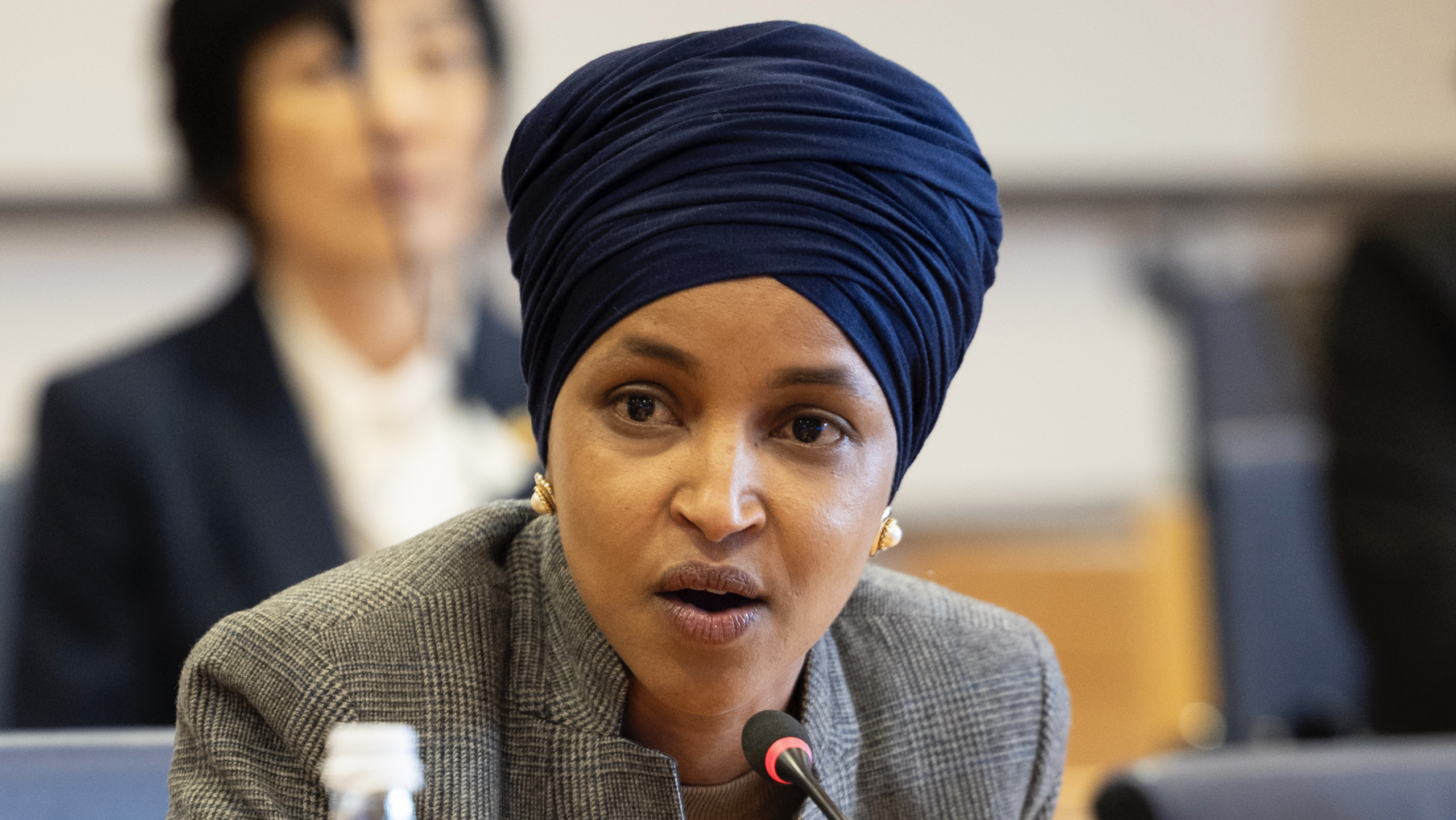
When the U.S. House of Representatives passed the Ukraine Support Act on the evening of June 4, 2026, the 226-195 vote was notable not just for the bipartisan coalition it required to reach the floor — but for a single dissenting vote on the Democratic side. Rep. Ilhan Omar (D-MN-5) stood alone as the only Democrat to vote against the legislation, and the following morning she took to X to explain exactly why — in terms that drew a sharp line between supporting Ukraine and endorsing the economic sanctions embedded in the bill.
Omar States Her Position
In a post published at 9:51 a.m. on June 5, 2026, Omar offered a full-throated defense of her vote, opening by affirming her support for Ukraine while making clear that her objection was specifically directed at the bill’s sweeping sanctions provisions. Her full post read:
“I have always, and will continue, to stand with the Ukrainian people and unequivocally condemn Putin’s illegal and brutal invasion. I voted against the Ukraine Support Act because of its inclusion of broad economic sanctions. Time and again, sanctions like these fail to achieve their stated goals while inflicting real suffering on ordinary people. Opposing Russian aggression does not require us to support policies that punish ordinary civilians who did not ask for this war.
The foreign policy establishment continues to return to the same failed playbook and expects different results. Economic sanctions fail to achieve their desired goals and in most cases are counterproductive to ending war.
I remain committed to supporting diplomacy, peace, and justice for the Ukrainian people affected by this horrific conflict. But I could not in good conscience support legislation that wages economic warfare on innocent civilians.”
What the Ukraine Support Act Does
The Ukraine Support Act (H.R. 2913), introduced by Rep. Gregory W. Meeks (D-NY-5) and sponsored by the Ranking Member of the House Foreign Affairs Committee, is a sweeping piece of legislation that addresses the war between Russia and Ukraine on two fronts: providing assistance to Ukraine and certain European countries, and establishing penalties for Russia and certain foreign persons.
On the aid side, the bill’s provisions are substantial. The legislation establishes a reconstruction trust fund for Ukraine, revives the President’s authority to lend or lease defense articles to Ukraine or Eastern European countries affected by the war through FY2028, and extends through 2027 the Department of Defense’s authority to provide security assistance and intelligence support to Ukrainian forces. It also requires the Department of State to take certain actions to build the capacity of the militaries and border forces of Baltic countries.
The Sanctions Mechanism That Triggered Omar’s Vote
At the core of Omar’s objection is the bill’s mandatory sanctions framework. Under the legislation, the President must periodically determine whether the Russian government or any proxy is waging a war of aggression against Ukraine, refusing to sincerely negotiate a peace agreement, or acting in violation of a negotiated peace agreement. If the President makes such a determination, he must impose property- and visa-blocking sanctions on certain Russian officials, property-blocking sanctions on Russian companies in the oil and mining sectors, Rosatom and its subsidiaries, and certain Russian financial institutions. It is precisely these broad, mandatory economic measures — targeting the financial architecture of the Russian economy — that Omar argued would ultimately harm ordinary Russian civilians rather than the government driving the war.
A Consistent Stance — Years in the Making
Omar’s position on Wednesday was not a sudden break from party orthodoxy but a continuation of a view she has held since the earliest days of Russia’s full-scale invasion. When Russia first invaded Ukraine in February 2022, Omar stated publicly: “I support sanctions that are targeted at Putin, his oligarchs, and the Russian military, including and especially targeted at their offshore assets. But I will continue to oppose broad-based sanctions that would amount to collective punishment of a Russian population that did not choose this.” Her June 5 post echoes that position nearly word for word, four years later.
That same consistency has coexisted with active support for Ukrainian accountability measures. Omar co-sponsored the Ukraine War Crime Deterrence and Accountability Act, legislation that would require the U.S. Department of State to collect and preserve evidence of war crimes committed by Russian forces in Ukraine and report to Congress on support for proceedings at the International Criminal Court and International Court of Justice. The distinction she has long drawn is between punishing Putin’s regime for aggression and punishing the Russian civilian population for a war it did not start.
How the Bill Reached the Floor
The Ukraine Support Act’s path to a House vote was itself a story of institutional maneuvering. The bill passed the House in a bipartisan 226-195 vote after a successful discharge petition forced Republicans to hold a vote despite the opposition of majority leadership. The petition reached its 218th signature — the threshold needed to compel a floor vote — after a coalition of lawmakers led by Meeks, Rep. Steny Hoyer (D-MD), Rep. Brian Fitzpatrick (R-PA), Rep. Marcy Kaptur (D-OH), Rep. Don Bacon (R-NE), Rep. Bill Keating (D-MA), and Rep. Kevin Kiley (R-CA) pushed it across the finish line.
The Vote Breakdown
On final passage, Democrats voted 207 in favor and 1 against, while Republicans voted 18 in favor and 194 against. Omar’s was the lone Democratic “no.” Nine members did not vote. The final tally of 226-195 reflected the unusual nature of the coalition — a bill that could not pass through normal House procedure, driven to the floor by a bipartisan discharge petition over the objections of Republican House leadership, and then opposed primarily by the majority party it bypassed.
The Bill Now Heads to the Senate
With House passage secured, the Ukraine Support Act now moves to the Senate, where its fate remains uncertain. The legislation represents one of the most significant congressional pushes to sustain U.S. military and financial support for Kyiv since the war entered its fourth year, and the sanctions provisions that drew Omar’s objection remain intact. Whether the Senate will take up the bill, modify its sanctions language, or stall it entirely will determine whether those provisions ever take effect.
Omar’s Call for a Different Approach
In her post, Omar did not call for abandoning Ukraine — she was explicit that her support for the Ukrainian people is unequivocal. What she called for was a different instrument of policy. Her argument, that economic sanctions targeting broad sectors of the Russian economy have historically failed to achieve their stated objectives while causing documented harm to civilian populations, reflects a debate that has run through U.S. foreign policy circles for decades. In her framing, the bill’s backers are repeating a mistake: “The foreign policy establishment,” she wrote, “continues to return to the same failed playbook and expects different results.”
Whether that argument carries weight in the Senate — or shifts any votes when the bill reaches that chamber — remains to be seen. For now, Omar’s solitary “no” stands as the only Democratic dissent in a House that otherwise voted in near-unanimous support of the legislation.