
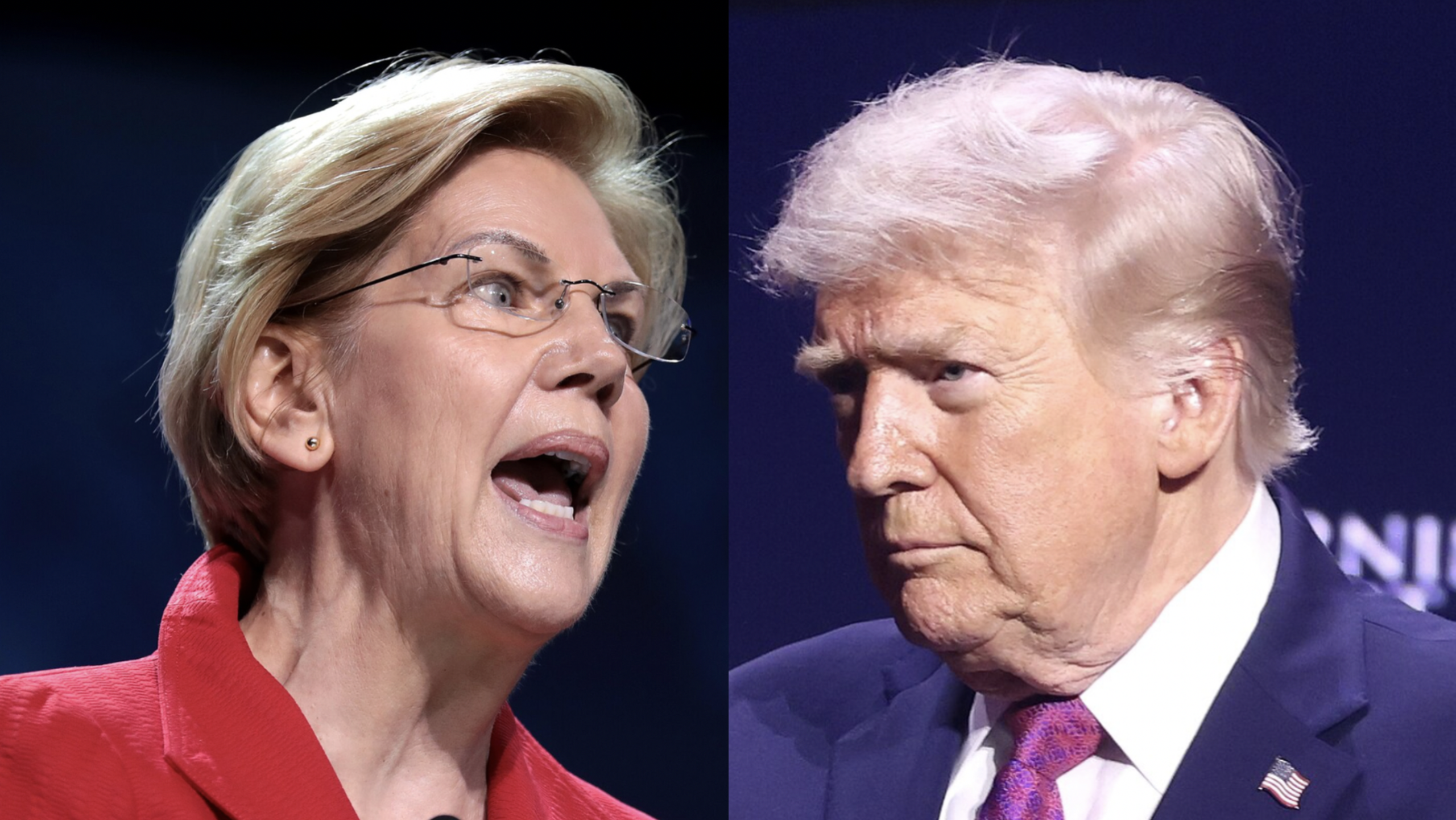
WASHINGTON, May 27, 2026 — Sen. Elizabeth Warren, D-Mass., introduced legislation Tuesday targeting President Donald Trump’s personal stock trading activity, declaring that the president “should not financially benefit from the very government he controls” and calling the trades a threat not just to government ethics but to national security itself. The bill, S. 4299, arrives as disclosures filed with the U.S. Office of Government Ethics reveal the president conducted more than 3,600 individual trades in the first quarter of 2026 alone — many of them in defense contractors and military technology companies with active, multibillion-dollar contracts before his own administration.
“I can’t believe I have to say this: The President should not financially benefit from the very government he controls,” Warren wrote on X. “I’ve got a bill to stop Trump’s corruption.” The legislation targets a well-documented gap in federal law: the president is not covered by the Stop Trading on Congressional Knowledge Act of 2012 and faces no statutory prohibition on trading individual securities while in office.
The Trades at the Center of the Controversy
The scale and timing of Trump’s trades have drawn the sharpest scrutiny. Disclosures filed with the U.S. Office of Government Ethics show Trump or his advisers made more than 3,700 trades in the first quarter of 2026, totaling between $220 million and $750 million, involving some of the biggest names in tech, defense, and retail — including Nvidia, Microsoft, Oracle, Apple, Amazon, Meta, Alphabet, Boeing, and Palantir. The disclosures ran over 100 pages.
Several of the most scrutinized trades involved companies sitting at the intersection of military contracting and administration policy. Trump purchased at least $260,000 worth of Palantir stock during the first three months of 2026, including multiple tranches in January and March, during the same period in which Palantir secured a billion-dollar agreement with the Department of Homeland Security to use the company’s software in the administration’s deportation surge. Palantir also holds a contract surpassing a billion dollars with the Pentagon to develop AI systems that help orchestrate attacks.
The Palantir trades carried an additional dimension. After purchasing the shares, Trump publicly praised Palantir on Truth Social, writing that “Palantir Technologies has proven to have great war fighting capabilities and equipment. Just ask our enemies!!!” The company’s tools have reportedly been used to identify targets in Iran. It marked the first reported instance of a sitting U.S. president buying stock in a defense technology company ahead of a public endorsement of that company.
Trump also purchased shares of Axon, the manufacturer of Tasers and law enforcement technology, before ICE outlined a $220 million Taser contract, and bought Nvidia stock one week before the Commerce Department approved Nvidia chip sales to China. Other trades included the private prison company GEO Group and the defense contractor RTX, formerly known as Raytheon — all companies with direct business before the federal government or subject to potentially costly and high-profile regulations.
Warren: “A National Security Disaster”
Warren has gone beyond framing the trades as an ethics violation, calling the president’s conduct “a national security disaster” — specifically citing the Nvidia purchase, which coincided with the U.S. government’s clearance of chip sales to certain Chinese firms, and pointing to the defense contractor overlap as the core of her concern.
That framing sharpens the political stakes considerably. When a president holds personal financial positions in the companies building the military’s AI targeting systems, managing its deportation infrastructure, and supplying its law enforcement equipment, the question is not merely whether disclosure rules were followed — it is whether military and national security decisions can be made free of personal financial incentive.
Warren pressed the issue directly before the Senate Armed Services Committee in April 2026, questioning Defense Secretary Pete Hegseth on allegations that Trump administration officials were engaging in possible insider trading by placing bets on the Iran War through prediction markets — a practice she characterized as a direct conflict of interest for officials with advance knowledge of military decisions.
A Pattern of Legislative Action
Tuesday’s bill did not emerge in isolation. Warren has been building a legislative architecture around executive branch conflicts of interest for months. In April 2026, she introduced the Ban Presidential Plunder of Taxpayer Funds Act alongside Senate Majority Leader Chuck Schumer, Rep. Jamie Raskin, and Rep. Dave Min. That bill targeted what its sponsors called an unprecedented pattern of using executive power to extract taxpayer funds, citing Trump’s October 2025 attempt to draw $230 million from the Justice Department to settle claims related to investigations into his alleged coordination with Russia, and a January 2026 lawsuit against the IRS seeking $10 billion in damages.
Also in May, Warren joined Sen. Rick Scott, R-Fla., on bipartisan legislation to impose a lifetime lobbying ban on former members of Congress — the rare instance of cross-aisle cooperation on an anti-corruption measure in the current political environment.
A Moment of Bipartisan Agreement — and Its Limits
The sharpest irony in the current debate came in February, when Trump himself called on Congress to address the very category of conduct now being directed at him. At his State of the Union address, Trump urged Congress to pass a ban on congressional stock trading, declaring that members of Congress should not “corruptly profit” from insider information — prompting a rare moment of bipartisan applause. Trump appeared visibly surprised when Democrats, including Warren, stood to applaud. “Did Nancy Pelosi stand up?” he quipped. “Doubt it.”
Trump urged Congress to pass the Stop Insider Trading Act “without delay,” though the bill has since stalled in the House after dozens of Republicans refused to support it. Democrats have called for a broader bill covering the executive branch as well. That distinction is the precise gap S. 4299 is designed to close: the Stop Insider Trading Act, as written, would ban congressional stock trading but does not cover the president or vice president.
The Administration’s Defense
The White House and Trump Organization have pushed back on the conflict-of-interest framing. A Trump Organization spokesperson said the president’s investment holdings are “maintained exclusively through fully discretionary accounts independently managed by third-party financial institutions with sole and exclusive authority over all investment decisions,” and that trades are executed through automated investment processes. Trump, his family, and the Trump Organization do not play a role in selecting, directing, or approving specific investments, the spokesperson added.
Vice President JD Vance echoed that position at a White House briefing, saying Trump “has independent wealth advisors who manage his money” and is “not sitting on his Robinhood account.” Vance also said “nobody should be taking proprietary information gained from public service and buying and selling stocks” — while maintaining that Trump’s trades do not constitute that practice.
Finance professionals have questioned the scale of the activity regardless of who is directing it. “This is an insane amount of trades,” said Matthew Tuttle, CEO of Tuttle Capital Management, adding that the volume — more than 40 trades per day over a three-month period — looks more like a hedge fund running automated trades than a personal account.
A Growing Legislative and Political Response
Warren’s bill has arrived alongside a broader wave of Democratic action. Sen. Mark Kelly introduced the Ban Congressional Stock Trading Act, which would cover both Congress and the executive branch. Rep. Melanie Stansbury vowed the trades “will be investigated.” Sen. Alex Padilla called Trump “the most corrupt president in our history.” Rep. Daniel Goldman — who served as lead counsel in Trump’s first impeachment — framed the stock trading as one of three core motivations driving Trump’s presidency, alongside avoiding criminal prosecution and exacting political revenge on enemies.
The specific overlap between Trump’s trades and the Pentagon’s most consequential technology vendors has given the debate a dimension that extends beyond standard ethics enforcement. Palantir’s AI systems are now embedded in U.S. military targeting operations. Axon’s technology equips federal law enforcement. Boeing builds the aircraft that project American airpower globally. That a sitting commander-in-chief holds personal financial stakes in those companies — and that no law currently prohibits it — is the gap Warren’s bill is now explicitly targeting.
“No one in this country should wonder whether or not their senator, their representative, and president is making a decision that is good for the country — or maybe just good for their own private portfolio,” Warren said last year. Tuesday’s legislation was her attempt to make that principle enforceable.