
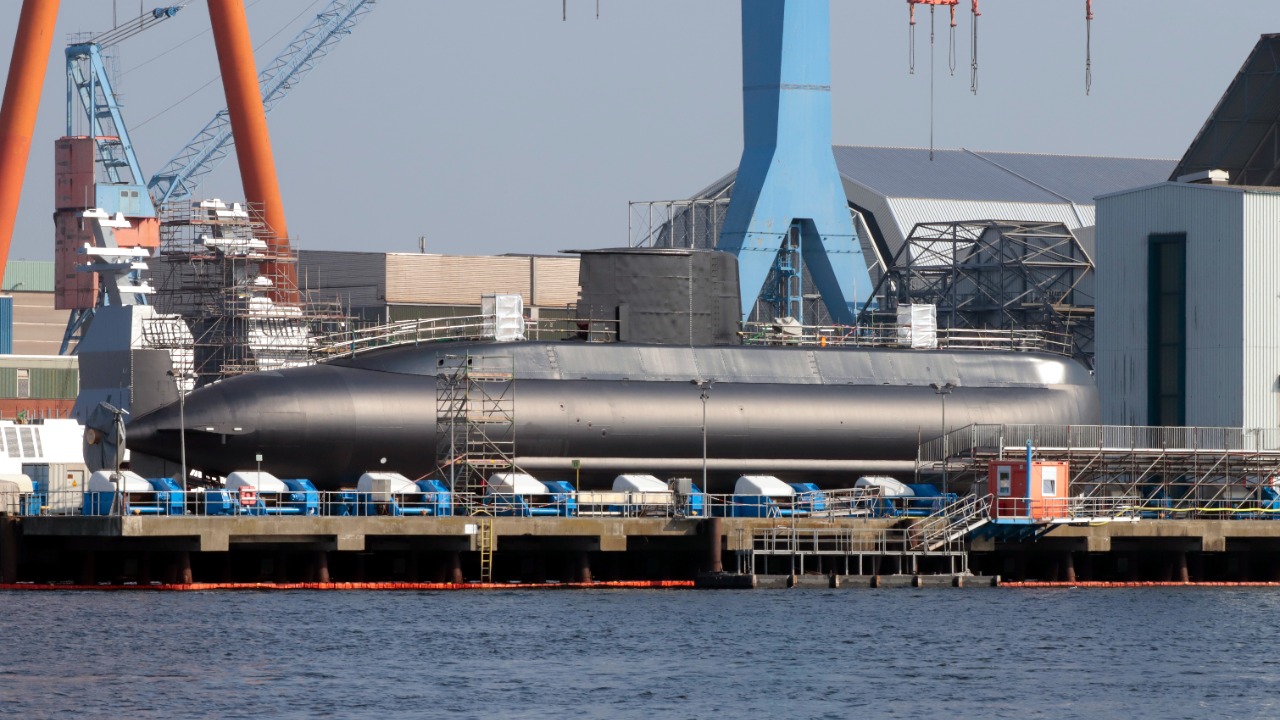
TKMS has turned a niche in high-end submarines into a surge of demand that is reshaping its financial outlook. The German shipbuilder now sits on a record order pile worth about $22 billion, giving it the confidence to lift its sales guidance for 2026 despite a difficult industrial backdrop. The scale of that backlog is starting to ripple through parent group planning, capital allocation and the strategic map of European naval production.
The company’s momentum rests on a sharp jump in order intake, stronger cash generation and a widening geographic footprint that includes major work in Germany and Asia. As governments from Europe to Asia Pacific respond to maritime security pressures, TKMS is positioning its yards and balance sheet to turn that demand into steady revenue growth over the remainder of the decade.
Record backlog and upgraded 2026 outlook
Investors have zeroed in on the size of the order book, which now gives TKMS a multi‑year line of sight on revenue. The German submarine specialist has reached an order backlog of about $22 billion, a level that marks a fresh high for the company and reflects sustained demand for complex underwater platforms. According to reporting on the group’s recent update, this backlog prompted management to raise the sales outlook for 2026 as the company phases large naval projects into production and delivery over the coming years, a shift that signals confidence in execution as well as demand.
The scale of the backlog also speaks to the type of contracts TKMS is winning, which are long-term, and often tied to strategic partnerships with navies. Coverage of the latest figures notes that TKMS, the German, has seen its order backlog climb step by step to this new peak while improving its outlook for sales. A separate account from FRANKFURT adds that TKMS hit a fresh $22 billion high in order backlog and raised its sales outlook, underlining that the company is not only booking more work but also expects to convert that pipeline into higher revenue as projects move from design into construction.
From trading debut to booming intake and cash
The stronger guidance for 2026 rests on more than a single quarter of orders. Since its trading debut, TKMS has reported a broad improvement across key financial indicators, including order intake and cash generation. In its 2024/2025 fiscal year, the group stated that order intake amounted to about € 8.8 billion, a figure that reflects major contracts for submarines and surface vessels and that helps explain why the backlog has climbed so sharply. That intake includes work for navies in Europe and Asia, providing a diversified base of future activity rather than reliance on a single customer or region.
Cash flow has strengthened in parallel. TKMS disclosed that free cash flow doubled to € 784 million compared with the previous year, a change that gives the group more flexibility to invest in facilities, digital tools and supply chain resilience. The company highlighted that this performance followed a successful trading debut and a significant increase in all key financial figures for the 2024/2025 fiscal year, with order intake amounting to and free cash flow that doubled to € 784 million, both cited as proof of the turnaround. That same update pointed to contracts for two further 218SG submarines, showing how individual high-value deals are feeding directly into the intake and cash metrics.
Parent group support and earnings resilience
The surge at TKMS is unfolding within a broader industrial group that is trying to steady earnings in a volatile market. Parent company Thyssenkrupp has described the environment as persistently challenging, with market-related declines in sales across parts of the portfolio. Even so, the group has reported that EBIT in the first quarter of the 2025/2026 fiscal year was up on the prior year, and that the forecast for all key performance indicators remained confirmed. That resilience gives TKMS cover to keep investing in its naval programs, even as other divisions face weaker demand.
Management at thyssenkrupp has framed the first quarter as a strong start into fiscal year 2025/2026, despite the pressure on sales, and has linked that performance in part to contributions from businesses such as TKMS that are on a growth path. In its communication on the quarter, the group stressed that EBIT was higher than the prior year and that the group’s forecast was confirmed for all key performance indicators, as outlined in thyssenkrupp. That backdrop matters for TKMS because it shapes access to capital, the appetite for further naval expansion and the willingness to back long lead time projects that may not deliver peak revenue until well after 2026.
Strategic yards, Singapore contracts and future growth
Behind the headline backlog, TKMS is also reshaping where and how it builds submarines. The company has long anchored its operations in Kiel, but it is now using its yard in Wismar as a second pillar for complex naval work. Reporting on its recent contracts with Singapore notes that the Singapore submarines will be built at the TKMS shipyard in Wismar, rather than at the company’s headquarters in Kiel, where the previous units for Singapore were constructed. That shift spreads employment and skills across northern Germany and gives the group more capacity to handle a crowded order book.