
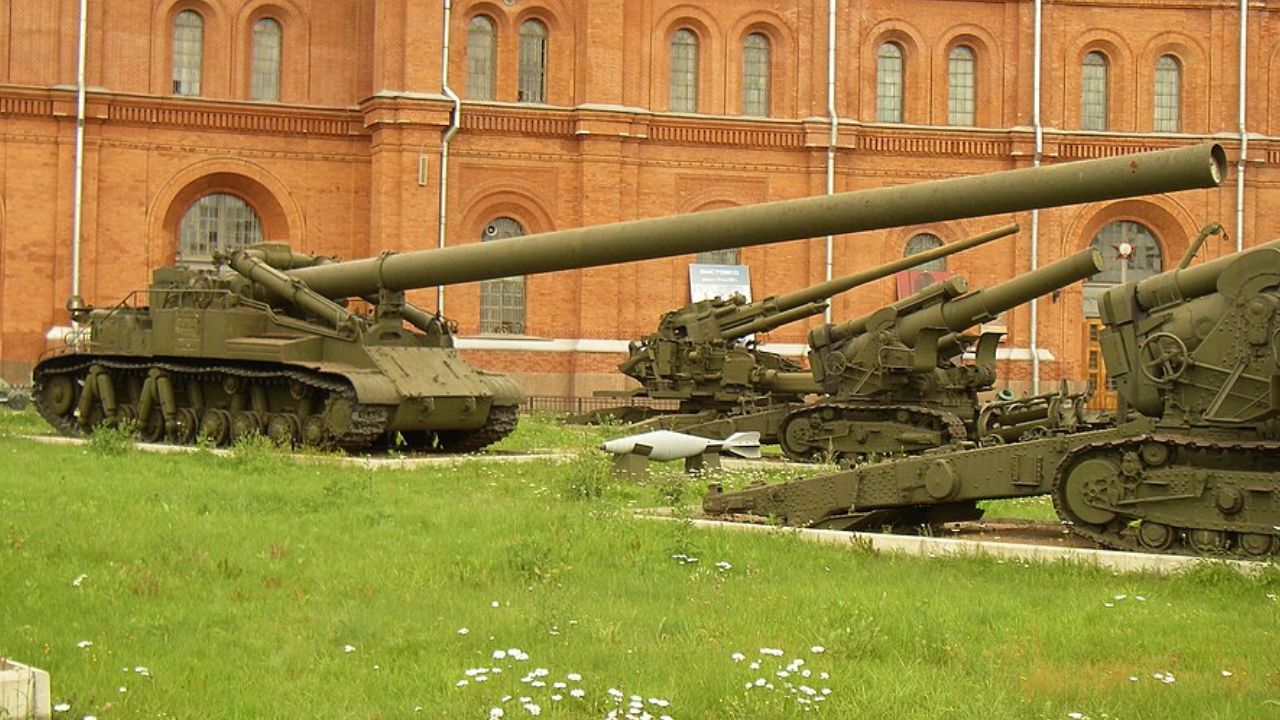
“Extreme artillery” isn’t only about larger shells or longer barrels. The systems that truly left a mark are the ones that changed what commanders and political leaders believed cannon fire could do—psychologically, politically, and in a few cases, strategically. The examples below range from fortress-busting siege weapons to Cold War showpieces, plus one U.S. gun built around a mission that still feels jarring: making nuclear use look like routine field artillery.
This is not a ranking of the “best” guns, and it avoids turning the story into a spreadsheet of disputed performance figures. Where accounts differ or where popular claims outpace the supplied references, the descriptions stay with what those references support and keep the framing cautious.
M65 280mm “Atomic Annie” (USA)

The M65 280mm “Atomic Annie” is the most direct example of artillery crossing a strategic and ethical line: a U.S.-built field artillery piece designed to fire a nuclear weapon. The consequence isn’t only technical—it’s institutional. This is nuclear employment packaged as an “artillery” mission rather than something confined to strategic bombers or missile forces, which can make the concept feel more like an extension of normal battlefield planning.
The central point supported by the supplied references is straightforward: the M65 was built for the capability to fire a nuclear round. Even without leaning on contested details about tests or operational history, that design purpose alone shows how far Cold War militaries were willing to go to make tactical nuclear use look like conventional fires.
Schwerer Gustav (80 cm railway gun) (Nazi Germany)

Schwerer Gustav remains the signature image of monstrous siege artillery: a German 80 cm railway gun intended to break fortifications and overwhelm defenders through sheer scale. It is described (in the supplied reference) as the largest-calibre rifled weapon ever used in combat, and it is frequently discussed among the heaviest mobile artillery pieces ever built. The engineering is the message as much as the munition.
Its wider impact is largely psychological. A weapon of this size signals intent in a way ordinary artillery cannot: it frames the fight as an industrial contest where concrete, distance, and morale are being challenged. At the same time, because specific performance claims can vary across secondary accounts, it’s best understood here as an extreme siege concept made real—spectacle and pressure as much as repeatable efficiency.
Karl-Gerät 040/041 (60 cm self-propelled siege mortar) (Nazi Germany)

Karl-Gerät 040/041 took the logic of siege warfare and tried to make it deployable: a 60 cm German self-propelled siege mortar built to pulverize forts and urban strongpoints. The supplied references link it to real-world use at targets including Sevastopol and during the Warsaw Uprising. “Self-propelled” in this context means the weapon was engineered to be moved as a system, not that it behaved like flexible frontline artillery.
What makes Karl-Gerät consequential is the idea it represents—extreme demolition treated as a fielded capability rather than purely an engineering project. But descriptions of specific strikes or effects in Warsaw can be contentious, so the safest publication framing is what the references support: the system is associated with those operations, while finer-grained claims should not be treated as settled without stronger archival backing.
Project Babylon “Big Babylon” supergun (planned 1000 mm) (Iraq)

Project Babylon sits where modern procurement and geopolitics produce an artillery story that reads like science fiction. The supplied reference describes an effort associated with Iraq and Gerald Bull to build “Big Babylon” guns with a planned 1000 mm bore. Whether the program was envisioned primarily as a weapon, a strategic signal, or something with broader ambitions, the scale is the point—and it advanced far enough to be treated as a real manufacturing effort, not just a sketch on paper.
Its effect on warfare is therefore indirect but still significant: it shows how a modern regime sought an asymmetric, attention-commanding capability outside the usual missile-and-airpower playbook. The same sourcing also supports restraint in conclusions—the project was planned/under construction and never completed—so its legacy is about intent and implications more than battlefield results. Pictured above: Two sections of Big Babylon that have been bolted together at Royal Armouries, Fort Nelson, Portsmouth.
2A3 Kondensator 2P (406 mm self-propelled gun) (USSR)
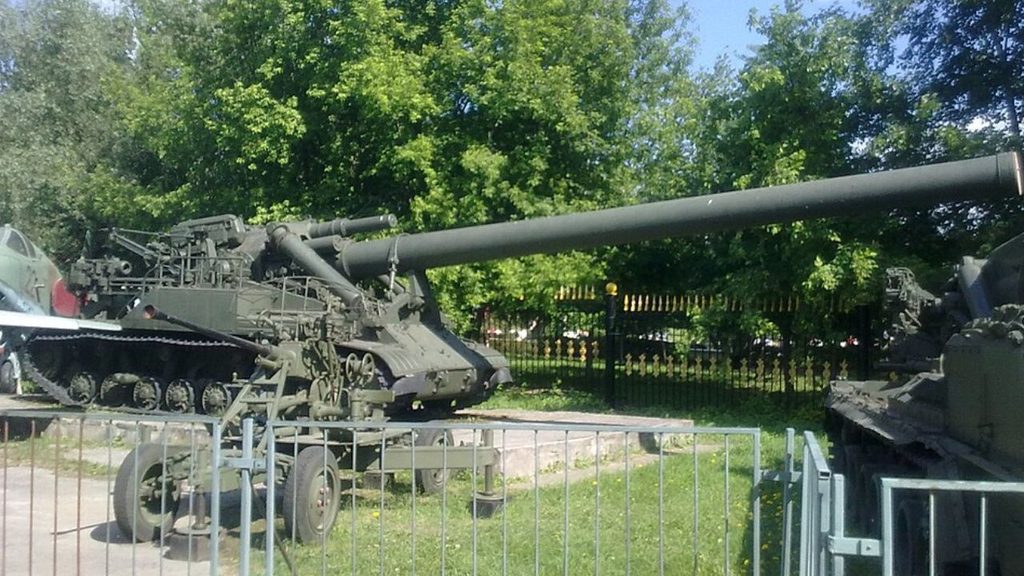
The 2A3 Kondensator 2P captures a particular Cold War instinct: escalation expressed through visible, battlefield-scale hardware. As summarized in the supplied reference, it was a Soviet 406 mm self-propelled howitzer system. Its importance is not just that it existed, but what it was meant to communicate—power, reach, and seriousness—at a time when militaries explored how “tactical” systems could carry strategic weight.
In that sense, Kondensator 2P is as much about signaling as employment: a gun that makes an argument in photographs and parades as readily as in firing positions. Because widely repeated claims about specific nuclear projectile details are not consistently documented in the supplied context, any discussion of nuclear payloads should remain cautious and non-assertive unless supported by stronger sources.
2B1 Oka (420 mm self-propelled heavy mortar) (USSR)
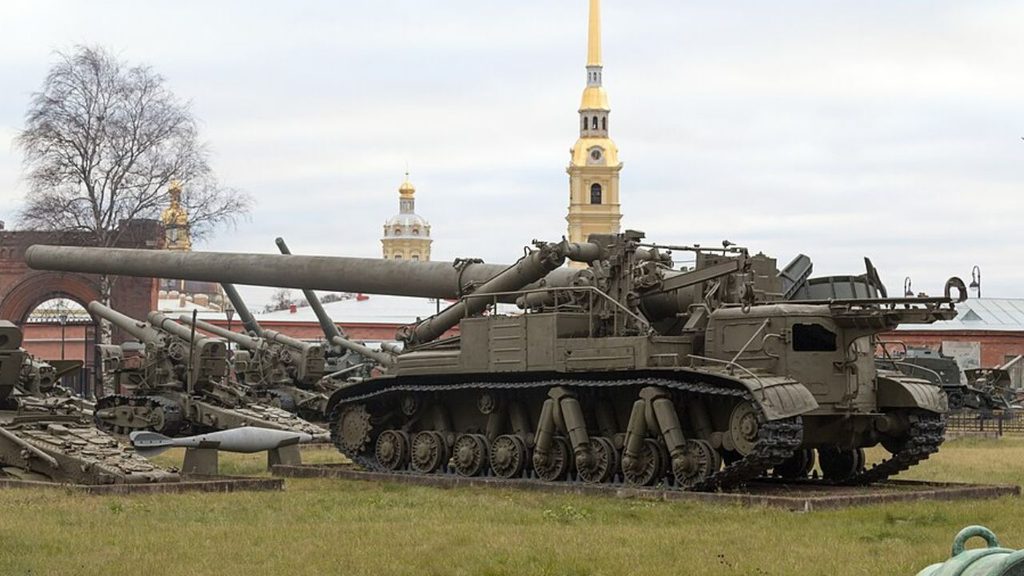
The 2B1 Oka is the Soviet Union’s other extreme artillery experiment from the same period: a 420 mm self-propelled heavy mortar, as summarized in the supplied reference. It takes a weapon type normally associated with high-angle, comparatively smaller munitions and pushes it into a super-heavy category intended to deliver outsized effects. Like Kondensator 2P, it reflects a willingness to test the outer limits of what ground-based firepower could look like in the Cold War.
Its broader lesson is about the boundary between “mobile” on paper and mobile in practice. Enormous caliber and mass can make movement and employment a planned evolution rather than a flexible battlefield choice, shaping what commanders can realistically do with such systems. And as with other super-heavy Cold War designs, any claims that drift into specific nuclear payload assertions should be treated carefully unless backed by explicit, high-quality documentation.