
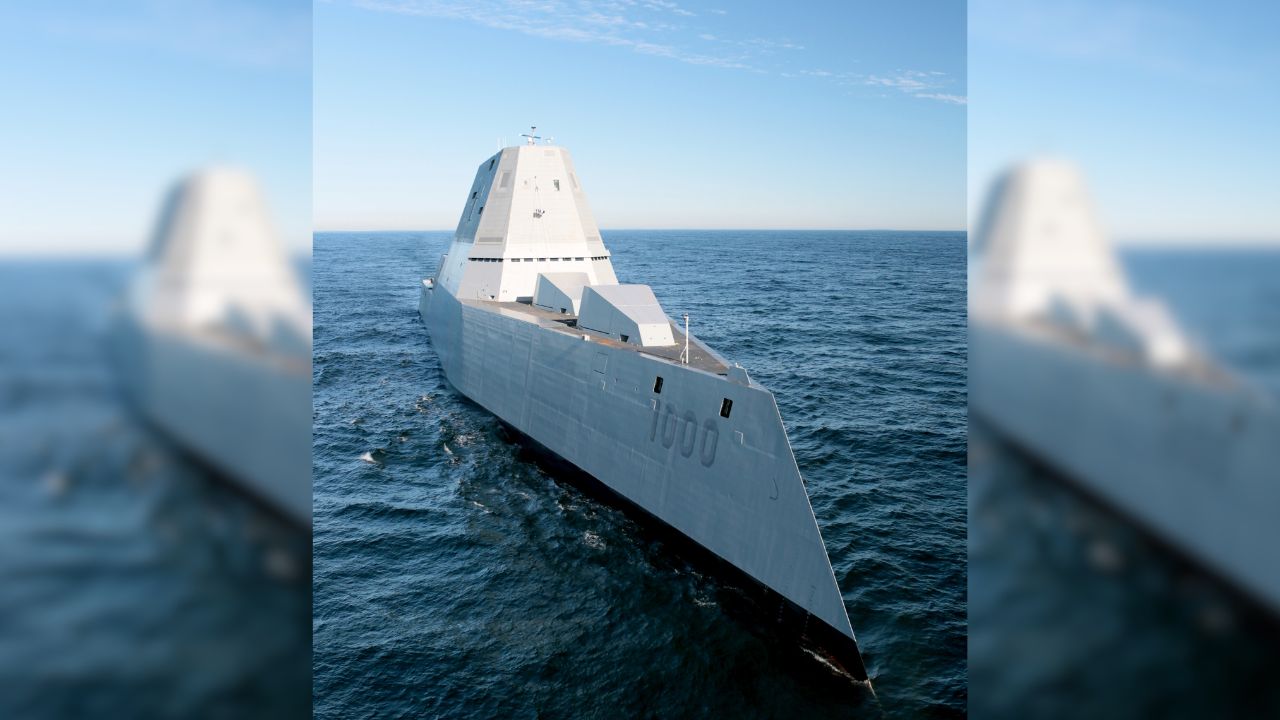
The United States has quietly sent a radically refitted 15,000-ton surface combatant back to sea, this time with cavernous launch tubes sized for hypersonic weapons instead of conventional guns. The lead Zumwalt-class destroyer, USS Zumwalt, has completed its first builder’s trials since an extensive conversion, validating a design bet that a stealth “ghost ship” can also serve as a long-range strategic striker. The result is a warship that blends low observability, heavy displacement, and Conventional Prompt Strike firepower in a way no other surface vessel currently matches.
The trials mark a turning point for a program once criticized as an expensive curiosity, recasting the angular destroyer as the Navy’s pathfinder for hypersonic sea power. With its new missile tubes, reworked topside, and upgraded combat systems, Zumwalt is moving from technological experiment to operational asset, and in the process is reshaping debates over how large surface ships fit into high-end conflict.
From troubled prototype to hypersonic pathfinder
The ship that has just returned from trials is the same Destroyer USS Zumwalt (DDG 1000) that entered service as a symbol of overreach, but it now carries a very different mission profile. After a lengthy modernization at HII’s Ingalls Shipbuilding yard in Pascagoula, the vessel has emerged as the Navy’s first surface combatant configured around hypersonic strike, a shift that reflects how far the service has moved from the original land attack gun concept. Reporting on the recent trials notes that the destroyer has taken a decisive step toward operational service as the Navy’s first hypersonic warship, underscoring how the program has been repurposed rather than abandoned through the work on Destroyer USS Zumwalt.
The modernization has been framed by the Navy as a deliberate transformation rather than a salvage operation. One detailed account describes how the milestone of builder’s trials validates the Navy decision to turn Zumwalt into its first surface vessel purpose-built for Conventional Prompt Strike, with the refit involving extensive structural and systems modifications to accommodate the new role. That same reporting refers to the ship as the First Stealth Hypersonic, and notes that the milestone validates the US decision to invest in this conversion path.
What changed on board: tubes, weapons, and “floating ghost” stealth
The most visible change to the ship is the removal of its twin 155 mm Advanced Gun System mounts and the insertion of large diameter launch tubes sized for the Conventional Prompt Strike weapon. Navy officials have explained that the upgrades included integrating the CPS weapon system and replacing the original gun installations, a shift that trades shore bombardment for long-range, high-speed strike against heavily defended targets. One technical summary notes that the CPS architecture is designed to fire a boost glide weapon at speeds exceeding Mach 5, and that the Zumwalt class is being structurally modified to accommodate up to 12 such Conventional Prompt Strike munitions.
Those weapons sit inside a hull that was already one of the most distinctive silhouettes at sea. Commentators have long observed that at first glance the ship looks like something out of a science fiction film, with a sleek, angular superstructure and slab sides that sharply reduce radar returns, making it a “floating ghost” in hostile waters. A widely shared description of the ship’s appearance highlights how the USS Zumwalt’s faceted hull and integrated mast are intended to scatter radar energy and hide a 15,000-ton ship in the clutter of a much smaller contact, a design that has been described as a stealth destroyer that can appear on sensors closer to a 50-foot fishing boat than a capital ship.
Sea trials, shipyard work and the road to deployment
The recent builder’s trials were the culmination of a long period in dry dock and at the pier. HII’s Ingalls Shipbuilding division has confirmed that it successfully completed builder’s sea trials for USS Zumwalt (DDG 1000), a key step in returning the ship to the fleet after the hypersonic conversion. The yard’s role has been central, with the company detailing how its Ingalls Shipbuilding team executed the complex structural work and systems integration needed to install the new launchers and associated combat systems on USS Zumwalt.
Other accounts of the trials emphasize that the ship’s return to sea is part of a broader hypersonic rollout across the Zumwalt class and beyond. One report notes that the Navy is refitting all three Zumwalt class destroyers with CPS hypersonic missiles so they can respond to emerging threats almost instantly, describing the lead ship as a futuristic 8 billion dollar stealth “battleship” that has now slipped out of port with new Mach 5 weapons canisters. Another analysis of the program explains that the Navy’s Zumwalt (USS Zumwalt (DDG 1000)) class destroyer program manager has targeted completion of the hypersonic weapon tube installation by the end of 2025, with the third hull, DDG 1002, due to start modification work in 2026, a schedule that underscores how the Navy is treating this as a class wide transformation rather than a one off experiment.
A new role for big surface combatants in the hypersonic era
The decision to turn Zumwalt into a hypersonic strike platform is also reshaping debates about the future of large surface combatants. Analysts have pointed out that the CPS weapon uses a common hypersonic glide body that can be shared with Army systems, and that putting it to sea on a stealthy destroyer gives the United States a flexible, survivable way to hold distant targets at risk. One detailed discussion of the refit notes that this “upgunned” configuration is already feeding into wider US naval force structure debates, since a ship that can launch a salvo of hypersonic weapons at speeds exceeding Mach 5 from a low observable hull changes the calculus for both offense and defense in contested regions, a point underscored in coverage of the CPS weapon.