
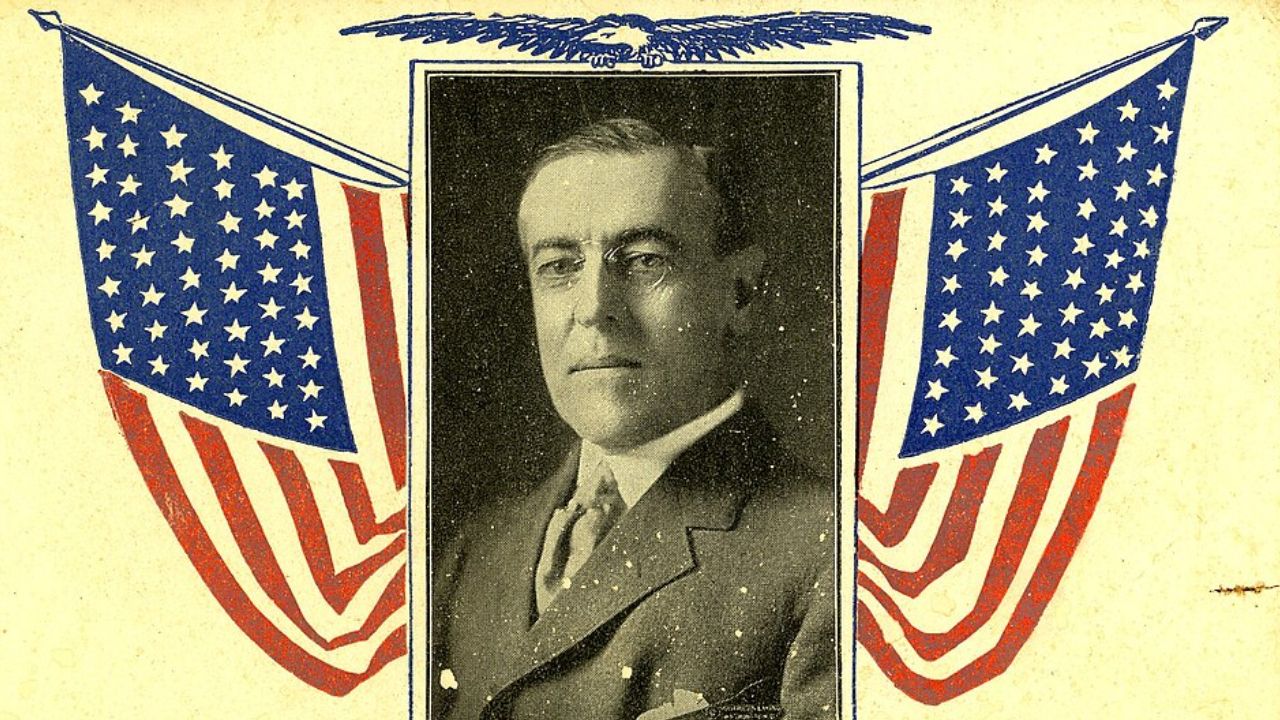
When Woodrow Wilson took office in 1913, the United States was already big, rich, and increasingly influential. But it still tended to act like a powerful neighbor who preferred to keep the curtains drawn—trade when it made sense, intervene nearby when it felt necessary, and otherwise focus on building at home. By the time Wilson left the White House in 1921, America had stepped into a louder, more public role on the world stage, talking about global rules, collective security, and the idea that U.S. power should come with a mission.
That shift didn’t happen in one clean moment. It came through a mix of idealism, hard realities, and war—plus Wilson’s own belief that America wasn’t just another country, but a country with a purpose. Love him or roll your eyes at him, Wilson helped set a new expectation: the U.S. would not only influence world events, it would try to shape the world’s future.
A professor-president with a mission
Wilson arrived with a pretty uncommon résumé for a president: he’d been a political scientist, a university president, and a reform-minded governor. He spoke in big themes—democracy, morality, public opinion—and he talked about foreign policy the same way. To Wilson, America’s power wasn’t just industrial and military. It was also supposed to be moral, the kind that could inspire other nations (and yes, that’s as ambitious as it sounds).
This wasn’t just rhetoric for speeches. Wilson believed foreign policy should reflect American values, not only American interests, and that the U.S. should be willing to act on those values. That outlook—sometimes called “Wilsonian idealism”—became one of the most durable flavors of American foreign policy, even among leaders who didn’t particularly like Wilson.
Before World War I, Wilson was already reshaping America’s role
It’s easy to think the story starts in 1917 with the U.S. entering World War I. But Wilson was already pushing outward before that. His administration took a more active role in the Western Hemisphere, especially in Mexico, Haiti, and the Dominican Republic, often framed as efforts to stabilize neighbors or encourage constitutional government.
Some of these moves were controversial then and now, because “helping” could look a lot like controlling. Wilson opposed old-school imperial talk, yet his policies still involved U.S. troops and strong pressure on smaller countries. The important shift was the rationale: he increasingly justified American action in terms of promoting political order and democracy, not just protecting investments or territory.
Neutral… until neutrality wasn’t workable
When war broke out in Europe in 1914, Wilson tried to keep the U.S. neutral. Many Americans wanted no part of Europe’s mess, and Wilson ran for reelection in 1916 with the popular slogan “He kept us out of war.” For a while, it seemed like he could hold that line.
But neutrality got harder as the war intensified. Germany’s unrestricted submarine warfare threatened American ships and lives, and the Zimmermann Telegram—Germany encouraging Mexico to oppose the U.S.—added fuel to the fire. Wilson didn’t suddenly become hawkish; he came to argue that staying out would leave the world shaped by forces hostile to democracy and peace.
“Make the world safe for democracy” (and what that really meant)
In April 1917, Wilson asked Congress for a declaration of war against Germany. His framing was striking: the U.S. wasn’t going to war for conquest, but to defend a world order where democratic nations could survive. The famous line—“make the world safe for democracy”—wasn’t just a slogan. It was an announcement that America’s involvement would be about shaping the postwar future, not simply winning a military contest.
This was a new way of presenting American power to Americans and to the world. Past U.S. wars had moral arguments too, but Wilson leaned hard into the idea of global responsibility. He was essentially saying: the U.S. can’t just be a spectator with a big economy; it has to be a co-author of international rules.
The Fourteen Points: America writes a blueprint
In January 1918, Wilson laid out the Fourteen Points, a set of principles for peace. They included ideas like open diplomacy, freedom of the seas, arms reduction, and national self-determination for peoples living under old empires. Most famously, they called for a general association of nations—what became the League of Nations.
Even where the specifics didn’t stick, the approach mattered: Wilson was offering a public, values-based blueprint for international order. That was different from the old model where great powers carved up agreements behind closed doors. It was also a sign that the U.S. saw itself not just as a participant, but as a designer of the system.
Paris, the League of Nations, and the limits of idealism
After the war, Wilson traveled to the Paris Peace Conference in 1919—an unusual move for a sitting president at the time. He pushed hard for the League of Nations, believing a permanent international body could prevent future wars through collective security and diplomacy. In Wilson’s mind, the League was the keystone; without it, the peace settlement would be shaky no matter what borders were drawn.
But Paris was a crash course in the realities of allied politics. Britain and France wanted security and reparations, and they had their own publics to answer to. Wilson won agreement on the League, but the final Treaty of Versailles included harsher terms than he’d hoped, especially for Germany—terms that would later feed instability.
America steps forward… then hesitates
Here’s the twist: Wilson’s bold global vision ran into a wall at home. The U.S. Senate refused to ratify the Treaty of Versailles, largely over fears that the League would drag America into future wars without congressional control. Wilson, stubborn and exhausted, refused to compromise with key senators, and a debilitating stroke in late 1919 weakened his ability to lead the fight.
The result was one of history’s great ironies. Wilson helped invent a new American role—global leadership tied to international institutions—yet the U.S. didn’t join the League he championed. America still emerged as a major world power after World War I, but it stepped back from the kind of formal international commitment Wilson wanted.
The lasting change: a new expectation for American power
Even with that setback, Wilson’s impact stuck. He made it normal for U.S. presidents to talk about foreign policy in moral and global terms, not just regional or economic ones. He also helped plant the idea that peace isn’t only about winning wars, but about building systems—rules, institutions, alliances—that shape what happens afterward.
Decades later, when the U.S. helped create the United Nations and NATO after World War II, it echoed Wilson’s basic argument: America is safer when it helps organize the international environment, not when it pretends it can ignore it. You can draw a line from Wilson’s Fourteen Points to a lot of the language modern leaders still use about “the international order,” for better or worse.
Wilson didn’t single-handedly put America at the center of world affairs—economic growth, geography, and the scale of global wars mattered just as much. But he did change the story Americans told themselves about what their country was supposed to do. After Wilson, it was harder to argue that the U.S. could stay permanently on the sidelines, because he’d already made the case—loudly—that the sidelines weren’t safe, and that America had a role in writing the rules of the game.