
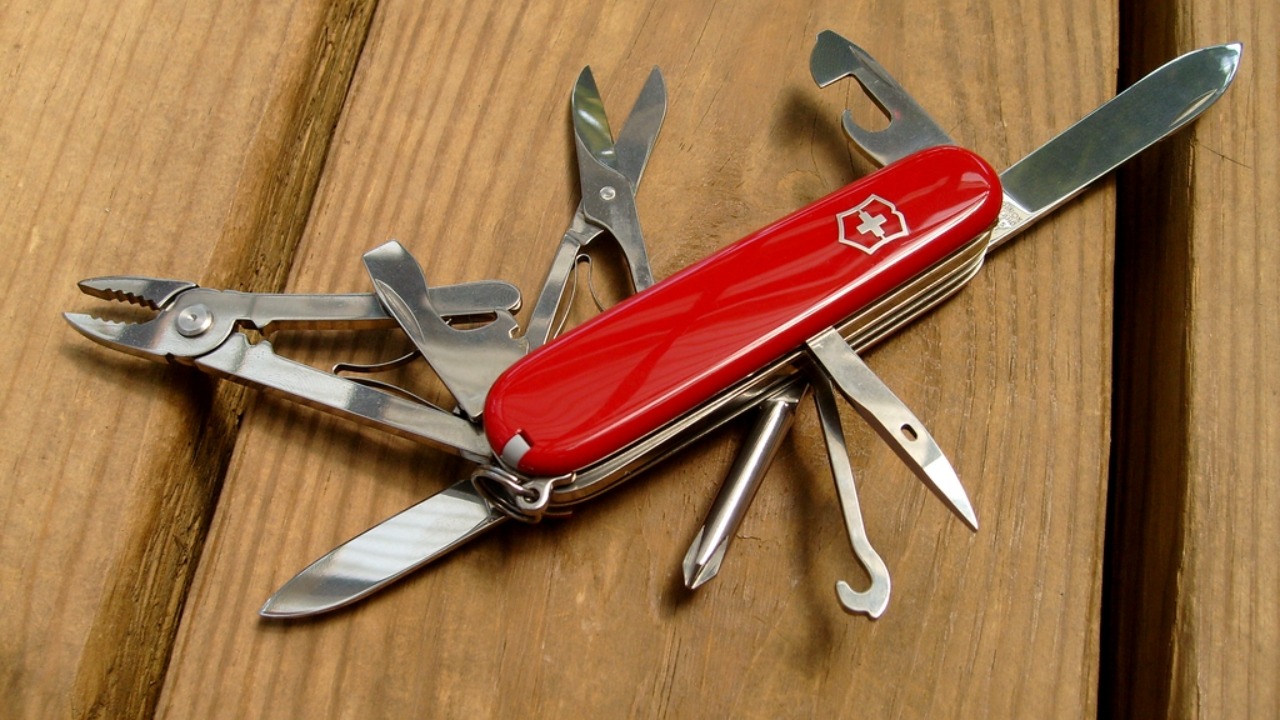
Swiss Army knives are shrinking, shedding blades and bottle openers in favor of a leaner set of tools that can actually be carried in modern cities. Instead of dampening enthusiasm, this shift toward stripped-back designs is igniting a new wave of obsession among collectors and everyday carriers who see focus, legality, and design clarity as the next evolution of the classic pocket tool.
The result is a quiet but significant redesign of one of the world’s most recognizable objects, driven by changing laws, urban life, and a surprising appetite for minimalism. Fans are not just tolerating the changes; they are debating every new variant and limited color as closely as watch collectors track reference numbers.
From battlefield icon to urban accessory
The Swiss Army Knife began life as a compact toolkit for soldiers, but it now lives in office drawers, commuter backpacks, and school pencil cases. That shift from field to city has exposed a tension between the knife’s traditional blade and the rules that govern crowded public spaces. The manufacturer, Victorinox, has acknowledged that in some markets the blade itself has become a liability, with Victorinox CEO Carl Elsener noting that in certain places the cutting edge creates an image of a weapon rather than a tool, which has prompted the company to rethink what a pocket companion should look like in daily life, as reflected in his comments reported in an interview with Carl Elsener, CEO, Victorinox.
That rethink is not happening in a vacuum. Victorinox has already confirmed that it is developing a new range of models without blades at all, a radical step for a product defined in popular culture by the very word “knife.” In an interview with Swiss outlet Blick, Victorinox CEO Carl Elsener cited a rise in legislation that bans or regulates carrying knives in public, and said that this trend is the reason the company has decided to develop models without a blade, as detailed in the article. The move signals that the Swiss Army Knife is being redesigned first and foremost as an urban accessory that must pass through metal detectors, school gates, and stadium security without incident.
Bladeless by design, not by compromise
What might sound like a compromise, a Swiss Army Knife without a knife, is being framed by Victorinox as a deliberate design choice rather than a reluctant concession. The company has explained that in some markets the blade is seen as a dangerous object, while tools like screwdrivers, scissors, or a sewing awl are still welcome, a distinction highlighted in coverage of why some Swiss Army models are going bladeless. By focusing on non-cutting implements, Victorinox can offer a multi-tool that still tightens glasses, opens packages, and fixes loose screws, but is less likely to be confiscated at a security checkpoint.
Regulators are not the only force shaping this new generation. In the city, however, when you go to school, to the cinema, or to go shopping, carrying pocketknives is severely restricted, as Elsener has observed in comments cited in In the. That reality has created a clear brief for designers, who are now sketching tools that can live on a keyring or in a handbag without triggering school rules or workplace policies. A bladeless Swiss Army Knife becomes less a compromise and more a passport, a way to keep a familiar object close in environments that have grown wary of anything sharp.
Minimalism, hidden tricks, and the thrill of focus
The appeal of these pared-back tools is not only legal, but it is also aesthetic and emotional. Enthusiasts who once chased the largest Swisschamp models, packed with layers of tools, are now celebrating the elegance of a slimmer profile that does a few jobs very well. The fascination with subtle functionality is not new, as shown by long time owners who still discover hidden features such as the tiny pin tucked behind the corkscrew on some models, a detail that surfaced when one user admitted that, after 10 years of ownership and watching a geek video, they finally noticed the rare pin behind the corkscrew on their After Swiss Army Knife. That kind of discovery rewards attention and reinforces the idea that less visible, more thoughtful design is part of the brand’s charm.
Bladeless and simplified models tap into the same instinct. Instead of a crowded stack of tools, fans are now comparing which configuration of scissors, file, screwdriver, and hook best fits their daily routine, a conversation that has become a staple of the everyday carry, or EDC, community. Video reviewers have asked whether one can still call it a Swiss Army knife if it does not have a blade, while showcasing bladeless Vtorox setups that focus on office-friendly tools, as seen in EDC discussions of Vtorox Swiss Army gear. The debate itself is part of the attraction, turning each stripped-back model into a statement about how its owner actually lives and works.
Color, collectability, and a future beyond tariffs
Even as Victorinox trims tool sets, it is doubling down on visual identity and collectability. The company’s official site highlights a wide range of product lines, from classic red cellidor scales to textured metal Alox finishes, underscoring how much of the modern appeal lies in color and feel as much as function, a trend visible across the Victorinox catalog. Limited runs have become a key part of that strategy, with the Victorinox Glacial Blue 2026 Limited Edition Swiss Army Knives Have Arrived collection presenting a cool, icy shade that is marketed as evoking calm, focus, and strength, according to descriptions of the Victorinox Glacial Blue Alox Swiss Army Knif series. Collectors have responded enthusiastically, with early buyers remarking that they got the new 2026 Limited Edition knives and that they like the color more than expected, calling it a pretty nice shade of blue, as reflected in community reactions summarized in Got the Limited Edition Gotta discussions.