
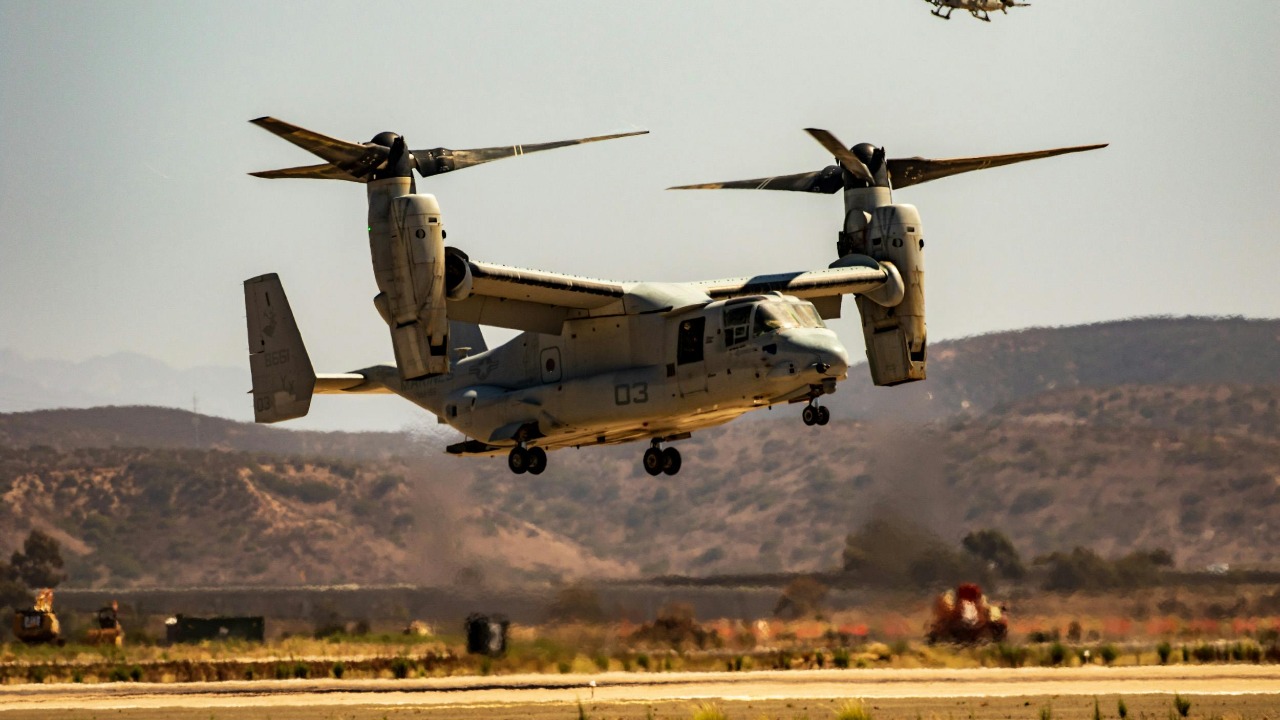
The Bell Boeing V-22 Osprey was built to do something no other production aircraft had done before: take off and land like a helicopter, then fly like a turboprop airplane. That hybrid promise has made it a centerpiece of U.S. military operations and, at the same time, one of the most scrutinized programs in modern defense aviation. Its tilt-rotor technology delivers speed and range that conventional helicopters cannot match, but the same complexity that enables those feats has fueled safety questions, high costs, and a long-running debate over whether the tradeoffs are worth it.
Understanding why the Osprey inspires such strong views starts with how it works. The aircraft’s rotating engine nacelles, interconnected drive systems, and fly-by-wire controls create a machine that behaves like two very different aircraft in one airframe, with unique aerodynamic risks and maintenance burdens. Those design choices, and the record of mishaps and mechanical issues that followed, explain why the V-22 is praised by many pilots yet remains controversial among critics and lawmakers.
How tilt-rotor technology lets the Osprey fly like two aircraft in one
At the heart of the Osprey is tilt-rotor technology, which allows its two massive nacelles to rotate from vertical to horizontal, shifting the aircraft from helicopter-style lift to airplane-style thrust. In vertical flight, the nacelles point upward and the three-bladed proprotors act like helicopter rotors, generating lift directly above the aircraft so it can hover, take off, and land in tight spaces. As the nacelles tilt forward, a fly-by-wire system gradually transfers the lifting role from the rotors to the fixed wing, until in full forward flight the nacelles are horizontal and the rotors behave like propellers while the wings carry most of the load, a configuration described in technical overviews of Design and in explanations of how the Osprey Plane Works. This transition is managed electronically rather than through direct mechanical linkages from the pilot, which allows precise control but adds layers of software and sensors that must all function correctly.
Several features distinguish this layout from a traditional helicopter. Because the Osprey’s rotors spin in opposite directions, they cancel each other’s torque, eliminating the need for a tail rotor that would otherwise counteract the twisting force of a single main rotor. The engines are tied together by an interconnecting driveshaft so that if one engine fails, the remaining engine can power both proprotors, a redundancy highlighted in descriptions of how The Osprey is engineered and in official material on the The CV variant. This architecture lets the aircraft keep flying after certain failures, but it also concentrates enormous power through complex gearboxes and shafts, which must withstand high loads in every flight mode.
What the Osprey can do that helicopters and planes cannot
The payoff for that complexity is a set of performance numbers that sit between a helicopter and a fixed-wing transport, and in some cases exceed both. In helicopter mode, the Osprey can lift off vertically from small clearings, ship decks, or improvised landing zones, then transition to airplane mode to cruise at higher speeds and longer ranges than conventional rotorcraft. Technical explainers on How the aircraft works and official descriptions of the Osprey emphasize that this combination gives commanders options that neither a pure helicopter nor a standard cargo plane can offer, particularly when distance and speed are critical.
Those advantages are most visible in special operations and long-range assault missions, where the CV-22 and other variants can insert forces from far offshore or from bases outside hostile air defense envelopes. The Osprey is described as combining vertical takeoff, hover, and vertical landing with the speed and range of a turboprop, a niche that has made it central to missions that demand both stealthy approaches and rapid exfiltration. Manufacturer material underscores that the aircraft is Unlike any other platform in service, a claim that reflects how few alternatives exist when forces need to move quickly over hundreds of miles and still land on a patch of dirt or the deck of a small ship.
Engineering complexity and the maintenance burden behind the controversy

The same engineering that makes the Osprey so capable also makes it difficult and expensive to keep flying. Each nacelle houses a turboshaft engine, a large proprotor, and a complex gearbox that must operate smoothly in both vertical and horizontal orientations, while the interconnecting driveshaft and high-pressure hydraulics run through the wing. Analysts who have examined the program note that the aircraft’s massive rotors, intricate gear trains, and redundant systems add weight and cost, creating a cycle where solving one engineering challenge can introduce new ones. That pattern is reflected in reporting that describes how Critics have long argued the Osprey is expensive to maintain and that its operational readiness has lagged behind more conventional helicopters.
Maintenance data cited in congressional and oversight reviews reinforce that picture. A detailed background report for lawmakers notes that a significant share of sustainment spending is tied to the nacelles and related systems, with a section on Nacelles explaining that large portions of maintenance hours and costs are spent on nacelle work. That focus reflects how the tilt-rotor mechanism, which is unique to the V-22, has become a recurring driver of downtime. The result is an aircraft that can deliver exceptional performance when available, but that demands intensive support, specialized parts, and highly trained maintainers to keep its complex systems within safe operating limits.
Safety record, mishaps, and why pilots still defend the aircraft
No aspect of the Osprey’s story has drawn more scrutiny than its safety record. A comprehensive investigation into mishaps involving the aircraft reported that Since the military began flying the V-22, 64 personnel have been killed and 93 injured in crashes and other incidents. A separate report prepared for Congress states that, As of July 2025, 65 m military personnel and civilians have died in mishaps involving V-22 aircraft, a figure that includes both training and operational accidents. These numbers have fueled public concern and prompted multiple investigations into whether the aircraft’s design, maintenance practices, or training pipelines are contributing to an elevated risk profile.
Investigations have identified several recurring technical and aerodynamic issues. Reports describe problems with the vertical engine and clutch assemblies, including cases where a clutch slipped and caused a sudden power transfer that damaged components and, in one instance, left a fuselage “opened like a sardine can,” as recounted in a detailed narrative of Osprey safety issues. Aerodynamic challenges such as Vortex Ring State, a dangerous loss of lift that can occur in certain descent profiles, have also been highlighted in technical discussions of tilt-rotor flight. Yet current and former pilots, including some who have survived crashes or lost colleagues, continue to argue that when flown within its envelope and properly maintained, the aircraft is safe and uniquely capable, a tension that keeps the safety debate active even as design fixes and new procedures are implemented.
Politics, perception, and the “most controversial” label
Beyond engineering and accident statistics, the Osprey has become a symbol in broader debates over military procurement, risk tolerance, and institutional culture. The aircraft’s long and costly development, coupled with its high-profile mishaps, has led some observers to label it “the most controversial” program of its kind, a characterization echoed in assessments that ask whether the Osprey deserves its reputation. Critics point to the combination of high acquisition and sustainment costs, lower readiness compared to traditional helicopters, and the human toll of accidents as evidence that the program reflects flawed priorities.
At the same time, some analysts argue that the Osprey’s image has been shaped by what they describe as groupthink, where early accidents and program troubles hardened into a narrative that has been slow to adjust as the aircraft matured. One commentary on Feb groupthink contends that a problematic or premature consensus, sometimes driven by particular agendas, can overshadow more nuanced assessments of risk and performance. Congressional oversight has tried to cut through those perceptions. Reports to lawmakers note that The House Committee on Government Oversight has investigated the V-22 program, pressed for design changes, and monitored the implementation of new operating procedures, signaling that the controversy is not just about public opinion but about how institutions manage complex, high-risk technology.
Why the debate over the Osprey is unlikely to fade
Even as design fixes, training updates, and maintenance reforms accumulate, the Osprey’s core tradeoff remains: it delivers capabilities that commanders value, at the cost of complexity that is difficult to simplify away. The aircraft’s ability to launch vertically, cruise at airplane-like speeds, and cover long distances without a runway has made it central to missions that range from special operations to long-range assault and humanitarian response. Official descriptions of the Osprey and manufacturer material that describe it as Unlike any other aircraft underscore how deeply it is woven into current force planning.
That reliance ensures that questions about safety, cost, and design will continue to matter. As oversight bodies revisit accident data and maintenance trends, and as pilots log more hours in real-world operations, the record will either reinforce or soften the aircraft’s controversial status. For now, the V-22 Osprey stands as both a proof of concept for tilt-rotor technology and a case study in the risks of pushing aviation design into new territory, where the line between breakthrough and vulnerability is measured in nacelle angles, gearbox tolerances, and the judgment of the crews who fly it.