
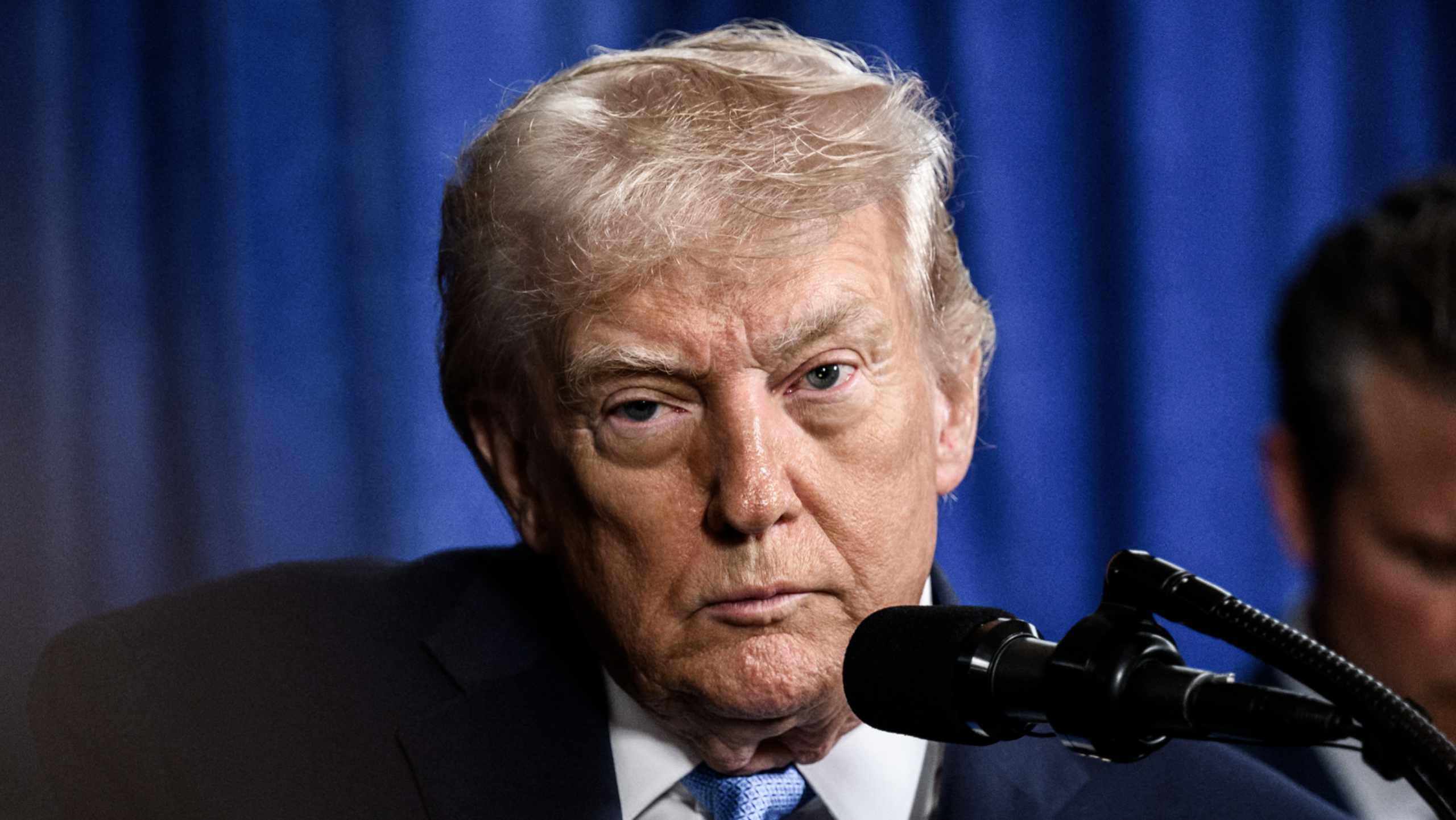
President Donald Trump issued a blunt military warning to Oman during a cabinet meeting at the White House on Wednesday, May 27, declaring that no nation — including U.S.-aligned Gulf states — will be permitted to exert control over the Strait of Hormuz, one of the world’s most critical shipping corridors, and that Oman would face destruction if it failed to comply.
The remarks came in response to a reporter’s question about whether Trump would consider a short-term arrangement allowing Iran and Oman to jointly manage the strait as part of ongoing nuclear negotiations with Tehran. Trump rejected the proposal outright, offering some of his most direct language yet regarding the administration’s position on freedom of navigation in the Persian Gulf.
“No, the strait’s going to be open to everybody,” Trump said. “And international waters. Nobody’s going to control it. We’re going to watch over it. We’ll watch over it, but nobody’s going to control it.”
Trump acknowledged that Iranian control of the Strait of Hormuz is among the demands Tehran has put forward during negotiations, but made clear the United States considers the issue non-negotiable. “That’s part of the negotiation that we have, they would like to control it,” he said. “Nobody’s going to control it.”
He then turned his attention specifically to Oman, a Gulf monarchy that has historically served as a quiet diplomatic back channel between Washington and Tehran, and issued a stark ultimatum. “Oman will behave just like everybody else, or we’ll have to blow them up,” Trump said, before adding, “They understand that. They’ll be fine.”
The Strait of Hormuz is one of the most strategically significant waterways in the world. Located between Oman and Iran, it is the only sea passage from the Persian Gulf to the open ocean and serves as the transit point for roughly 20 percent of global oil trade. Any disruption to shipping through the strait has immediate consequences for global energy markets, a fact Trump acknowledged at the meeting.
Trump sought to contextualize the economic stakes for the United States itself, arguing that American energy dominance insulated the country from the worst effects of a prolonged closure. “The United States has so much oil that we are an exporter of oil, so we have plenty of oil,” he said. “We’re very lucky. We’re blessed with the greatest piece of land in the world from that standpoint.”
He added that the United States currently produces more than double the combined oil output of Russia and Saudi Arabia — a figure he called “a great stat” — and suggested that the addition of Venezuelan oil to America’s energy portfolio had strengthened that position considerably. Trump said he believed the country now controls roughly 64 percent of the world’s accessible oil when Venezuela is factored in.
Despite Trump’s claims of energy independence, he acknowledged that American consumers are currently feeling the effects of the strait’s restricted status, noting gasoline prices of around $4.45 per gallon nationally. He expressed confidence that prices would fall sharply once the conflict with Iran concluded, and suggested they could return to levels seen during his first term, when some gas stations posted prices below $2 per gallon.
The warning to Oman marks a notable moment in American foreign policy. Oman has long maintained cordial relationships with both the United States and Iran and has served as a trusted intermediary in sensitive diplomatic exchanges going back decades, including early back-channel talks that eventually led to the 2015 Iran nuclear agreement. The country is not a party to the current military conflict between the U.S. and Iran.
Trump did not elaborate on the specific scenario under which a military strike against Oman would become warranted, nor did he detail what Oman would need to do — or refrain from doing — to remain in good standing with Washington. His follow-up remark that “they understand” and “they’ll be fine” appeared intended to frame the statement as a warning rather than a declaration of imminent action.
The Strait of Hormuz has emerged as a central flashpoint in the broader standoff with Iran. With an estimated 1,400 to 1,500 vessels currently held up in the strait, according to Trump’s own description, the administration is navigating significant international pressure to restore commercial shipping access while simultaneously pursuing what it describes as comprehensive nuclear concessions from Tehran.
Trump reiterated throughout the cabinet meeting that the primary driver of U.S. urgency is not economic but existential — specifically, preventing Iran from acquiring a nuclear weapon. “Regardless of anything,” he said, “as Marco said, better than anybody can say, you can’t let them have a nuclear weapon. They would use it instantly. They wouldn’t think about it.”
The administration indicated that diplomatic negotiations with Iran are ongoing through envoys Steve Witkoff and Jared Kushner, and that a deal remains possible. But Trump made clear that military options remain fully on the table if talks fail to produce the outcome Washington is demanding.