
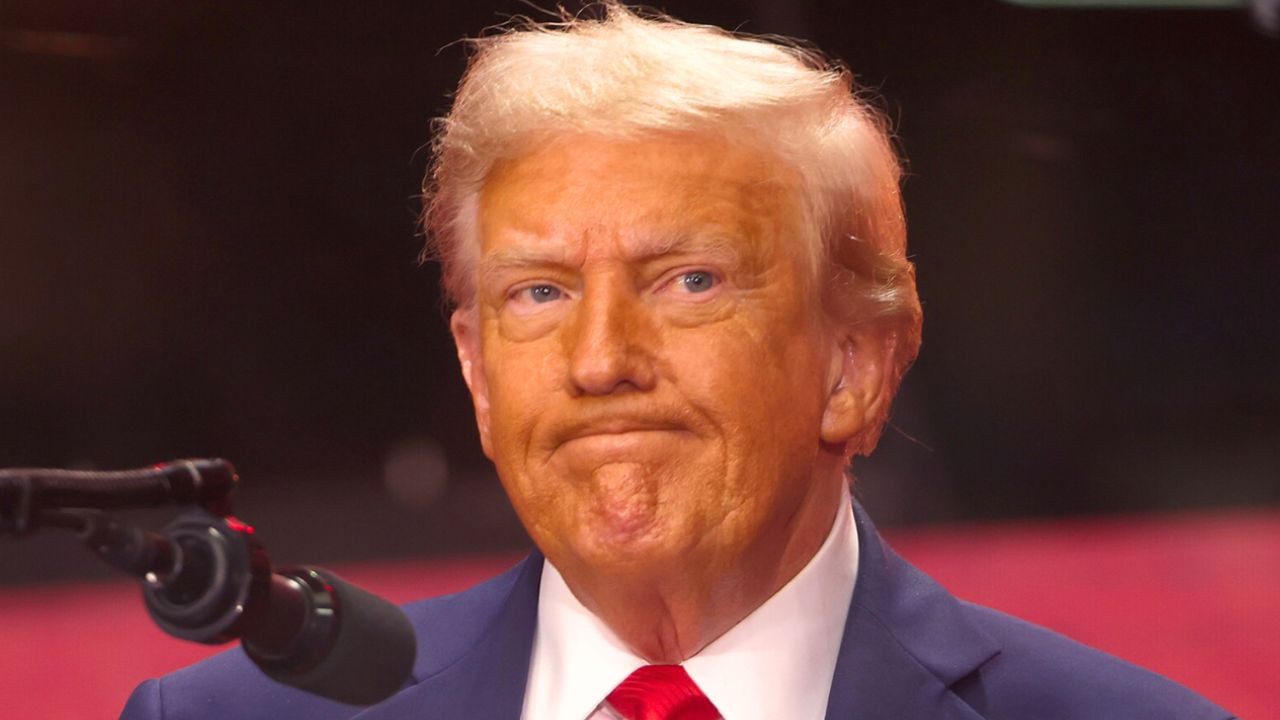
President Donald Trump told reporters Wednesday that the war between the United States and Iran will conclude “immediately” after the November midterm elections, the latest in a series of timelines the president has offered since launching the conflict more than six months ago — none of which have held.
Speaking ahead of a midterm convention rally in Dallas, Trump was asked about the prospects for renewed negotiations with Tehran. He answered by returning to a familiar refrain. “This war will end immediately after our election,” he told reporters. Moments later, discussing Iran’s posture more broadly, he added: “I think the war is going to end immediately after the election. I think the war will end immediately after the election because they can’t hold out any longer.”
Trump attributed Iran’s strategy to domestic U.S. politics, arguing Tehran is waiting for a shift in Congress. “They’re desperate to try and affect the election so that we can get a nice weak group of people in there and leave them alone and let them have their nuclear weapon,” he said.
The prediction is the latest checkpoint in a timeline that has shifted repeatedly since the war’s Feb. 28, 2026, start. Trump initially told the public the conflict, launched jointly with Israel under the name Operation Epic Fury, would last only “four to five” weeks. By late July, with the war having passed the 100-day mark, that original estimate had been left far behind, and the public still had no reliable sense of when the fighting might actually end.
An initial ceasefire, reached April 7-8 with Pakistani mediation, was extended indefinitely by Trump on April 21 after the two sides failed to finalize a lasting agreement. Fighting nonetheless continued intermittently through the following weeks, driven largely by disputes over access to the Strait of Hormuz.
In June, Trump again suggested a resolution was close, telling reporters after an NBA Finals appearance that a deal could be reached within “two or three days” and calling the emerging agreement “very, very good.” A White House official told CNBC at the time that Iran was “desperate to make a deal” because of the success of U.S. military and economic pressure campaigns. That characterization came even as Israeli Prime Minister Benjamin Netanyahu said the broader war against Iran and its proxies “has not yet ended,” and had left both sides weaker but unresolved.
A memorandum of understanding was ultimately signed by the two countries’ presidents on June 17, intended to formally end the war within 60 days and reopen the Strait of Hormuz to shipping. No firm deadline was attached to a related ceasefire extension, and subsequent proposals from both sides to end the war were rejected in the weeks that followed.
The agreement broke down entirely by July 8, after Iran struck commercial vessels transiting the strait in what it described as an assertion of sovereignty over the waterway — an action that surprised U.S. officials and reignited direct strikes between the two countries.
Reporting on the war’s trajectory has periodically noted the gap between Trump’s public predictions and the conflict’s actual course. A CNBC report from June, published the same week Trump predicted a deal within days, noted that “Trump has previously promised an imminent resolution to the conflict, only for hostilities to resume later.”
Despite the war’s repeated setbacks, Trump’s characterization of Iran’s position has remained consistent: that Tehran is economically and militarily exhausted and simply waiting for a more favorable political environment in Washington. Wednesday’s IAEA referral to the U.N. Security Council — the first in 20 years — added a new diplomatic front to the standoff, even as the council’s ability to act is limited by Russia and China’s veto power as permanent members.
Separately, Pakistani mediators said in late August that talks toward reviving the collapsed memorandum of understanding were showing “significant progress,” even as the U.S. Treasury moved to tighten financial restrictions aimed at further isolating Iran’s economy.
With the midterm elections roughly two months away, Trump’s Wednesday comments set a fourth informal deadline for the war’s conclusion since February — one that, like the three that preceded it, remains unverified and contingent on developments neither side fully controls.