
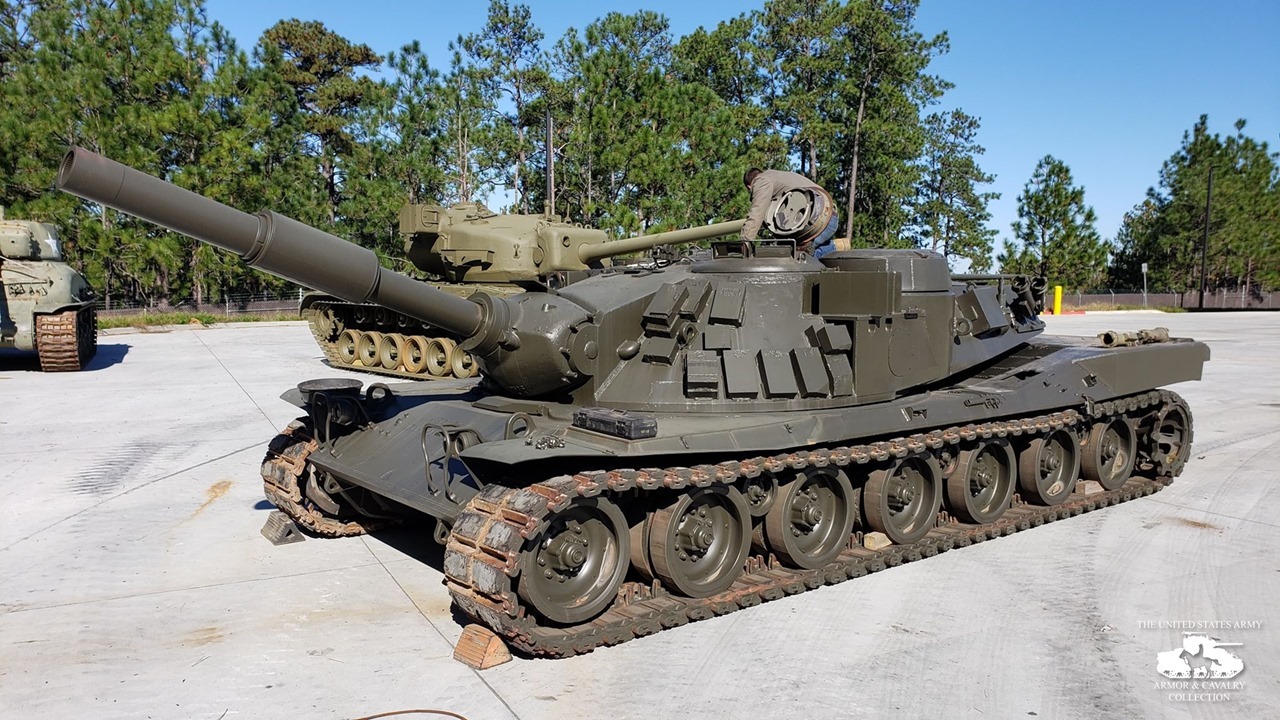
The MBT-70 was conceived as a tank that could leap a generation ahead of Soviet armor, compressing a decade of innovation into a single, radical machine. Instead, it became a case study in how ambition, politics, and technology can collide, producing a vehicle that reshaped future designs even as it failed to reach the battlefield.
Decades later, the project still looms large over armored warfare, both as a warning about overreach and as a quiet architect of the M1 Abrams and Leopard 2. The story of this experimental main battle tank is less about a single “flop” and more about how a bold idea can be too advanced for its own era, yet still define what comes next.
From Cold War urgency to a joint super-tank gamble
The MBT-70 emerged from a moment when the United States and West Germany feared that standing still meant falling behind the Warsaw Pact. Rather than field separate incremental upgrades, the two countries agreed to build a shared main battle tank that would vault past existing designs in one move, a joint effort that formalized the partnership between the United States and West Germany. The project, known as MBT-70, was intended to replace aging fleets on both sides of the Atlantic and to set a new standard for NATO armor.
On paper, the concept promised a leap in survivability, firepower, and mobility that would outclass Soviet tanks for years. The joint program was framed as a way to share costs and harmonize logistics, but it also meant reconciling different engineering cultures, from metric versus imperial measurements to competing ideas about guns, engines, and armor. As later assessments of the MBT, The Tank Nightmare the Army Never Saw Coming make clear, those early compromises planted the seeds for a classic procurement headache that would only grow as the prototype evolved.
Radical design: a tank packed with tomorrow’s technology
What set the MBT-70 apart was not one headline feature but the decision to pack almost every cutting-edge idea of the 1960s into a single hull. The tank used a hydropneumatic suspension that could “kneel,” lowering its profile to roughly 1.8 m for a hull-down firing position or raising it for higher speed and better cross-country performance, a capability that made it look more like a science-fiction vehicle than a conventional Cold War design. The entire three-man crew sat in the turret rather than the hull, supported by an automatic loader that eliminated the traditional fourth crew member and helped keep the silhouette low, a configuration that contemporary descriptions of the MBT-70 still highlight as revolutionary.
Firepower was equally ambitious. Instead of a standard smoothbore gun, the designers chose a 152 m XM150 gun-launcher that could fire both conventional shells and the MGM-51 Shillelagh anti-tank guided missile, promising engagement ranges far beyond typical tank duels. Yet the same sources that praise this innovation also note that, Though the 152 m system looked like an advantage on paper, its specialized ammunition and complex handling created new problems. Layered on top of this were early forms of spaced armor, robust nuclear, biological, and chemical protection, a remote 20 mm autocannon that could retract into the turret, and advanced fire control with a laser rangefinder, all of which made the MBT-70 feel less like a contemporary of the M60 and more like a preview of the Abrams era.
When innovation becomes a liability
The same features that made the MBT-70 dazzling in concept also made it fragile in practice. The caseless ammunition for the 152 m gun was vulnerable to moisture and heat, which could cause swelling, jams, or even dangerous cook-offs inside the turret. The rotating driver’s station, designed so the driver always faced forward as the turret turned, left test crews disoriented and nauseated, a problem that later accounts of the MBT, The Brilliant Tank That Failed describe as a vivid example of technology outpacing human factors. Even the retractable 20 mm autocannon, meant to give the tank a flexible anti-air and anti-vehicle option, proved overly complex and difficult to operate under stress.
Cost magnified every technical flaw. As engineers wrestled with the hydropneumatic suspension, exotic armor, and missile-firing gun, the unit price ballooned from early expectations to more than five times the original estimate, climbing from roughly $200,000 to over $1 million per tank in 1960s dollars. Political patience eroded as each new test exposed another subsystem that needed redesign or replacement, and later retrospectives on Why the Military Super MBT Tank Failed point to these spiraling costs and unresolved engineering risks as the decisive factors that turned a visionary prototype into a budgetary cautionary tale.
Transatlantic friction and the politics of failure
Technical risk was only half the story. The joint nature of the program meant that every design choice became a negotiation between American and German priorities, and those priorities often diverged. German engineers favored a conventional 120 mm gun and a diesel engine, while their U.S. counterparts pushed for the 152 m gun-launcher and, in some concepts, a gas turbine, a clash that mirrored broader debates about doctrine and logistics. Even basic engineering standards became contentious, with metric and imperial measurements complicating shared production, a dynamic that later analysis of the American German MBT program highlights as a surprisingly stubborn barrier.
As disagreements piled up, so did the weight of the vehicle, which eventually exceeded 50 tons and strained German infrastructure and transport limits. West Germany ultimately walked away from the joint effort, leaving the United States to decide whether to salvage the design or cut its losses. Accounts of the The MBT Tank Flop Army Never Could Have Predicted describe how, even as some technology was considered cutting-edge, the political optics of a runaway binational project became untenable. Congress eventually canceled the program, and later reviews of the same Flop, Army Never Could Have Predicted underscore how technical setbacks and alliance friction combined to make termination the only politically viable choice.
The legacy that built the Abrams era
For all its problems, the MBT-70 did not simply vanish into the archives. Many of its core ideas, from advanced suspension and armor concepts to sophisticated fire control, migrated into the next generation of Western tanks. The M1 Abrams, developed after Congress killed the joint project, was explicitly shaped by lessons learned from the failed prototype, a connection that modern overviews of how the Abrams MBT replaced the canceled program make clear. German designers followed a similar path with the Leopard 2, adopting more conservative gun and engine choices while still drawing on the research base created by the joint effort.
In that sense, the MBT-70 functioned as an expensive, full-scale laboratory. Its XM150 gun-launcher, advanced sensors, and armor experiments informed later decisions about what to keep, what to modify, and what to abandon, shaping the Abrams and its peers even when specific components were dropped. Analysts who revisit the Changed Everything argument note that some of the most influential defense projects are those that never enter service, because they force militaries to confront the limits of technology, doctrine, and coalition politics in real time.
A failed tank that still shapes modern battlefields
Seen from today’s battlefields, where M1 Abrams and Leopard 2 tanks continue to define Western armored power, the MBT-70 looks less like a dead end and more like a rough draft. Its attempt to combine missiles and gunfire in a single main armament, to automate loading, and to protect a compact crew inside a heavily shielded turret all anticipated trends that are now standard in high-end armor. Later commentary on the future U.S. and allied tanks emphasizes that the program’s failures directly informed how designers balanced ambition and practicality in subsequent generations.
The MBT-70 also left a quieter legacy in how militaries manage joint programs and technological risk. Its story is now used as a reference point when planners debate whether to field incremental upgrades or chase a single transformational platform, and when allies weigh the trade-offs of shared development against national control. As later reflections on the Summary and Key Points of the program argue, the tank that never entered service still helped create the blueprint for modern Western armor. The MBT-70 was too advanced, too complex, and too politically fraught to survive, yet its DNA runs through the vehicles that did, shaping how armored warfare looks in the twenty-first century.