
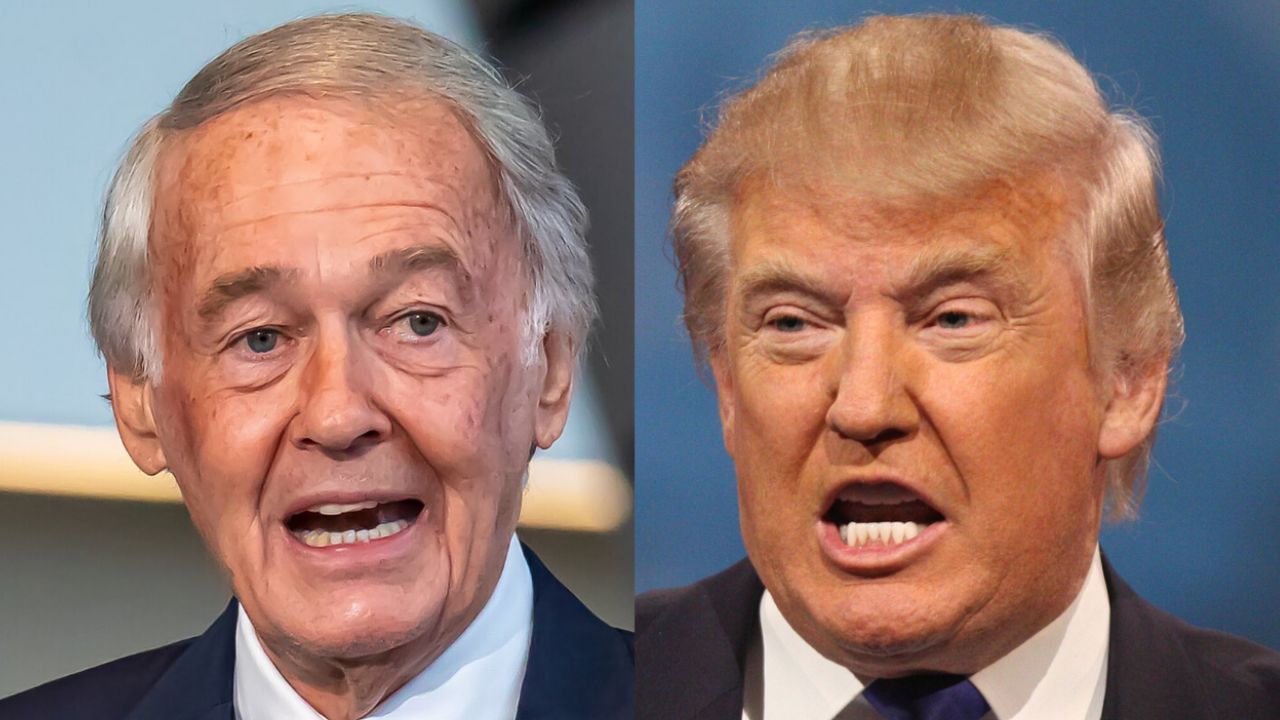
U.S. Senator Ed Markey (D-Mass.) on Friday accused President Donald Trump of driving diesel fuel prices to a historic $6 a gallon through what he called an “illegal and chaotic war in Iran,” warning that the surging cost of fuel is now rippling into grocery bills and household budgets across the country. Markey’s statement, posted to X on the morning of September 11, 2026, came hours after national fuel-tracking data confirmed that the average price of diesel in the United States had broken $6 a gallon for the first time in the nation’s history.
The Full Statement
Markey’s post, published to his official X account at 10:11 a.m. on September 11, 2026, read in full:
“Thanks to Trump’s illegal and chaotic war in Iran, diesel prices are now over $6 a gallon. Higher diesel costs mean higher prices for groceries and everyday essentials that fuel daily life. Americans should not have to pay for this reckless war at the pump and in their bills.”
Diesel Crosses $6 a Gallon for the First Time in U.S. History
Markey’s post landed the same day that motor club AAA confirmed the national average price of diesel had reached $6.05 to $6.06 a gallon, a level never before recorded in the United States. The national average of $6.05 was up from $5.85 the previous week and $3.70 at this time last year, according to AAA. The new figure marked a 14 percent increase over the average price one month earlier and a 64 percent increase from the average price one year earlier.
Diesel prices are now significantly higher than they were before the United States and Israel launched their war against Iran in late February, when the national average sat at about $3.76 per gallon, according to AAA. Prices climbed as the cost of crude oil, the main ingredient in refined fuels including diesel and gasoline, soared amid supply chain disruptions across the Middle East, with tanker traffic bottlenecked in the Strait of Hormuz. Brent crude, the international benchmark, was trading above $105 a barrel on Friday, up from roughly $70 a barrel before the war began.
Gasoline prices have climbed alongside diesel, though not as steeply. The national average for a gallon of regular unleaded gasoline stood at $4.29 on Friday, up from $2.98 before the Iran war began, though still below the 2022 peak of nearly $5.02 a gallon.
Why Diesel Prices Matter for Everyday Costs
Economists have pointed to diesel’s outsized role in the broader economy as the reason its price increases translate so directly into higher costs for ordinary Americans. KPMG chief economist Diane Swonk said “the cost of diesel gets into just about everything,” from running a farm to the cost of food and everything shipped across the economy.
Analysts have also flagged the strain the war has placed on refining capacity and global shipping. Helima Croft, head of global commodity strategy at RBC Capital Markets, said rising diesel prices pose an “enormous challenge” for the Trump administration, noting that U.S. refineries are running at 98 percent utilization with no spare capacity.
The disruption to global shipping has been especially acute in the waters surrounding the Middle East. Earnings for supertankers traveling from the Middle East to China reached a record $759,969 per day in September, while the cost of shipping crude from the U.S. Gulf Coast to China hit a record $29.5 million per voyage on September 4, according to S&P Global. Tanker traffic through the Strait of Hormuz has slowed to a 10-day moving average of just 10 commodity ships per day, down from roughly 125 to 140 daily transits before the war.
Petroleum analyst Patrick De Haan reported that the increase has shown no signs of slowing, and projected the daily economic toll would continue to mount. De Haan projected Americans will collectively spend $711 million more on gasoline and diesel on Friday than they did a year earlier, warning that the figure “could soon be $1 billion per day”.
A Pattern of Warnings From Markey Since the War Began
Friday’s post is the latest in a monthslong series of statements in which Markey has tied rising fuel costs directly to the war in Iran, which began in late February 2026. In March, after voting for a war powers resolution introduced by Senator Chris Murphy that failed 47-53, Markey said, “As Trump prepares to send more troops to the Middle East, the costs of Trump’s illegal war will only grow in number and severity, with the cost to human life, the cost to American and Middle East security and stability, and the cost of oil and gasoline. This war is an ever-expanding quagmire with no clear exit that is only making us less safe. We must end this war now.”
In April, after a separate war powers resolution introduced by Senator Tammy Duckworth also failed, Markey said, “Trump’s war of choice in Iran is a moral tragedy and economic disaster playing out before our eyes. It is only making the United States and the world less safe.” He added, “The United States and Iran are blockading the Strait of Hormuz—crippling the global economy and sending energy prices sky high,” noting at the time that gas prices were $1.20 a gallon higher than before the war began.
A week later, following a fifth failed war powers vote on a resolution from Senator Tammy Baldwin, Markey said, “Trump’s war of choice on Iran is proving to be a wasteful, unjust, and useless mission as negotiations and the ceasefire remain fragile. Congress never authorized this war, and now we are dealing with the consequences of Trump’s recklessness. Thirteen U.S. service members have died and over five thousand civilians have been killed in the region, gas prices have skyrocketed, and we are all less safe than before the war started.”
Oversight Letters and Legislation on Fuel Costs
Beyond his floor statements, Markey has used his role as Ranking Member on the Senate Committee on Small Business and Entrepreneurship to press federal agencies for data on the war’s economic toll. In March, he sent a letter to the acting commissioner of the Bureau of Labor Statistics demanding “full transparency about the economic costs of Trump’s illegal war with Iran and how the war will harm American consumers,” citing gas prices that had already risen 20 cents a gallon in Massachusetts in the war’s first week.
In May, as the national average for regular gasoline surged past $4.50 a gallon, Markey sent a letter to Federal Trade Commission Chairman Andrew Ferguson demanding an investigation into oil and gas companies for price gouging, arguing that families and small businesses were being squeezed by “Trump’s tariff taxes, surging electricity prices, and skyrocketing” costs on top of war-driven fuel prices.
In June, with gas prices still elevated, Markey introduced the Gas Money Saved Act, legislation that would direct the Department of Transportation to examine strengthening fuel-economy standards and reinstate penalties on automakers that fail to produce efficient vehicles. “Fuel economy standards help American drivers get around without breaking the bank while gas prices are high, but Trump and the Republicans gutted these standards as part of their crusade to put Big Oil above American families,” Markey said at the time. “Auto innovation should give consumers better choices, not cut corners at their expense.”
Broader Political Reaction
Markey is not alone among Democrats in linking Friday’s record diesel price to the war. The official social media account for House Democrats responded to the news by warning of “higher delivery prices, more expensive groceries, and surging electric bills,” writing that “Trump’s war with Iran did this.” Alex Jacquez, senior vice president of policy, advocacy, and research at Groundwork Collaborative, separately criticized the administration’s recent imposition of additional tariffs.
Context Heading Into the Midterms
The record diesel price arrives less than two months before the November midterm elections, in which fuel and grocery costs have become a central point of contention between the two parties. The milestone adds pressure on farming, freight and home heating ahead of elections that Trump has been working to win. For his part, Trump has acknowledged the political and economic weight of the moment. For more than six months, Trump insisted the Iran war would be short, but this week he conceded that high gas prices are not likely to come down anytime soon.
Some analysts have noted that, adjusted for inflation, diesel prices have been higher in past crises. Ahead of the 2008 financial crisis, diesel hit about $4.74 a gallon, equivalent to roughly $7.20 in 2026 dollars, and 2022’s record of nearly $5.82 a gallon would be about $6.56 today when accounting for inflation. That historical context has done little to soften the political fallout, as the nominal price has never been higher and continues to climb heading into the fall campaign season.