
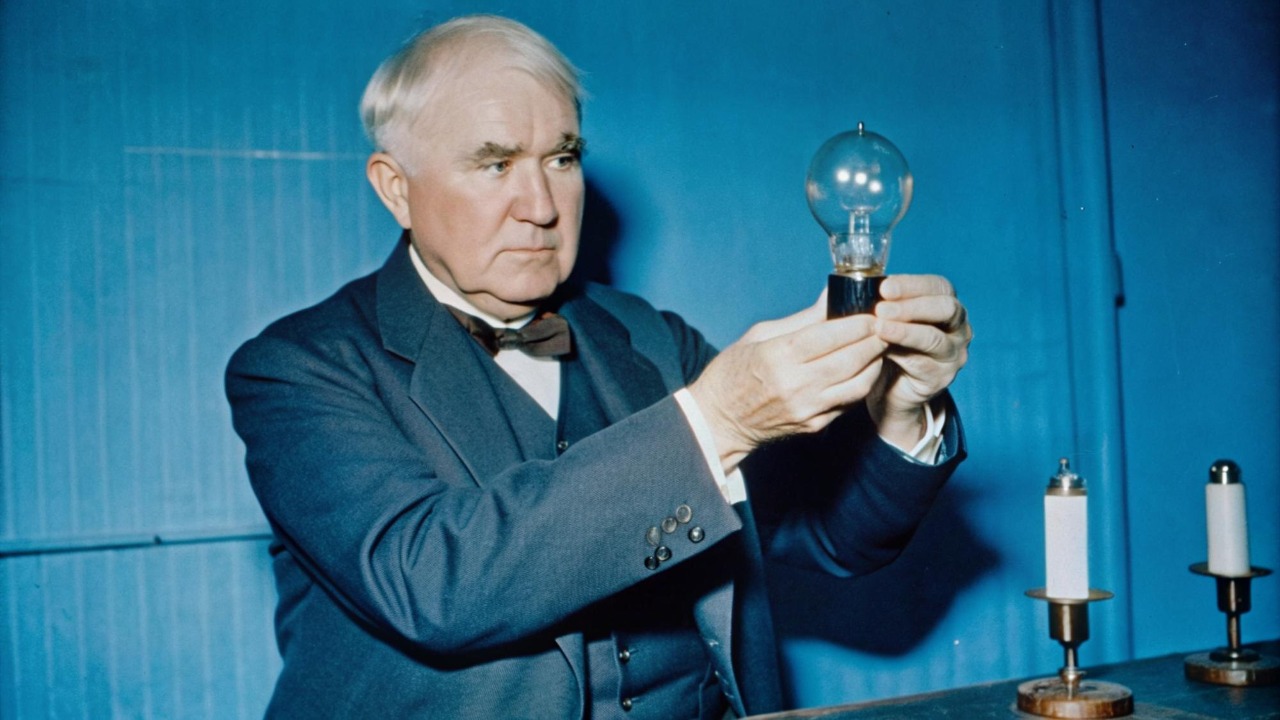
When a modern research team set out to rebuild Thomas Edison’s first practical light bulb, they expected a lesson in Victorian engineering, not a glimpse of cutting-edge materials science. By retracing the steps of the 1879 experiment, they uncovered evidence that the iconic inventor may have inadvertently created graphene, a material that would not be formally identified for well over a century. The finding suggests that one of history’s most famous devices was not only a symbol of electrification but also an unrecognized doorway into the physics of atom-thin carbon.
The revelation reframes Edison’s workshop as an early, accidental nanotechnology lab, where extreme heat and fragile filaments quietly sculpted carbon into exotic forms. It also underscores how often scientific revolutions arrive long before the language to describe them, hiding in plain sight inside everyday objects. The bulb that lit up a New Jersey laboratory in the nineteenth century may now help illuminate the future of electronics, energy storage, and quantum materials.
The bulb that changed the night
Long before anyone spoke of graphene, Thomas Edison was racing to perfect a reliable electric light that could replace gas lamps and candles. In the late 1870s he and his team cycled through hundreds of materials before settling on carbonized plant fibers, including cotton and bamboo, as filaments that could glow for hours without disintegrating inside a glass envelope. Historical accounts of then describe how Edison tested a carbonized cotton thread that burned for more than 1,200 hours, a performance that helped secure his reputation and patent.
The incandescent lamp that emerged from Menlo Park relied on a simple but brutal principle, electricity forced through a thin carbon filament until it glowed white hot, all while sealed in a partial vacuum to slow its destruction. When Thomas Edison’s patent for the incandescent light bulb was granted, it formalized a design that used carbonized plant filaments instead of the tungsten wires that would dominate in the twentieth century, and when powered, these filaments heated to extreme temperatures inside the glass globe. Contemporary descriptions of Thomas Edison emphasize how this configuration balanced durability with manufacturability, turning a laboratory curiosity into a commercial product that reshaped cities and factories.
Rebuilding a nineteenth century experiment
More than a century later, researchers decided to recreate that 1879 bulb as faithfully as possible, not as a museum piece but as a scientific sample. They fabricated new filaments from carbonized bamboo and cotton, mounted them in glass bulbs, and subjected them to the same punishing currents that Edison once used to light his laboratory. According to reporting on the project, the team led by Jan and colleagues carefully matched the geometry and operating conditions of the original lamp so that any microscopic changes in the filament would mirror what happened in the nineteenth century, a process described in detail in modern analyses of Edison’s 1879 design.
Once the replica bulbs had burned, the scientists removed the fragile filaments and examined them with high resolution tools that Edison could never have imagined. They used techniques such as Raman spectroscopy, which reads vibrational signatures in a material like a barcode, to probe the atomic structure of the carbon. Reports on the study explain that Jan and collaborators saw clear spectral fingerprints of graphene in specific regions of the filament, indicating that parts of the carbon had reorganized into atom-thin sheets under the intense heat. One technical summary of Jan notes that this method is extremely precise and widely used in modern materials science, giving the team confidence that they were not misreading the data.
Graphene hiding in a Victorian glow
The conclusion that Edison’s bulb may have produced graphene hinges on how carbon behaves when it is heated to extraordinary temperatures in a controlled environment. Under the right conditions, disordered carbon can rearrange into stacked layers of hexagonal lattices, with some regions thinning down to a single atomic layer. Researchers who reconstructed the lamp argue that this is exactly what happened inside the 1879 filament, where the hottest zones near the center transformed into graphene-like structures while cooler regions remained more amorphous. Coverage of the work notes that Edison’s 1879 lamp may therefore have been an unintentional graphene factory, operating decades before physicists had the tools or theory to recognize what was happening.
To verify that interpretation, the team turned to even more targeted probes. By beaming lasers at the filament, Eddy and his colleagues confirmed that they had cooked up a form of graphene, a result that was reported as part of a broader discussion of how historic experiments can harbor modern surprises. One account quotes the view that such spectroscopic tools are difficult to fool, reinforcing the claim that the material on the filament was not just generic carbon but a structured, layered form with properties associated with graphene. Another synthesis of the findings explains that new research suggests Thomas Edison’s early light bulbs made carbon with loosely stacked atomic layers, a description that aligns with how graphene and related materials are now understood.
Rewriting the origin story of a “miracle material”
For today’s physicists and engineers, the most striking implication is that graphene’s practical history may be far older than its formal discovery. Graphene first exploded into the mainstream in 2004, when researchers isolated single atomic layers of carbon and highlighted their extraordinary electrical conductivity, mechanical strength, and thermal properties. A profile of Graphene research notes how the material was quickly touted as a miracle material with potential applications in flexible electronics, high-capacity batteries, and advanced sensors. If Edison’s lamp really did host graphene-like regions, then the story of this celebrated material stretches back to the age of telegraphs and phonographs, even if no one at the time could see it.