
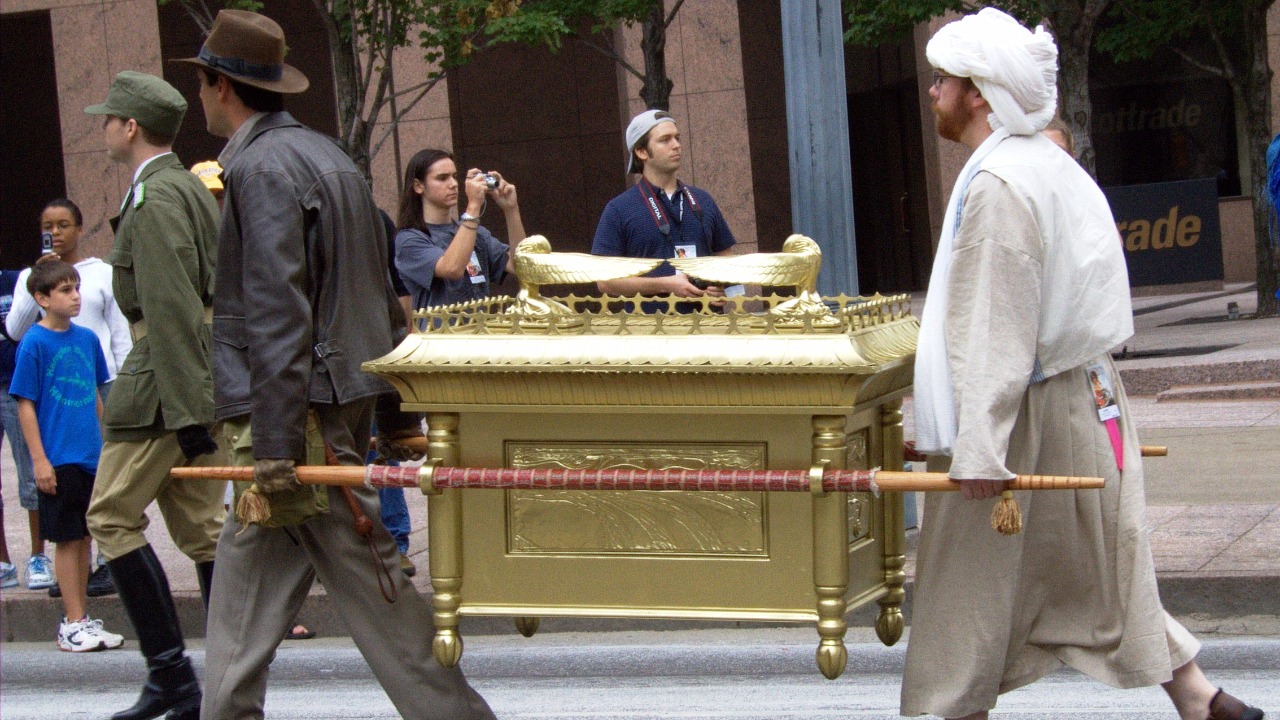
The Ark of the Covenant has long occupied a singular place in religious imagination, portrayed as a golden chest that carried both divine presence and national destiny. New archaeological work and fresh textual analysis are now unsettling that familiar picture, suggesting a more complex object whose meaning shifted across centuries. Together, these findings challenge inherited assumptions about where the Ark stood, what it symbolized, and why it ultimately vanished from history.
Rather than confirming a single dramatic storyline, recent research points to overlapping traditions, political agendas, and theological debates that shaped the Ark’s legacy. Excavations in the Judean highlands, re‑readings of the so‑called Ark Narrative, and bold proposals about Egyptian influence are forcing scholars and believers alike to reconsider what this most enigmatic artifact may really have been.
From sacred chest to shifting symbol
For generations, the starting point has been the biblical description of The Ark as a sacred chest of acacia wood overlaid with gold, understood as the earthly throne of God and the container for God’s commandments in Israel’s life. That traditional view presents the object as a fixed, unchanging reality, a stable anchor of covenant law and divine presence in Israel’s story. Yet even within the biblical texts, the Ark appears in different roles, from a liturgical focus in the sanctuary to a mobile palladium carried into battle, hinting that its significance was never entirely static, even when it was revered as the holiest item in Judaism.
New scholarship is pressing that observation further, arguing that the Ark’s portrayal reflects evolving theological concerns rather than a single timeless institution. The tension between the commandment against graven images and the golden cherubs that adorned the Ark has been highlighted as a sign of internal debate about how God should be represented, with the object at the center of arguments over whether divine power could be localized and used to bless Israel or punish its enemies. In this reading, the Ark becomes less a simple relic and more a contested symbol through which ancient writers negotiated questions of law, worship, and national identity.
Excavating Kiriath-Jearim and the politics of holy ground
Archaeology is now adding a concrete landscape to those textual debates. Excavations led by Finkelstein at a hill identified with Kiriath Jearim have focused attention on a site long linked in tradition to the Ark’s residence before its transfer to Jerusalem. The dig has revealed that Kiriath Jearim occupied a commanding position in the Judean highlands, about 12 kilometers west of Jerusalem on a hill above Abu Ghosh, and that the summit functioned not only as a cultic center but also as an important administrative hub. That combination of religious and political roles suggests that the Ark’s presence there, if historical, would have served royal power as much as piety.
Further work has identified a large, carefully constructed platform that some researchers argue may have supported a shrine associated with the Ark of the Covenant, a feature that fits with the idea of a monumental installation tied to the kingdom of Judah. The same line of inquiry has prompted renewed interest in how After David established his capital at Jerusalem he sought to bring the Ark into the city, a move that would have relocated both religious prestige and political legitimacy. By situating the Ark within a network of fortified hills, platforms, and royal centers, archaeologists are reframing it as part of a broader strategy of territorial control rather than a purely spiritual object floating above history.
Rethinking the Ark Narrative and its ancient neighbors
Textual critics have turned to the Ark Narrative and its original meaning to probe how early stories about the chest were shaped by later editors. In that narrative, the Ark is captured and brought as loot into the temple of the Philistine god Dagan in Ashdod, then sent away on a cart drawn by cows separated from their calves until it arrives first at Beth Shemesh and eventually in Jerusalem. Scholars such as Thomas Römer argue that this sequence preserves memories of a powerful cult object whose movements were reinterpreted over time, with episodes of disease among those who mishandled it hinting at an older tradition of a dangerous, numinous artifact. The focus on Philistine cities and their god Dagan also places the Ark in a regional religious landscape rather than isolating it within Israel alone.
Römer’s broader work, presented in academic lectures and publications, proposes that some of the most striking Ark traditions may have been shaped during the reigns of kings like Hezekiah, when centralization of worship in Jerusalem was a pressing political project. In this view, the stories of the Ark humiliating foreign gods and bringing both blessing and curse function as theological propaganda that elevates Jerusalem’s cult above its rivals. Comparative evidence from reliefs of rulers such as Sargo, where objects resembling a mobile sanctuary appear in deportation scenes, has encouraged some researchers to see the Ark as part of a wider Near Eastern pattern of portable shrines, rather than a uniquely Israelite invention sealed off from its neighbors.
Egyptian echoes and contested claims of discovery
One of the most provocative recent proposals comes from An Egyptologist who argues that the Ark of the Covenant was deliberately constructed using ancient Egyptian religious symbols as a kind of theological rebuke. According to this theory, the Ark’s form and ornamentation echo Egyptian ritual furniture, but its function is inverted to assert the superiority of Israel’s God over the gods of the Nile. The suggestion that the Ark, often dated by some scholars to around 1445 BC, may have been conceived in conscious dialogue with Egyptian cultic objects has sharpened debates about how much of Israel’s early religion emerged in conversation with, rather than in isolation from, its imperial neighbor.
Alongside these academic arguments, popular fascination with the Ark’s fate has fueled a steady stream of claimed discoveries. Gray’s Account, for example, recounts how Jonathan Gray linked the Ark of the Covenant to a series of underground chambers, a story that has been circulated by AIBA with the caveat that, perhaps predictably, the physical evidence remains inaccessible or unverified. Other reconstructions note that Most scholars agree the Ark was never placed in the Second Temple, the Temple of Zerubabel and Herod, and that it disappears from the Bib record after the First Temple period, a gap that has encouraged speculation about its removal to locations such as a church in Axum in Ethiopia. These contested narratives, ranging from sober historical reconstruction to adventurous treasure hunting, underscore how the Ark’s mystery continues to invite both rigorous scrutiny and imaginative leaps.
Absence, memory, and the modern struggle over sacred objects
The last historical mention of the Ark in biblical tradition is associated with Josiah, and During the reforms he brought to Judah the text implies that the chest was no longer in its expected place, prompting calls for the Ark to be returned to the temple. That silence after Josiah has become a crucial datum for historians who argue that the Ark’s disappearance was already an unresolved problem for later writers, not a puzzle invented by modern enthusiasts. In the meantime, theological reflection has continued to emphasize that the Ark, a sacred chest made of acacia wood and overlaid with gold, once served as the physical manifestation of God’s throne on earth, even as its physical whereabouts slipped beyond reach. Devotional readings of the stories about how After David moved the Ark to Jerusalem, where it brought both blessing and curse depending on how it was treated, keep the object alive as a moral and spiritual touchstone rather than an archaeological target.