
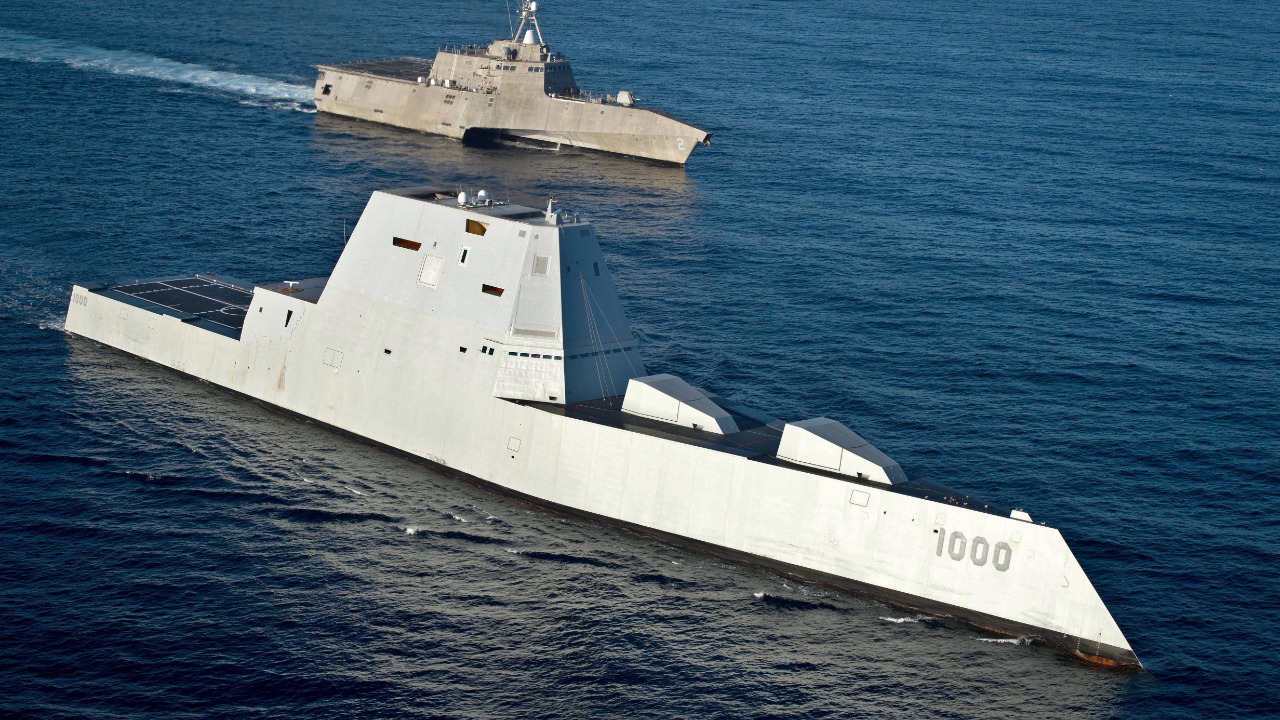
The United States Navy is turning its most controversial warships into some of the most feared strike platforms at sea. The stealthy Zumwalt class, once derided as an expensive misstep, is being rebuilt around hypersonic firepower that can hit targets at extreme range in minutes. Instead of futuristic gunships that never quite worked, these destroyers are being recast as compact missile barges built to launch some of the fastest weapons the Navy has ever fielded.
The shift is more than a technical retrofit. It signals a strategic bet that a handful of stealth ships, armed with a small number of very high-value missiles, can shape a fight across entire regions. As rivals race to deploy their own hypersonic systems, the Navy is trying to turn a troubled program into a spearhead for America’s next generation of maritime strike power.
From failed experiment to hypersonic flagship
The Zumwalt class began as a bold attempt to reinvent the surface combatant, with a stealthy tumblehome hull, advanced sensors, and two massive guns that were supposed to fire precision shells over the horizon. Those guns never received affordable ammunition, leaving the ships without their intended main armament and turning the program into a symbol of overreach. Faced with three completed hulls and no clear mission, the Navy chose to reframe the design as a platform for hypersonic strike and is now transforming these futuristic stealth destroyers into what internal advocates describe as hypersonic missile bombers.
The lead ship USS Zumwalt, along with her sister ships, is being stripped of the unused gun mounts and refitted with large vertical launch tubes sized for the Navy’s Conventional Prompt Strike system. That decision aligns the class with a broader Pentagon effort to field hypersonic weapons that can travel at Mach 5 or faster and maneuver in flight. The United States is currently developing three such programs, including the Navy’s Conventional Prompt Strike missile and the Army’s Long Range Hypersonic Weapon, both of which are designed to deliver conventional warheads against high-value targets at intercontinental distances.
USS Zumwalt and Lyndon B. Johnson lead the refit
The first tangible proof of the concept is the work on USS Zumwalt, which is being modified to carry the new hypersonic launchers in place of its original gun systems. Earlier reporting on the retrofit noted that the Navy expects the changes to make the USS Zumwalt class significantly more lethal at greater distances and speeds, with the ship’s stealth shaping helping it close within launch range before firing. The retrofit effort, described in detail by analysts following the Zumwalt hypersonic missile, is intended to turn the ship into the first U.S. warship to deploy such weapons at sea.
The third ship in the class, the Lyndon B. Johnson, is following close behind. The U.S. Navy is refitting this second-in-class stealth “battleship” to fire hypersonic missiles from new canisters that can carry up to 12 weapons, giving it global reach and a potent offensive punch. Observers watched as the Lyndon B. Johnson slipped out of port with new Mach 5 hypersonic weapons canisters installed, a visible sign that the Navy is serious about turning the class into a dedicated long-range strike asset.
Conventional Prompt Strike and the race for speed
At the heart of the transformation is the Conventional Prompt Strike missile, a joint program that will give the Navy a sea-based hypersonic option. Senior leaders have been explicit about their intent to place these weapons on the Zumwalt class, with one official stating in a public briefing that the service is going to put hypersonic missiles on board the Zumwalt class destroyers, and that is exactly what the current refit work is designed to achieve. That commitment was captured in a widely shared Zumalt program video, which framed the installation of Conventional Prompt Strike as a central mission for the ships.
The technical logic is straightforward. Hypersonic glide vehicles can travel at Mach 5 or faster, maneuver in the upper atmosphere, and strike hardened or time-sensitive targets before an adversary can react. Analysts have described this as a Mach 5 solution to save the Zumwalt class stealth destroyer, arguing that the combination of speed, range, and stealthy launch platforms allows the Navy to go long and strike fast, with missiles that can dive into and destroy a target from thousands of miles away. That assessment is reflected in detailed discussions of the Mach 5 solution, which frame the weapons as both a technological leap and a political justification for keeping the ships in service.
The Navy is already moving from theory to practice. The US Navy successfully tests a hypersonic missile at sea for deployment to the Zumwalt class, a milestone that marked the emergence of what some have called the first stealth hypersonic strike destroyer. That progress was highlighted when the US Navy confirmed that USS Zumwalt had completed builder trials in parallel with preparations for the new missile system.
Strategic stakes in the Indo-Pacific and beyond
The strategic logic behind turning these stealth destroyers into hypersonic missile barges is rooted in the Indo-Pacific, where long distances and dense anti-access networks favor platforms that can strike from afar. Analysts have argued that the Navy’s hypersonic battleships, as some have dubbed the class, are making a comeback because they can be forward-based alongside other hypersonic assets and play a central role in America’s hypersonic future at sea. That vision is laid out in assessments of the Stealth Zumwalt class, which emphasize how a small number of such ships, armed with Conventional Prompt Strike, could threaten key nodes across the Western Pacific.
The Navy is already positioning the first hulls to support that role. One stealth destroyer is set to be home for the first hypersonic weapon on a U.S. warship, a move that turns what was once described as a costly flub into a potential asset for deterrence. Reporting on the stealth destroyer homeport decision notes that the U.S. Navy is transforming a costly flub into a potential game changer, with one analyst at the Hudson Institute arguing that the ship’s new role could significantly alter regional calculations.