
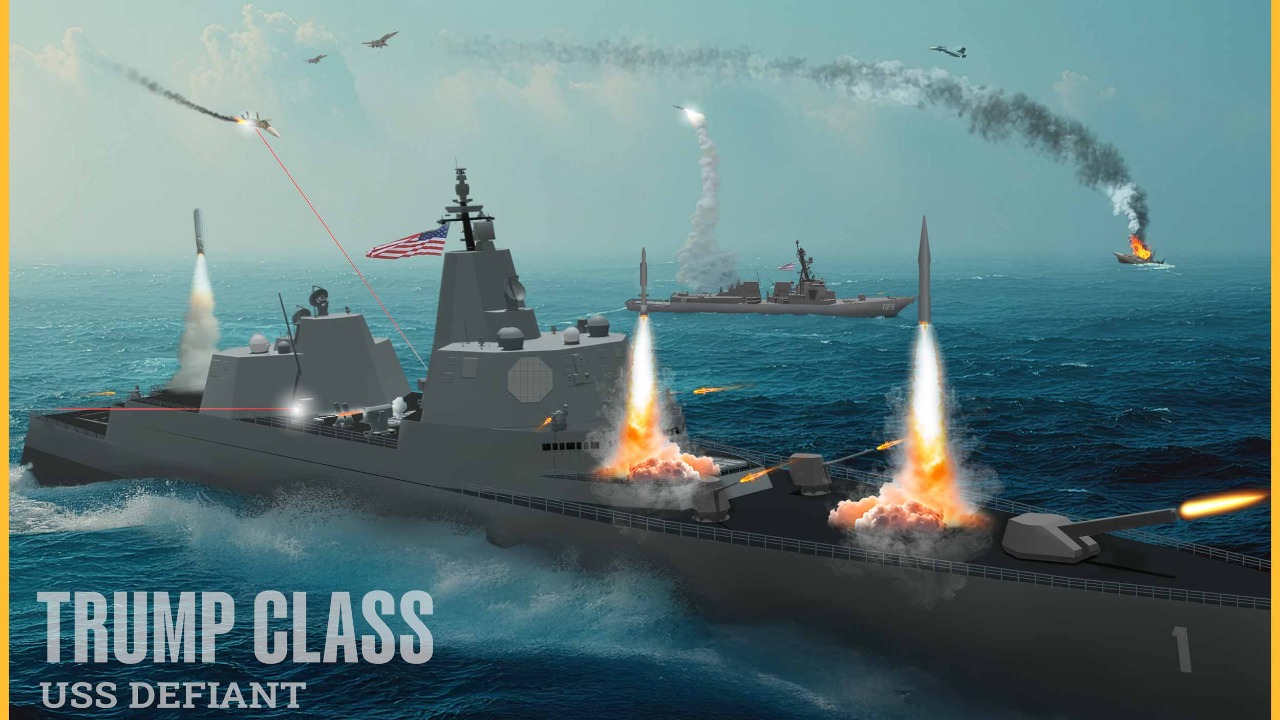
The United States Navy has begun to pull back the curtain on the Trump-class, a proposed line of super battleships that would be the largest American surface combatants since the Second World War. New design graphics, cost estimates, and leadership comments are sharpening a program that President Donald Trump first framed as a bold break with what he called “obsolete” ships. The emerging picture is of a vessel that blends the imposing scale of a classic dreadnought with the firepower and sensors of a modern guided missile platform.
As more technical hints surface from Navy events and budget documents, the Trump-class is shifting from political slogan to concrete, if still controversial, blueprint. The first ship, often referred to as the future USS Defiant, is now associated with specific displacement figures, weapon mixes, and price tags that would reshape the service’s force structure for decades.
From campaign promise to guided missile behemoth
President Donald Trump used a December 2025 press event to announce that the United States Navy would pursue a new guided missile battleship that would be longer and heavier than existing surface combatants and would replace ships he described as outdated. In that appearance, he framed the Trump-class as part of a broader “Golden Fleet” concept, promising superior vessels that would restore a sense of maritime dominance. According to a newly created website for the Golden Fleet, the guided missile battleship is set to be roughly the same size as a modern aircraft carrier, a claim that immediately sets it apart from current destroyers and cruisers.
Subsequent Navy releases described the Trump-class as a multi-role platform that combines traditional naval guns with a large vertical launching system for missiles. Public descriptions of the design emphasize that the ships would be guided missile battleships with extensive strike and air defense capacity rather than simple gun platforms. Early concept art and fact sheets cited in open sources indicate that the future USS Defiant would be the largest, deadliest, most versatile, and best-looking warship in the fleet, underscoring how closely the program is tied to presidential rhetoric as well as to Navy ambitions.
Size, firepower, and the return of the “super battleship”
The most striking technical detail to emerge is the sheer scale of the proposed hull. Current reports describe a displacement of more than 35,000 tonnes, a figure that would make the Trump-class more than twice as large as the Navy’s existing Zumwalt destroyers, which displace 15,000 tons. A graphic shown by Navy officials at the Surface Navy Association symposium on Thursday depicted a ship with that displacement bracketed by heavy armor, large caliber guns, and a dense battery of vertical launch cells. At triple the size of an Arleigh Burke destroyer, which is largely built by HII’s Ingalls Shipbuilding in Pascagoula, the new battleship would sit in a category of its own within the surface fleet.
Weapons fit is intended to match that scale. Planning documents and public commentary describe a mix of conventional guns, laser weapons, railguns, and hypersonic and nuclear-capable missiles, all integrated around a large vertical launch capacity. One analysis notes that the planned Trump-class battleships would displace over 35,000 tonnes and combine laser defences, hypersonic and nuclear-capable missiles, railguns, and large vertical launch capacity, a combination that would give each hull a strategic as well as tactical role. Trump has also said the new ships would carry nuclear-armed sea-launched missiles, a feature that Navy Secretary John Phelan has framed as central to a new deterrence posture at sea.
Industrial base, cost shock, and the fight for funding
As design details have solidified, the projected price has become a central point of debate. A recent assessment tied to the Surface Navy Association event suggested that the first Trump-class battleship could cost over $20 billion, a figure that would rival or exceed the price of a nuclear-powered aircraft carrier. That estimate surfaced just as the base budget request for FY 2026 sought three battleforce ships for a total of $20.8 billion, including one Columbia ballistic missile submarine, one Virginia attack boat and one T-AGOS ocean surveillance ship. The comparison highlights how a single Trump-class hull could consume the funding now spread across multiple high-end programs.
Supporters argue that the industrial base can absorb the challenge by leveraging yards that already handle large surface combatants. Reporting on the announcement noted that at triple the size of an Arleigh Burke, the new battleship would likely draw on experience at HII’s Ingalls Shipbuilding in Pascagoula, which has built that destroyer line for years. Advocates inside the Navy have also linked the program to job creation, echoing Trump’s own promise that “we’re going to have the jobs be created” as part of the new battleship push. Critics, however, warn that concentrating so much money and industrial capacity into a small number of massive ships risks crowding out other priorities and could “sink” broader modernization if costs spiral.
Strategic gamble and Navy culture shift
Strategically, the Trump-class represents a bet that very large, heavily armed surface ships can survive and matter in an era of long-range missiles and drones. According to Navy descriptions, the ships are envisioned as multi-role platforms that can provide shore bombardment, carrier escort, missile defense, and long-range strike, all while acting as visible symbols of American power. Some analyses argue that, as envisioned, the ships will be more heavily armed than Cold War era battleships, with a mix of hypersonic and nuclear-capable missiles that would give them a role in both conventional and strategic deterrence. Supporters see them as a way to overmatch regional adversaries and to anchor the Golden Fleet concept in a single, unmistakable silhouette.