
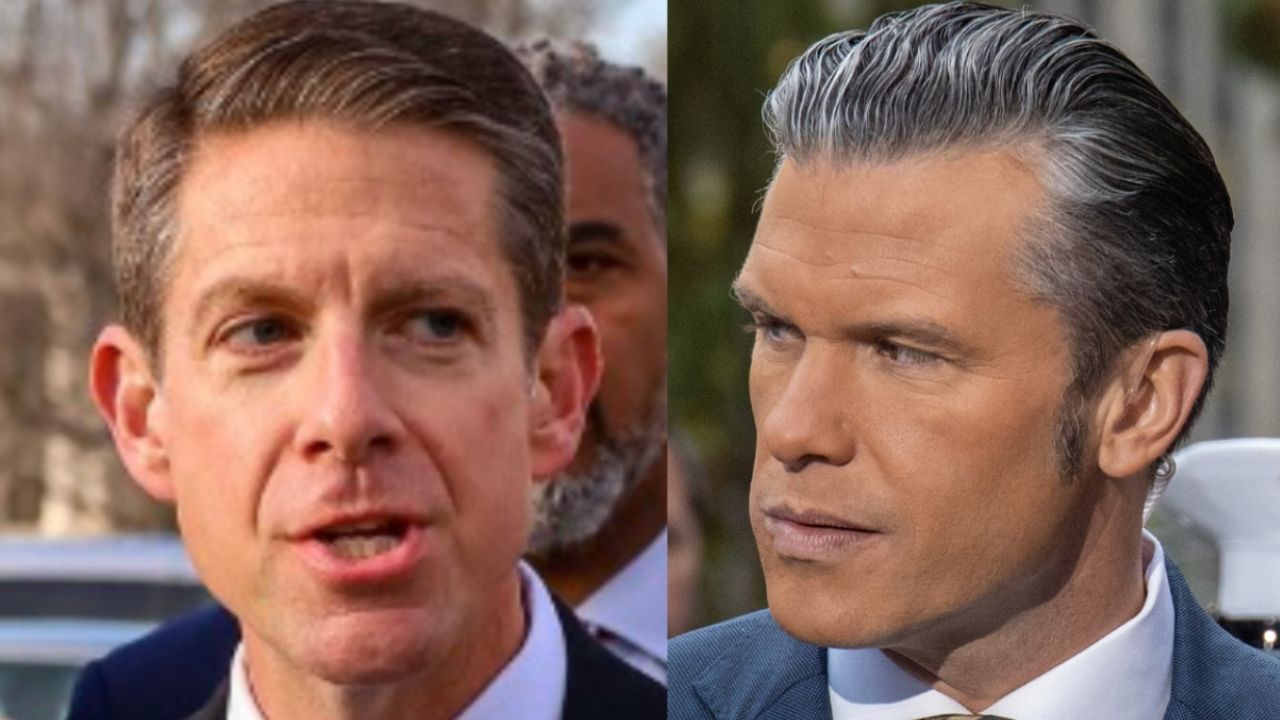
Representative Mike Levin, a California Democrat, publicly challenged Defense Secretary Pete Hegseth on Sunday over the prolonged absence of a permanent Army chief of staff, accusing the Pentagon of gutting the service’s most experienced leadership at a moment when American troops are actively defending U.S. bases from Iranian missile attacks. In a post on X published at 10:47 a.m. on August 30, 2026, Levin directly addressed Hegseth, demanding an explanation for what he described as the ongoing removal of “battle-tested leaders in the middle of a war.”
Levin’s post, sent from his official X account, read in full:
“Mr. Hegseth, what possible reason could you have for purging battle-tested leaders in the middle of a war?
The Army has gone FIVE months without a permanent chief of staff after you fired him without explanation, pushed out several potential successors, and forced out a generation of senior officers with decades of combat experience.
Meanwhile, our soldiers are defending U.S. bases from increasingly sophisticated Iranian missiles and confronting some of the fastest-changing threats in modern warfare.
You do not strengthen the Army by stripping away its experience at the very moment we need it most.
Our adversaries must be thrilled to watch this leadership vacuum grow, and our troops are the ones being asked to carry the risk.
If you are going to gamble with military readiness by firing the leaders responsible for preparing our forces for war, you better be prepared to explain yourself to Congress.”
The Firing That Started The Vacancy
Levin’s post referenced the dismissal of General Randy George, who was removed as Army chief of staff on April 2, 2026, without a public explanation from Hegseth’s office. Pentagon spokesperson Sean Parnell said at the time that General George would be “retiring from his position as the 41st Chief of Staff of the Army effective immediately,” and thanked him for his “decades of service to our nation.” General George, a career infantry officer and West Point graduate who fought in the Gulf War, Iraq and Afghanistan, had been nominated by President Biden and confirmed in 2023 for a term that would typically have run until 2027.
General George’s removal came alongside the ousters of Gen. David Hodne, who led the Army’s Transformation and Training Command, and Maj. Gen. William Green, head of the Army’s Chaplain Corps, both of whom were dismissed the same week without explanation.
LaNeve’s Stalled Path To A Permanent Nomination
In the wake of General George’s dismissal, Gen. Christopher LaNeve, previously Hegseth’s senior military assistant and the Army’s vice chief of staff since February 2026, was installed as acting chief of staff. Parnell described LaNeve as a “battle-tested leader with decades of operational experience” who is “completely trusted by Secretary Hegseth to carry out the vision of this administration without fault.”
Nearly five months later, LaNeve remains only “acting” chief of staff. Reporting from Breaking Defense on August 26, 2026, found the Pentagon is working to “lock in” LaNeve’s nomination amid signs of bipartisan Senate resistance, with concerns compounded by reports that Army Secretary Daniel Driscoll could leave his post as early as next month.
Committee Chair Roger Wicker, a Mississippi Republican, has acknowledged he is “aware of some” GOP opposition to LaNeve on the Senate Armed Services Committee, and Senator Tommy Tuberville, an Alabama Republican, said he has heard concerns that LaNeve lacks sufficient four-star experience.
Senator Joni Ernst, an Iowa Republican and 22-year veteran of the Iowa National Guard, has also emerged as an obstacle to LaNeve’s confirmation. According to reporting on the matter, Ernst had understood Hegseth to have assured her that General George, a fellow Iowan, would be permitted to finish his term before he was abruptly fired.
Democrats On The Armed Services Committee Have Raised Similar Alarms
Levin is not the only lawmaker to publicly question the firings. House Armed Services Committee Ranking Member Adam Smith, a Washington Democrat, issued a statement following General George’s ouster warning that the move would “weaken our national security and national defense at a time when we can least afford it,” and called the pattern of dismissals “cause for serious alarm.”
Representative Pat Ryan, a New York Democrat and former Army intelligence officer, has similarly warned that the purges endanger troops and threaten to politicize a military that is supposed to remain nonpartisan, telling reporters that “hollowing out the most battle-tested and most lethal, proven leaders in a time of war means troops are less safe and we’re less likely to win.”
Levin’s Broader Record On Military Readiness Under Hegseth
Sunday’s post fits into a pattern of scrutiny Levin has directed at Hegseth’s Pentagon throughout 2026. In August, Levin led a San Diego congressional delegation letter to Hegseth and Acting Navy Secretary Cao demanding answers about conditions aboard the USS Abraham Lincoln, pressing the Pentagon on unsanitary conditions, inadequate mental health support, and delayed communication with military families.
Levin also voted against the House-drafted Fiscal Year 2027 National Defense Authorization Act in July, criticizing the bill’s $1.5 trillion authorization as bolstering what he called an “unauthorized and illegal war in Iran” while noting Hegseth had separately told Congress he needed an additional $67 billion to continue the conflict.
The Leadership Purge Extends Beyond The Chief Of Staff Post
Levin’s post came days after the New York Times published an extensive investigation on August 25, 2026, documenting how the Army’s leadership ranks have been thinned across multiple echelons under Hegseth. The report found that as recently as January 2025, when Hegseth took office, the Army had 10 four-star generals on active duty; it now has five, the fewest in decades. Beyond General George, Hegseth has fired or forced out roughly half a dozen senior officers, according to the report, thinning what current and former officials described as a generation of the service’s most combat-hardened leaders.
Among those departures was Gen. Christopher Donahue, whose command overseeing U.S. ground troops in Europe was reduced from a four-star to a three-star position in July, effectively forcing him toward retirement. Donahue’s command had built and deployed drone-defense teams to the Middle East drawing on lessons from the war in Ukraine.
The Wartime Backdrop Levin Cited
Levin’s post directly tied the leadership vacuum to escalating threats facing American forces overseas. Army air defense soldiers have played the leading role in defending U.S. bases in the Middle East from Iranian missile attacks since the outbreak of Operation Epic Fury in February 2026, with Iran increasingly deploying advanced missiles capable of evading U.S. defense systems. One such strike hit prefabricated housing units at a U.S. base in Jordan on July 17, killing three American soldiers and wounding more than 100 others, according to the Times report. The Army has since been burning through scarce supplies of Patriot interceptors to keep pace with the attacks.
Hegseth’s Office Has Largely Deferred Comment To The Army
Hegseth’s office has not issued a detailed public explanation for General George’s dismissal or the broader wave of senior officer departures. When approached by the Times for comment, Hegseth’s office referred questions about the firings to the Army itself, which declined to discuss what it characterized as internal “leadership changes.” In a statement, Army spokeswoman Cynthia O. Smith said that “Army leaders exemplify the highest standards of duty, selflessness, and professional excellence” and that the service’s “strategic objectives are met” and “global readiness is never compromised.”
Separately, Chief Pentagon spokesperson Sean Parnell said the Department of War would “continue to work with the White House and the Senate to nominate and ultimately confirm President Trump’s pick to lead the United States Army,” referring to LaNeve’s stalled nomination.