
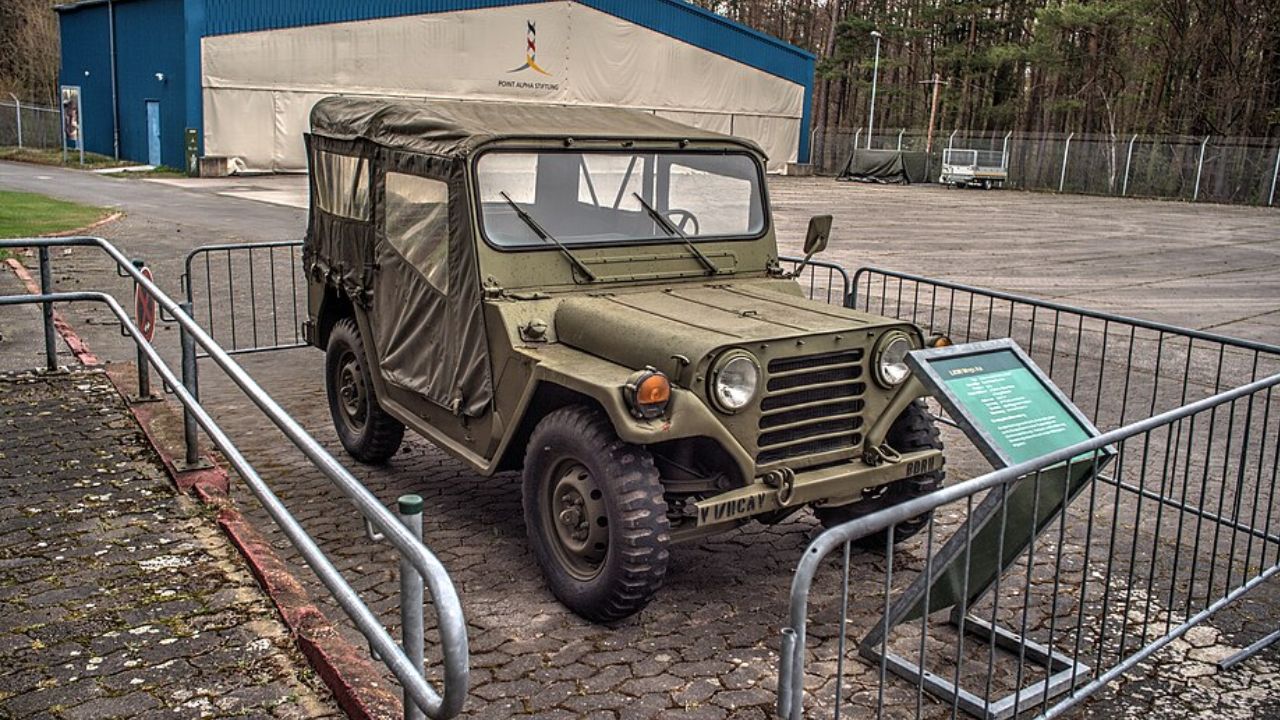
The M151 “MUTT” (Military Utility Tactical Truck) was the U.S. Army’s bid to update a vehicle category that WWII- and Korean War–era Jeeps had defined, but that was increasingly hard to stretch into new roles. As Cold War operations emphasized wider dispersion and routine radio use, the light utility truck became more than a runabout. It had to carry communications gear, support liaison and staff movement, and keep pace with units operating across rough terrain. The M151 came out of that shift—not as a rejection of the Jeep’s reputation, but as an effort to design around newer expectations.
At its core, the MUTT story is about the unglamorous “connective tissue” of ground forces. The Army—and often the Marines and allied forces receiving U.S. vehicles through assistance channels—wanted a small truck that could better accommodate mission equipment and growing electrical demand without requiring constant improvised fixes at unit level. The M151 was intended to close those gaps, even as it developed a complicated reputation of its own.
Why the early Jeeps hit a ceiling
The WWII/Korea Jeep lineage—often grouped as “Willys/Jeep” light utility vehicles—was built around simplicity and general-purpose usefulness. That approach worked extremely well when the baseline jobs were light cargo, liaison, and moving personnel over poor roads at modest speeds. Over time, however, mission creep pressed hardest on the areas where a small, short-wheelbase platform has limited room to grow: carrying more equipment, supplying more power to that equipment, and maintaining predictable handling as loads and operating tempo increased.
As radios and field kits became routine rather than exceptional, the light utility vehicle increasingly served as a carrier for command-and-control tools. That meant more weight and more demand on the vehicle’s electrical system. Earlier Jeeps could be adapted, but the impetus behind the M151 was the sense that these adaptations were becoming standard practice instead of rare exceptions.
What the MUTT was designed to do differently
The M151 program is best understood as an attempt to build a light utility truck around those Cold War realities from the outset. In broad discussions of the MUTT, two themes come up repeatedly: improved on-road and off-road behavior at useful speeds, and a layout better suited to carrying radios and other field equipment. In practice, these points are linked. A vehicle that can move more confidently over broken terrain while carrying mission kits helps units sustain tempo and reduces the cumulative toll of constant movement on drivers and maintenance.
Equally important was making the vehicle a more reliable host for expanding electrical loads. The modernization push was not about turning the light truck into something glamorous; it was about making everyday tasks—moving commanders, messengers, wire teams, medics, and maintenance personnel—less dependent on ad hoc workarounds. The MUTT was part of a broader shift in which communications and mobility increasingly had to travel together.
Standardizing roles: liaison, reconnaissance support, and beyond
Early Jeeps were famously versatile, but versatility still has practical limits when a vehicle becomes overloaded or awkward to configure. The M151 family appealed in part because it lent itself to more repeatable configurations for common jobs such as liaison and reconnaissance support, as well as utility cargo and ambulance-oriented variants. The point is not that it eliminated improvisation, but that it aimed to reduce the number of one-off solutions that differed from unit to unit.
That kind of standardization matters because it supports readiness. When vehicles can be set up in more consistent ways, training becomes easier to normalize, maintenance is less dependent on individual ingenuity, and the supply system has a clearer idea of what parts and assemblies are actually in demand. A light utility platform that can be configured reliably across routine roles can also keep more specialized vehicles available for tasks that truly require them.
Integration and modernization tradeoffs
Another distinction often raised in high-level comparisons is the M151’s more integrated construction approach relative to earlier Jeep-style designs. Without getting lost in specifications, the modernization impulse was to make the light utility truck feel less like a minimally adapted civilian pattern and more like a purpose-built military system. Integration can improve how equipment is packaged and mounted, but it can also change repair considerations and how damage is managed in the field.
This trade space is part of why the M151 is not remembered simply as “a better Jeep.” It was a vehicle meant to address real operational pressures—equipment growth, communications carriage, and sustained mobility—while introducing new constraints that the force had to manage.
The rollover reputation: capability meets operating reality
No discussion of the M151’s legacy can ignore its reputation for rollover and handling issues. What can be said safely is that the subject is often discussed, and accounts vary widely by configuration, terrain, and driver behavior. The larger lesson is that light tactical vehicles are “systems” in practice: their safety and effectiveness depend on training, doctrine, and enforced operating limits as much as on the hardware itself.
Within that frame, the MUTT’s history is frequently described as involving a mix of modifications and changes in how the vehicle was driven and managed. Whatever the specific measures in a given unit or period, the broader point holds: when a platform develops a persistent safety narrative, that narrative becomes part of its operational footprint—affecting training emphasis, risk tolerance, and day-to-day use.
Why this mattered in Vietnam-era operations
Vietnam-era imagery can turn vehicles into icons, but the practical driver was day-to-day movement and coordination. A light utility vehicle that could better support radios and carry small teams across rough roads was well aligned with dispersed operations and constant friction at the tactical level. For commanders and staff elements, that could mean staying connected more reliably; for logistics and maintenance, it could mean fewer slowdowns in the last mile.
That does not mean the M151 “replaced the Jeep everywhere,” and it should not be treated as a straight line to later HMMWV-era requirements. Other light platforms and Jeep derivatives persisted in different roles and timelines. Still, in its own era, the M151 reflected a clearer assumption that light mobility and communications support belonged in the same vehicle, as a baseline expectation rather than an add-on.
Production, stockpiles, and the “what happens after” problem
Even relatively simple tactical vehicles create long-term commitments once fielded at scale. Large fleets shape motor pool workload, spare parts forecasting, and training pipelines for drivers and mechanics. Modernization, therefore, is not only about choosing a better-performing truck; it is also about choosing a sustainment burden the force can live with for years.
The MUTT’s afterlife also shows how surplus decisions can become contentious. Public discussion has included claims that some M151s were scrapped rather than sold intact, often framed around a mix of safety concerns, liability, and demilitarization policy. Without treating any single explanation as definitive, the broader takeaway is that end-of-service decisions can become especially sensitive when a vehicle carries a complicated safety reputation.
The strategic takeaway: small trucks, big consequences
The M151 addressed the limits of the Army’s early Jeeps by treating light utility mobility as a platform for modern warfare’s routine requirements: carrying radios, moving small teams, supporting coordination, and keeping units moving at a steady tempo. Strategically, that matters because these vehicles make higher-level plans executable. They move the people and equipment that keep formations coherent. When they fall short—whether in carrying capacity for mission gear, electrical support, or durability under demanding use—the force feels it as delays, workarounds, and reduced momentum.
The larger pattern is not a single clean replacement story, but an ongoing cycle of tradeoffs. Each era’s light utility vehicle reflects the battlefield’s demands and the military’s tolerance for risk, cost, and sustainment complexity. The M151 remains a useful case study: modernization is often driven by communications, movement, and maintenance realities—and solving one set of problems can surface another, especially once a vehicle becomes ubiquitous.