
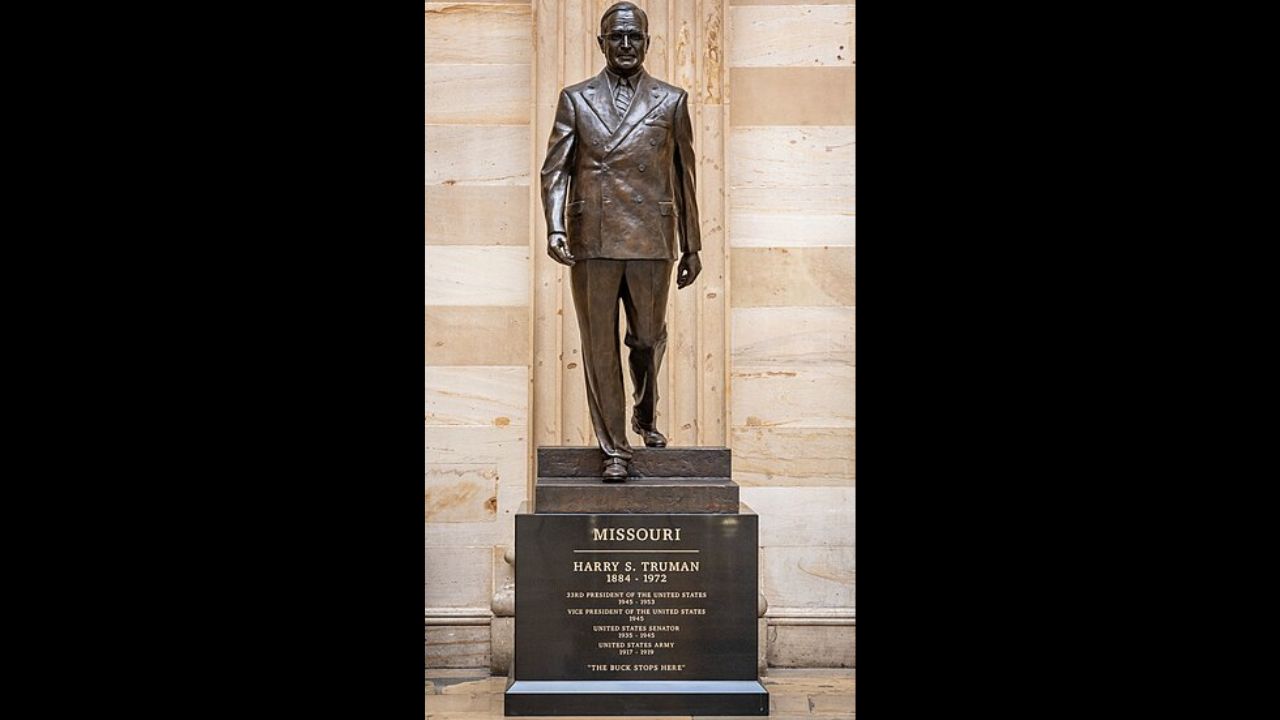
When Franklin D. Roosevelt died on April 12, 1945, most Americans were stunned. Harry S. Truman was, too—only he also inherited the most complicated inbox on Earth. One minute he was vice president, a job that can feel like a ceremonial spare tire; the next, he was commander in chief in the final, most dangerous stretch of World War II.
Truman didn’t glide into power on a wave of long preparation. He’d been vice president for just 82 days, and Roosevelt hadn’t exactly been chatty about the biggest secrets of the war. So Truman walked into the Oval Office with a steep learning curve, a nation holding its breath, and a world that was already rearranging itself.
A sudden promotion at the worst possible moment
There’s never a “good” time to take over the presidency, but 1945 comes close to the worst. Millions of Americans were overseas, families were exhausted, and the country was running at full wartime speed. Truman had to project calm while privately sprinting to catch up.
He also had to step out of Roosevelt’s long shadow. FDR had been elected four times and was practically a political landmark. Truman, by contrast, was seen by many as a plainspoken former senator from Missouri—steady, yes, but not exactly the obvious heir to a global crisis.
The war in Europe was ending, but the peace wasn’t written yet
Within weeks of Truman taking office, Germany surrendered. Victory in Europe brought relief, but it also opened a new set of problems: occupied cities, displaced people, shattered economies, and the question of who would control what. Allies who’d cooperated out of necessity started eyeing each other’s intentions.
Truman had to help shape the postwar order while the map was still smoking. Decisions about Germany’s future—reparations, borders, political structure—weren’t abstract policy debates. They were choices that would affect stability for generations, and everyone involved had a different definition of “fair.”
The Pacific war and the awful math of ending it
While Europe celebrated, the war with Japan raged on. U.S. forces faced fierce resistance, and planners expected a potential invasion of the Japanese home islands to be devastating. Truman was handed estimates, arguments, and options that all came with a grim price tag.
Then came the Manhattan Project—an enormous secret Roosevelt’s team had kept tightly locked up. Truman learned, quickly and bluntly, that the U.S. had a new weapon of unprecedented power. In August 1945, he authorized atomic bombings of Hiroshima and Nagasaki, a decision that ended the war days later but launched moral debates that have never really cooled.
From allies to rivals: the early Cold War arrives fast
Even before the shooting fully stopped, the relationship with the Soviet Union started to sour. The U.S. and USSR had been partners against Hitler, but they weren’t friends, and they didn’t share the same vision for postwar Europe. Truman faced rising fears about Soviet expansion and growing pressure at home to “stand firm.”
This wasn’t a neat, cinematic turn from peace to rivalry—it was messy and incremental. Disputes over Poland, Germany, and influence in Eastern Europe piled up. Truman had to decide how hard to push back without stumbling into another war, which is a balancing act no one can do perfectly.
A new strategy: Truman Doctrine, Marshall Plan, NATO
By 1947, the administration openly committed to containing Soviet influence. The Truman Doctrine promised support for countries resisting subversion, starting with aid to Greece and Turkey. It was a big shift: the U.S. was no longer just reacting to emergencies but taking on an ongoing global role.
Then came the Marshall Plan, a massive investment to rebuild Western Europe’s economy. It wasn’t just generosity—though it helped millions—it was also strategic, aimed at stabilizing democracies and undercutting extremist movements. In 1949, NATO followed, tying the U.S. to a formal peacetime military alliance, something earlier generations of leaders had often tried to avoid.
Back home: the rocky landing from a wartime economy
At home, Truman had to manage the shift from wartime production to peacetime life. Soldiers returned needing jobs and housing, factories retooled, and consumers wanted everything they’d gone without for years. That surge of demand helped fuel inflation, and inflation has a way of making everyone grumpy at once.
Labor unrest exploded in 1946, with major strikes across key industries. Truman sometimes sympathized with workers and sometimes clashed with unions, and neither side consistently loved him for it. Meanwhile, Americans expected fast improvements—because after winning a world war, why wouldn’t you expect your refrigerator and rent situation to improve immediately?
Civil rights pressures that wouldn’t wait politely
Truman also confronted civil rights issues that had been building for decades. Black veterans returned from the war demanding the freedoms they’d fought for, and activists pushed harder against segregation and violence. Truman, who’d grown up in a segregated Missouri, evolved in office under the weight of events and the urgency of injustice.
In 1948, he ordered the desegregation of the armed forces. It was a major federal step, and it came with political costs, including a split in the Democratic Party. Truman chose to spend political capital on it anyway—one more item on an already overloaded agenda.
The “Do-Nothing” Congress and an election nobody expected him to win
If it feels like Truman didn’t get a breather, that’s because he didn’t. After Republicans won control of Congress in 1946, Truman fought bitter legislative battles and accused lawmakers of blocking needed reforms. He was blunt about it, calling them the “Do-Nothing Congress,” which is the kind of phrase that sticks because it sounds like something a fed-up neighbor might say.
Then came the 1948 election, where polls and pundits practically wrote his political obituary in ink. Truman crisscrossed the country by train, giving punchy speeches from the rear platform and leaning into his plainspoken style. He won anyway, one of the most famous upsets in American political history—and proof that sometimes the “experts” are just guessing with better stationery.
Korea: war returns when peace was supposed to be the point
Just when postwar strategy was taking shape, the Korean War erupted in 1950 after North Korea invaded South Korea. Truman committed U.S. forces under the banner of the United Nations, framing it as resisting aggression and protecting the postwar order. Many Americans, tired of conflict, were stunned that another war had arrived so soon.
The conflict turned brutal and complicated, with shifting front lines and mounting casualties. Truman also clashed with General Douglas MacArthur over strategy and civilian control of the military, ultimately firing him in 1951. It was a politically risky move, but Truman believed the principle mattered: in the U.S., generals don’t set national policy.
Why Truman’s challenge list still feels unreal
Looking back, what’s striking isn’t that Truman made controversial decisions—anyone in that seat would have. It’s that he had to make so many of them, so quickly, with so little runway. End a world war, manage the dawn of the nuclear age, face down a new global rivalry, rebuild economies, wrestle with inflation and strikes, push civil rights forward, and fight a shooting war in Asia—all within one presidency.
Truman once said he felt like the moon, the stars, and all the planets had fallen on him. It’s a dramatic line, but it fits. He didn’t inherit a calm moment; he inherited a hinge in history, and the door swung hard.