
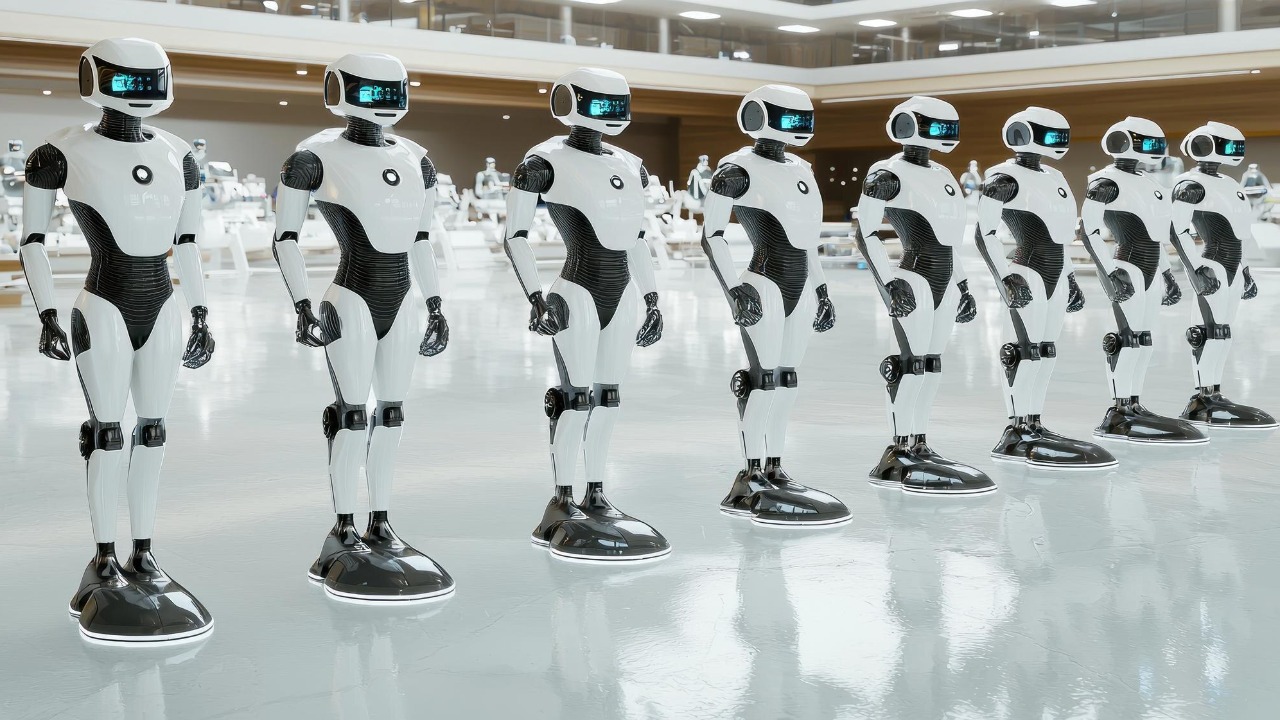
China is racing to turn humanoid robots from lab curiosities into mass-produced tools, with factories, tech parks and investors aligning behind a national push to scale up quickly. The country’s emerging champions are building thousands of units across multiple lines, targeting everything from warehouse work to retail greetings as they chase a goal of deploying humanoids at industrial scale.
That sprint is reshaping the global balance of power in automation, putting Chinese firms in direct competition with United States rivals that once dominated the field. The milestone of rapidly ramped-up production, and the ambition to reach several thousand humanoids in short order, signals that China now sees full-body robots as a strategic technology on par with electric vehicles and smartphones.
China’s humanoid factories shift into high gear
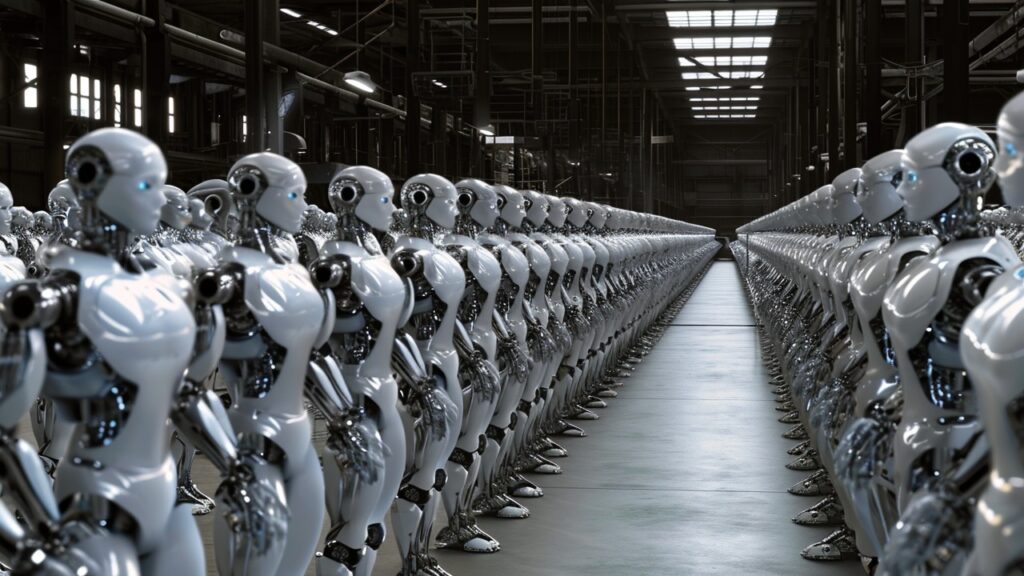
China is treating humanoid robots as the next frontier of advanced manufacturing, building out dedicated industrial clusters and production lines to accelerate output. In Shanghai, Zhangjiang AI Robot Valley is being positioned as a hub capable of turning out more than 10,000 units a year, a sign that policymakers expect humanoids to move beyond pilot projects and into routine deployment on factory floors and in public spaces. That ambition is backed by companies that are already running multi-line production for different categories of humanoids, from lightweight demonstrators to heavier-duty industrial models.
The country’s broader robotics sector is also scaling fast, with China’s rapid advancements in humanoid robotics tied directly to national initiatives that push for mass production goals by 2025. Reporting on the country’s industrial strategy describes a coordinated effort that links AI research, component supply chains and large-scale assembly, with humanoids treated as a flagship product for “hyper-intelligent automation.” That context helps explain why Chinese officials and executives talk openly about hitting multi-thousand-unit milestones in a short window, even as the technology is still maturing.
Agibot and its rivals lead a crowded field
Inside this national push, a handful of companies have emerged as standard-bearers for China’s humanoid ambitions. Agibot, often stylized as AgiBot, is one of the most visible, building full-body robots that can perform choreographed dances at exhibitions, guide visitors through show floors and handle basic logistics tasks in controlled environments. Its production ramp is part of a broader charge that also includes Galbot, Ubtech and Dobot, which are all cited as key players in China’s humanoid robot makers ramping up production despite persistent technical hurdles. These firms are experimenting with different body designs, joint configurations and sensor suites, but they share a common goal of getting humanoids out of the lab and into real workplaces.
The ecosystem extends beyond that first wave. Chinese reporting highlights how AgiBot, UBTech, Fourier Intelligence, Unitree Robotics and XPeng are all actively developing humanoid platforms and partnering with AI chip leaders to improve perception and control. Companies like Fourier Intelligence and Unitree Robotics are particularly focused on motion control and bionic realism, while XPeng brings electric vehicle manufacturing expertise to robot assembly. Together, these firms form a dense cluster of competitors and collaborators, each racing to refine actuators, reduce costs and gather the real-world data needed to make humanoids reliable at scale.
From warehouses to show floors: where humanoids actually work
For all the hype around general-purpose robots, most humanoids in China today are deployed in relatively narrow roles that play to their strengths. The most common use cases are in warehousing, logistics and manufacturing, where robots can repeat structured tasks such as moving boxes, feeding parts into machines or performing quality checks along conveyor belts. Reporting on Chinese deployments notes that most of the humanoid robots in real-world use are still concentrated in these industrial settings, including on the production lines of Chinese electric vehicle manufacturer Nio. That focus reflects a pragmatic calculus: factories are controlled environments where robots can be fenced off, monitored and gradually given more responsibility.
At the same time, Chinese companies are pushing humanoids into public-facing roles that showcase their capabilities and generate valuable data. Exhibition robots perform synchronized dances, greet visitors and deliver scripted introductions, while retail pilots test humanoids as store guides or promotional hosts. Video explainers on China’s humanoid robot boom emphasize how these show-floor deployments double as live experiments, letting engineers observe how robots handle crowds, noise and unpredictable human behavior. The entertainment value helps justify the cost, but the real prize is the stream of interaction data that can be fed back into training systems to improve navigation, gesture recognition and conversational AI.
Data, AI and the race to out-innovate the United States
Behind the hardware, Chinese firms are betting that data will be the decisive advantage in humanoid robotics. Companies like AgiBot are building what executives describe as “data collection factories,” where fleets of robots operate in semi-structured environments specifically to generate training data for their AI models. That approach mirrors the logic of autonomous driving, where millions of kilometers of logged driving data helped Chinese EV makers close the gap with foreign rivals. In humanoids, the goal is to capture everything from how a robot’s ankle joint responds to a slippery floor to how shoppers react when a machine approaches them with a product recommendation.
This data-centric strategy is unfolding as China and the United States compete for leadership in automation. Analysts point out that China has already overtaken the United States in some measures of industrial automation, a shift that many describe as a new arms race of the twenty-first century. Earlier this year, a report cited by Peter Diamandis found about 100 companies working on humanoid robots globally, with Chinese firms accounting for a growing share of that total. The sheer number of players, combined with state-backed industrial parks and access to vast manufacturing capacity, positions China as a formidable rival to U.S. companies like Boston Dynamics and Tesla that are also racing to commercialize humanoid platforms.
Bubble risk or durable industrial shift?
The speed and scale of China’s humanoid buildout has prompted debate over whether the sector is entering a bubble. Some analysts warn that the rush to ship thousands of units could outpace real demand, especially if robots remain expensive and limited in capability. Reporting on Chinese humanoid robot makers underscores that serious technical and price issues still need to be conquered, from battery life and balance control to the cost of high-torque actuators. If those challenges prove harder to solve than expected, some factories built for tens of thousands of units could sit underutilized.
Yet there are also signs that the current surge reflects a deeper industrial shift rather than a passing fad. Analysts who track china has just overtaken the United States in automation argue that demographic pressures, rising wages and the need to maintain export competitiveness are all pushing Chinese manufacturers toward more aggressive robot adoption. In that context, humanoids are not just flashy demos but a potential way to retrofit existing human-centric factories without redesigning every workstation. If companies like Agibot, Galbot, Ubtech, Dobot and their peers can keep improving reliability while driving down costs, the target of deploying several thousand humanoids in short order may look less like a speculative bet and more like an early phase of a long-term restructuring of how work is done on the factory floor and beyond.