
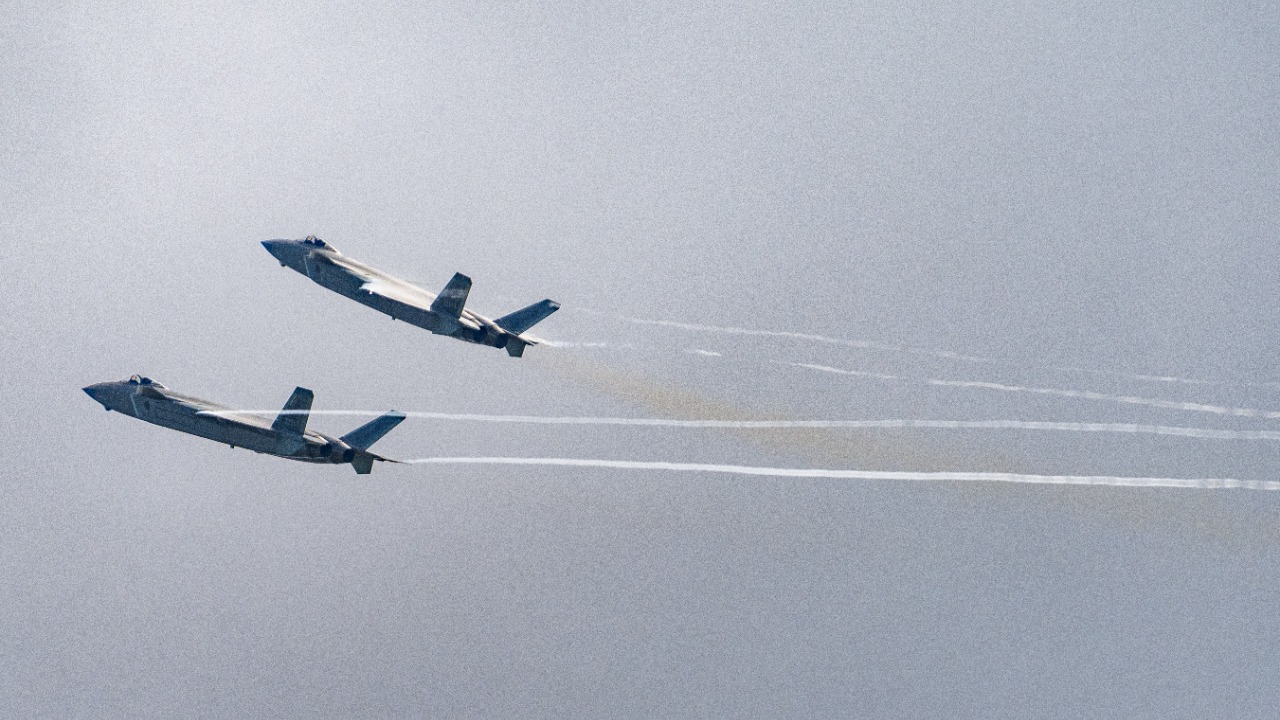
China has moved at striking speed to field a fourth flying prototype of its J-36 sixth-generation fighter, signaling a deliberate effort to lock in an early lead in the next era of air combat. The rapid expansion of the test fleet, combined with visible design changes between airframes, suggests a program that is learning in real time and willing to iterate in public view. For rivals that are still working toward first flights of their own next-generation designs, the message is clear: the race has already shifted from concept art to concrete hardware.
The J-36 effort also marks a broader shift in Chinese airpower, from catching up with foreign designs to trying to shape the technological frontier. By pairing a new class of tailless, stealthy aircraft with long-range weapons and carrier operations, Beijing is building a toolkit aimed at controlling the skies over key maritime chokepoints. The fourth prototype is not only a milestone for engineers, it is a signal to the Asia Pacific region that China intends to contest air superiority far from its coastline.
Fourth prototype and a fast-moving test campaign
Chinese state-linked imagery and independent analysis indicate that the J-36 program has already produced four distinct flying airframes, with the latest prototype entering tests after a compressed development cycle. Reporting on the program describes a sequence of early demonstrators followed by more refined aircraft, culminating in a fourth prototype that reflects lessons from earlier flights and ground evaluations. Analysts note that this pace, with multiple airframes in the air within roughly a year of the first sightings, positions the J-36 as the world’s first sixth-generation fighter program to reach such depth in flight testing, a point underscored by detailed coverage of the fourth prototype.
The latest airframe appears to incorporate structural and systems changes that go beyond cosmetic tweaks, reinforcing the impression of a maturing design rather than a static technology demonstrator. Observers highlight refinements in the engine installation, sensor apertures, and control surfaces, which together suggest a shift from proof-of-concept flying to operationally relevant performance testing. A separate technical breakdown of the J-36 program notes that the aircraft is being treated as a full combat platform rather than a one-off demonstrator, with the fourth prototype framed as part of a deliberate march toward serial production and deployment in the Asia Pacific theater, a trajectory echoed in analysis of the Asia Pacific balance.
Tailless design, three engines, and sixth-generation ambitions
At the heart of the J-36 story is a distinctive airframe that breaks with the twin-tail silhouettes of earlier stealth fighters. Imagery and expert assessments describe a tailless configuration with blended wings and a broad fuselage, a layout chosen to cut radar reflections and improve efficiency at high altitude. The aircraft is also reported to use a three-engine arrangement, an unusual choice that promises high thrust and redundancy but demands sophisticated flight control software. Technical commentary on China’s 6th-gen fighter family stresses that this combination of tailless shaping, advanced aerodynamics, and integrated avionics is central to the country’s claim to sixth-generation status.
Engineers and analysts argue that the J-36 prototypes are being used as flying laboratories for a suite of emerging capabilities, from cooperative engagement with drones to advanced electronic warfare. The same assessments describe how the tailless, three-engine layout is intended to support long-range missions, high subsonic cruise, and agile maneuvering while preserving low observability. A closer look at the evolving prototype series notes that each new airframe appears to refine these trade-offs, with visible changes in engine fairings and control surfaces that point to ongoing work on stability, maneuverability, and stealth performance.
Carrier operations and the J-20 partnership
The J-36 is not being developed in isolation, but as part of a broader reconfiguration of Chinese airpower around both land-based and carrier-based stealth aircraft. Naval aviation specialists point to imagery of a J-36 variant operating from a carrier deck, with folding wings and reinforced landing gear that allow the aircraft to work within the tight confines of a flight deck. One detailed assessment notes that the fighter’s footprint is about 36 m across key dimensions when configured for deck handling, a figure that underscores the scale of the platform and the challenge of integrating it into carrier operations.
On land, the J-36 is expected to fly alongside the fifth-generation J-20, creating a high-low mix of stealth fighters with complementary roles. Analysts describe how the J-20, already in service, would handle many front-line interception and air dominance tasks, while the newer aircraft focuses on deep strike, command-and-control, and complex electronic warfare. Reporting on the integration of the J-36 aircraft with the J-20 fleet emphasizes that the two platforms are being tested together, with shared datalinks and tactics designed to project air superiority across the western Pacific in the 2030s.
Strategic shock in Washington and the Indo-Pacific
The speed and visibility of the J-36 program have triggered a sharp response in Washington, where planners had expected the United States to retain a comfortable lead in sixth-generation fighters. A recent assessment of Chinese airpower notes that The US Department of War has highlighted the J-36 and related projects as evidence that Chinese industry is moving faster than anticipated on advanced combat aircraft. The same report warns that these developments could erode long-standing US advantages in stealth, sensors, and long-range weapons, a concern captured in the latest Pentagon report on Chinese capabilities.
For all the alarm, Western programs are not standing still. Analysts tracking the J-36 note that earlier Chinese fifth-generation efforts, such as the J-20, took years to move from prototype to fully operational units, and they caution that the same could hold true for this new aircraft. A detailed review of the J-36 test campaign points out that prototypes have been flying in public since late 2024, with at least 36 distinct test events observed, and that the industrial base will still need to prove it can sustain mass production. Separate technical coverage of China’s sixth-generation fighter jets and their evolving prototype series, along with assessments of how the J-36 is no longer an isolated prototype but part of a structured test fleet, underline that the decisive question is no longer whether China can build a sixth-generation fighter, but how quickly it can turn four prototypes into a combat-ready force.