
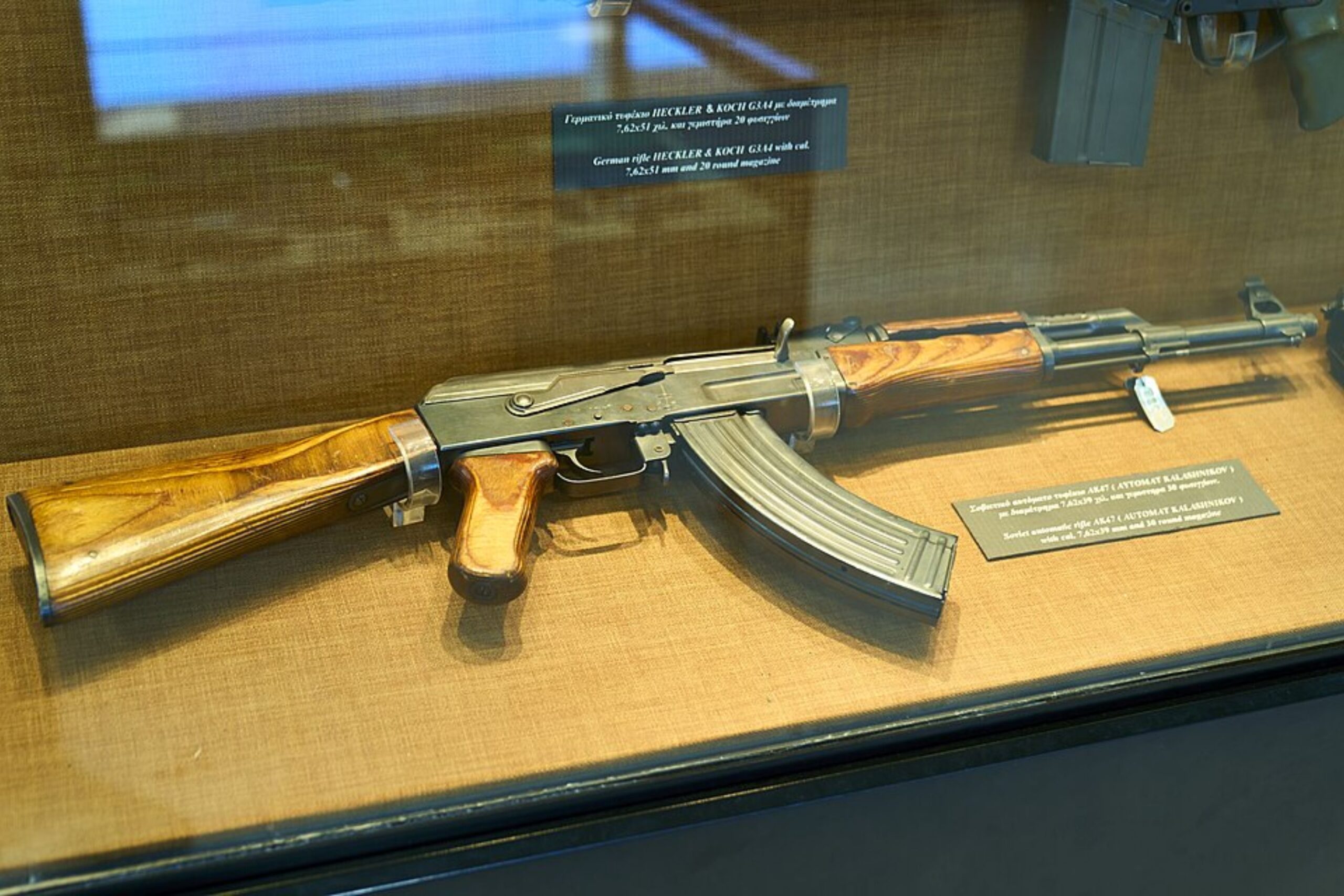
There are famous designs, and then there are designs that become shorthand for an entire idea. The AK-47 sits firmly in that second category. Whether it’s seen in old newsreels, modern conflicts, video games, or museum displays, the rifle’s silhouette is so familiar that many people can recognize it even if they couldn’t name a single part.
That recognition didn’t come from flashy innovation or luxury engineering. It came from something much more practical: an obsession with reliability and simple mass production. In a world that rarely gives second chances to equipment that fails, the AK earned its legend the unglamorous way—by working.
A rifle born from hard lessons
The AK-47’s story starts in the shadow of World War II, when the Soviet Union was taking a long look at what worked (and what didn’t) on the battlefield. One key lesson: armies needed a lightweight rifle that could fire an intermediate cartridge—more controllable than a full-power rifle round, but with better range and punch than a pistol round. That concept shaped a new generation of “assault rifles” worldwide.
Mikhail Kalashnikov, a wounded Soviet tank mechanic turned designer, became the name most attached to the winning solution. His team’s design evolved through trials and revisions, and by 1947 the core concept that people now call the AK-47 had taken form. It wasn’t born as a pop-culture icon; it was built as a tool for soldiers who needed a rifle to run in mud, snow, and stress.
What “reliability” actually meant in the field
When fans say the AK is reliable, they’re not talking about gentle range days and careful cleaning routines. They mean it keeps cycling when things get ugly: dirt, sand, inconsistent maintenance, rough handling, and mass-issued magazines that have seen better decades. The AK’s long-stroke gas piston system, generous clearances, and robust parts generally give it a tolerance for grime that many rifles envy.
That tolerance comes with trade-offs, of course. Looser tolerances can mean less inherent precision than a tightly fitted target rifle, and AKs vary a lot depending on factory and era. But the design goal was clear: consistent function under real-world abuse, not winning benchrest competitions.
Simple manufacturing, global scale
The AK’s other superpower is that it’s relatively straightforward to make at scale, especially once production methods matured. Early versions used stamped receivers, some of which were tricky at first, leading to a period where milled receivers were more common. Over time, stamping improved, and the “AKM” (a modernized variant introduced later) helped standardize lighter, cheaper production.
This mattered because the Soviet Union wasn’t just equipping a small professional force. It was building for huge numbers and planning for the logistical reality of a massive military. The rifle’s design paired neatly with that goal: durable, repairable, and suited to being produced and maintained across a wide industrial base.
Why the AK spread so widely
Engineering alone doesn’t make something the world’s most recognized anything. The AK’s global spread was also political and historical: Cold War alliances, military aid programs, licensed production, and the messy ripple effects of proxy wars. In many regions, the rifle arrived not as a consumer choice but as a strategic shipment.
Once it was in circulation, it tended to stay there. A reliable rifle with plentiful magazines, parts, and ammunition can outlive governments and outlast supply chains. That longevity helped the AK become less of a single product and more of a platform—copied, adapted, and produced in many countries in countless local variations.
Not just one rifle: AK-47 vs. the “AK family”
People often say “AK-47” the way they say “jeep” or “kleenex,” meaning the general thing rather than the exact model. Technically, the original AK-47 refers to early variants, while later versions like the AKM became far more common. Then there are further evolutions—different calibers, different furniture, side rails, folding stocks, and modern accessories.
The public image, though, blends them all into one instantly recognizable outline: the curved magazine, the gas tube above the barrel, the chunky receiver, the simple sights. In the same way most folks call every tissue a tissue, the world calls a whole family of rifles “an AK.” That’s branding you can’t buy, even if the marketing budget is exactly zero.
From battlefield tool to cultural symbol
At some point the AK crossed a line from being “common” to being symbolic. It appears on flags and emblems in a few places, showing how tightly it became tied to certain political stories and revolutionary movements. In movies and television, it’s often used as a visual shortcut: show the rifle, and the audience immediately understands the kind of conflict being portrayed.
There’s a strange irony there. A design prized for practicality became a kind of global icon—sometimes treated like a prop, sometimes like a statement. It’s hard to think of many machines where the shape alone carries so much cultural baggage.
The truth behind the myths
The AK’s reputation sometimes gets exaggerated into cartoon territory—like it can never jam, never break, and will run forever after being dragged through a swamp. Real rifles don’t work like that, and neither do AKs. Bad ammunition, damaged magazines, worn springs, and neglected parts can cause problems in any platform.
What’s real is more interesting than the myth. The AK tends to be forgiving, which is a different claim than “invincible.” It’s designed so that when maintenance is imperfect—which, let’s be honest, is often the case in harsh environments—it still has a solid chance of functioning as intended.
Why it’s still instantly recognizable today
Decades after its introduction, the AK remains a reference point in conversations about small arms design. Modern rifles have pushed modularity, optics integration, and refined ergonomics, but the AK’s core identity—rugged simplicity—still resonates. For many, it represents a certain engineering philosophy: prioritize function, keep it straightforward, and make it tough.
That’s why it’s become the world’s most recognized rifle. Not because it’s perfect, and not because it’s the newest, but because history put it everywhere and the design was dependable enough to stay there. It’s a reminder that in technology, the most famous solution is often the one that keeps working when conditions are at their worst.