
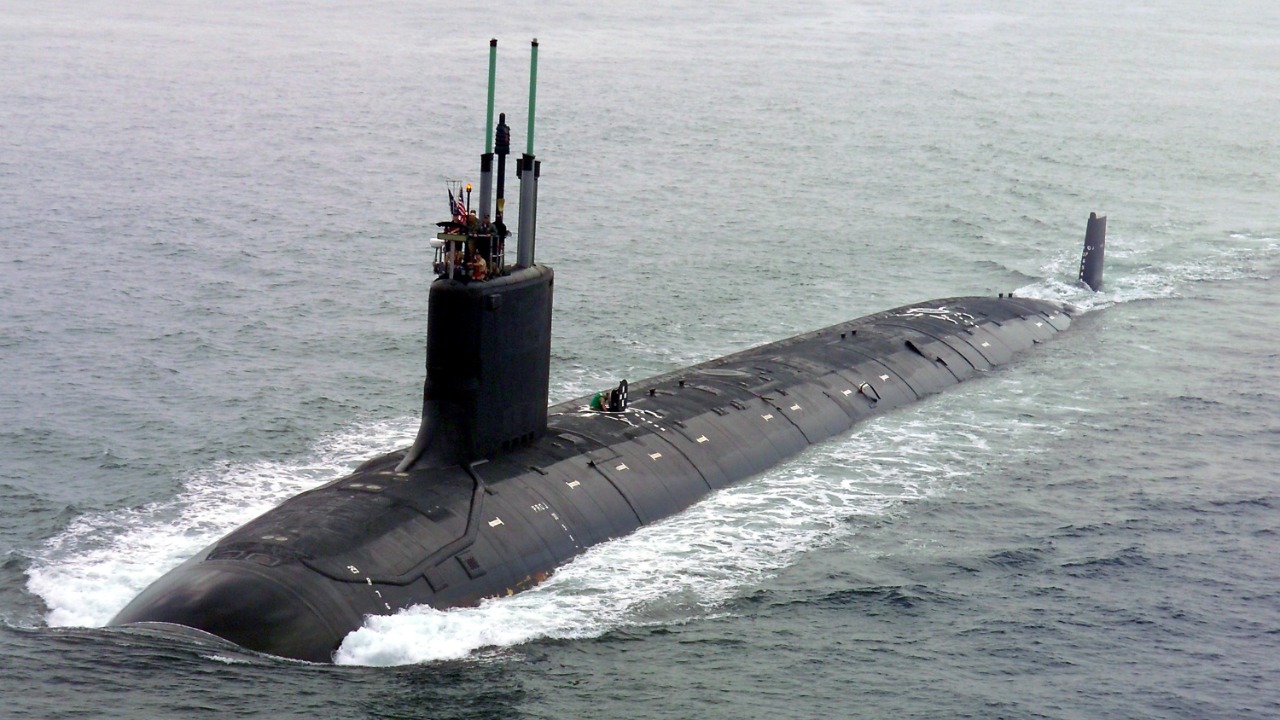
The Virginia-class attack submarine has become the quiet backbone of American sea power, built to slip beneath contested waters and stay there long enough to shape events above. Battle tested in exercises and patrols, it is battle approved by a Navy that increasingly relies on its reach, stealth, and adaptability. From hull form to software, every element is tuned for a long contest under the surface rather than a single dramatic clash.
What distinguishes these boats is not only raw firepower but the way they merge nuclear endurance, advanced sensors, and modular payloads into a single, repeatable design. The result is a class that can stalk adversary submarines, shadow surface groups, and support forces ashore, all while remaining largely invisible to those it is tracking.
The SSN-774 lineage and a post–Cold War design brief
The Virginia class, formally designated the SSN-774 class, was conceived as the successor to earlier fast attack boats that had been optimized for a very different era. Where Cold War designs focused on blue-water duels with Soviet submarines, the new boats were shaped for littoral operations, intelligence collection, and precision strikes in crowded coastal seas. The lead hull, numbered 774, signaled a generational shift in how the United States approached undersea warfare.
At the heart of that shift was a decision to build a nuclear-powered attack submarine, or SSN, that could carry cruise missiles while remaining affordable enough to field in numbers. The Virginia class, sometimes referred to simply as the Virginia, was framed as a flexible answer to both open-ocean and near-shore missions, complementing the larger guided-missile conversions of the Ohio-class submarines. Its development reflected a recognition that future conflicts would demand stealthy platforms able to support special operations, gather intelligence, and deliver precision fires without warning.
Dimensions, depth, and the quiet geometry of survival
Survivability beneath the surface begins with basic geometry, and the Virginia-class hull is sized to balance endurance, maneuverability, and payload. Each Virginia-class boat measures 114.8 meters in length, stretching to 140.5 meters when fitted with the Virginia Payload Module (VPM), and has a 10.36-meter beam providing volume for reactors, crew spaces, and weapons. Those dimensions are not arbitrary; they are tuned to accommodate the extra payload capacity of the VPM while preserving the hydrodynamic efficiency needed for quiet transit and evasive maneuvering.
Depth performance is central to the class’s reputation. Official figures list a test depth greater than 800 feet (240 m), with some sources suggesting the actual limit is around 1,600 feet (490 m). Operating at such depths complicates adversary tracking and targeting, giving commanders more room to exploit thermal layers and seabed contours. The geometry of the hull, combined with depth and speed, turns the submarine into a moving pocket of uncertainty that adversaries must respect even when they cannot locate it precisely.
Weapons, sensors, and the modular edge
The Virginia class is defined as much by what it carries as by how it moves. Early boats were fitted with 12 Armament cells in a Vertical Launch System, or VLS, alongside four torpedo tubes that can fire heavyweight torpedoes and land-attack cruise missiles. Later variants replace the 12 individual Vertical Launch System tubes with two large-diameter 87-inch Virginia Payload Modules (VPM) in the bow, allowing the Navy to experiment with new payload mixes without redesigning the entire submarine. This modularity turns the submarine into a testbed for evolving weapons, from additional cruise missiles to future unmanned undersea vehicles.
Firepower alone would not justify the class’s central role without a matching leap in sensing and control. Reporting on the sensor suite highlights a sophisticated array of sonar and eavesdropping systems, tied into a control system that simplifies ship handling and weapons employment. These capabilities allow the crew to detect, classify, and track contacts at long range, then launch land-attack munitions or torpedoes with minimal delay. In practice, that means a single Virginia-class submarine can monitor a chokepoint, shadow adversary submarines, and hold shore targets at risk, all while remaining largely undetected.
Industrial muscle, AI upgrades, and cultural imprint
Behind every patrol lies a sprawling industrial and institutional effort. The Virginia-class is the latest generation of nuclear-powered fast attack submarines (SSN), built to replace aging Los Angeles-class boats. Shipbuilders note that these submarines are designed to meet post–Cold War requirements, using advanced technologies to enhance firepower, maneuverability, and stealth while enabling deployments of up to three months. When the future USS Iowa joined the fleet, Navy leadership described the Virginia-class submarine as representing a navy and industry commitment to deliver warfighting excellence, a statement that underscored how closely the service and its contractors are tied together in sustaining undersea dominance.
The technological trajectory of the class is now bending toward artificial intelligence and modular software. Recent reports describe the newest Virginia-class submarines as enhanced with AI-enabled decision aids and modular software, allowing rapid updates without extended maintenance periods. That modernization has seeped into public consciousness as well, with even a children’s title like battle of the echoing the language of competition that now surrounds high-end military technology. The cultural imprint is visible in consumer items, from scale models of the virginia-class submarine to media portrayals highlighting their quiet, persistent undersea power.