
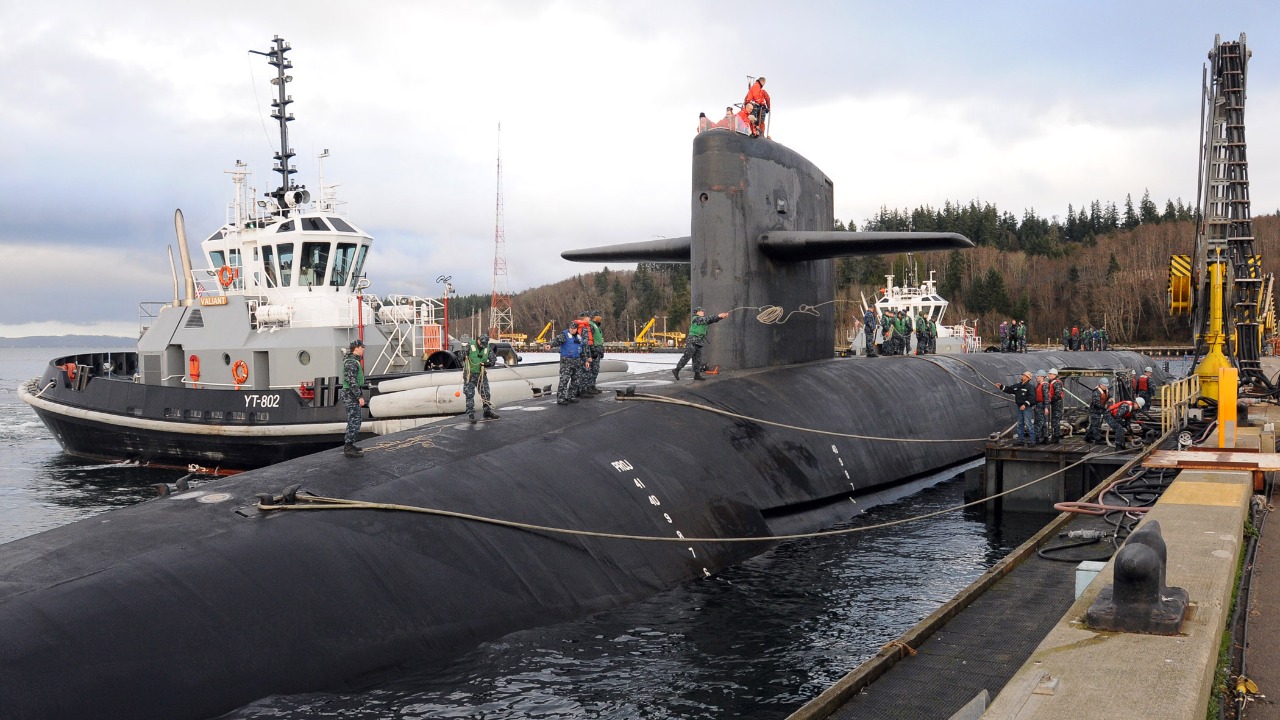
The United States has built its nuclear posture on the quiet confidence that some of its most decisive weapons are also its least visible. At the center of that logic sits the Ohio-class submarine force, a fleet designed to survive the unthinkable and guarantee that any nuclear attack on the country would be met with a devastating response. Battle tested in countless patrols rather than open combat, these boats have become a strategic backbone precisely because they are built to disappear and still shape the choices of every potential adversary.
As new technologies and rival arsenals advance, the Ohio-class has been asked to do something rare in military history: remain both legacy platform and frontline asset at the same time. The result is a class of submarines that must keep deterring in the present while buying time for its successor, the Columbia-class, to arrive in sufficient numbers. That tension, between proven capability and looming replacement, defines the stakes of the Ohio story today.
The quiet core of the nuclear triad
Strategic planners have long regarded ballistic missile submarines as the most survivable leg of the nuclear triad, and the Ohio-class sits at the heart of that calculation. The boats were built from the keel up as guided and ballistic, giving the Navy a platform that could carry nuclear-armed ballistic missiles for deterrence and, in converted variants, conventional guided missiles for precision strike. Within that family, The Ohio and her sister ships have been described as the backbone of the Navy’s strategic deterrent, a role that reflects both their payload and their ability to remain hidden in vast ocean patrol areas.
That survivability is not an abstract concept but a daily operational reality. Today, the Ohio-class submarines remain an important part of the Navy’s strategic deterrent, patrolling the depths around the clock to deter threats and defend the nation. Their continuous presence at sea, largely invisible to the public and to potential adversaries, underpins the credibility of the United States nuclear response and shapes the calculations of any state contemplating a first strike.
Engineering a deepwater “sledgehammer”
Beyond their strategic role, the Ohio-class boats are feats of engineering designed to vanish into the deep while carrying extraordinary destructive power. One widely cited description characterizes the Ohio class as the US Navy’s deepwater sledgehammer, a 560 ft 18,750 ton machine built to disappear into black ocean and reshape any conflict it is drawn into. Those figures, 560 feet in length and 18,750 tons in displacement, hint at the scale required to house long-range ballistic missiles, sophisticated sonar suites and the nuclear reactor that allows the submarine to remain submerged for extended periods.
The design has also proven adaptable as operational concepts have evolved. The Ohio-class submarines have been used as testbeds for new technologies and operational concepts, including conversions from ballistic to guided missile roles that enable the launch of large salvos of conventional cruise missiles. By pairing that flexibility with the inherent stealth of a nuclear-powered submarine, the Navy has turned the Ohio hull into a platform that can support both nuclear deterrence and conventional strike, reinforcing its reputation as a battle approved asset even in an era of rapid technological change.
Relentless patrols and life extension at sea
The strategic value of the Ohio-class is measured not only in design specifications but in the rhythm of its deployments. The Ohios are usually underway conducting deterrence patrols for about 77 days, a cycle that keeps at least one boat on station while others prepare for the next deployment. After completing patrols, the submarines return to port for maintenance and crew turnover, ensuring the vessels remain technically sound and sailors can sustain the demanding tempo of life at sea. This pattern of extended, routine patrols is what transforms the Ohio-class from a theoretical deterrent into a constant, operational reality.
That operational grind has continued even as the fleet ages and its replacement remains on the horizon. With Columbia-class replacements still years from full strength, with Columbia still ramping up, the Ohio-class continues to patrol, extend its service life and shoulder the bulk of the undersea deterrent mission. That extension requires careful management of reactor cores, hull integrity and onboard systems, but it also reflects a strategic judgment that there is no acceptable gap in the nation’s ability to keep a secure second-strike force at sea.
Handing off to Columbia without losing deterrence
The emergence of the Columbia-class is meant to ensure that the undersea leg of the nuclear triad remains credible well into the future, yet the transition must be handled with precision. Analysts note that a credible SSBN fleet ensures that even if an adversary executed a nuclear first strike, enough submarines would survive to deliver a retaliatory blow, making such an attack irrational. That logic underlines why the Ohio-class must remain fully capable until enough Columbia-class submarines are operational.
That requirement has sparked calls for a more aggressive production schedule for the new class, even as the current fleet continues to operate. Advocates for expansion argue that the Columbia program should be radically accelerated to avoid overtaxing the aging Ohio hulls and to preserve the credibility of a deterrence arsenal that depends on multiple submarines being at sea at any given time. In the meantime, existing Ohio-class submarines, intended to prevent wars rather than be used, continue to carry the burden of deterrence while the Columbia-class takes shape in U.S. shipyards.