
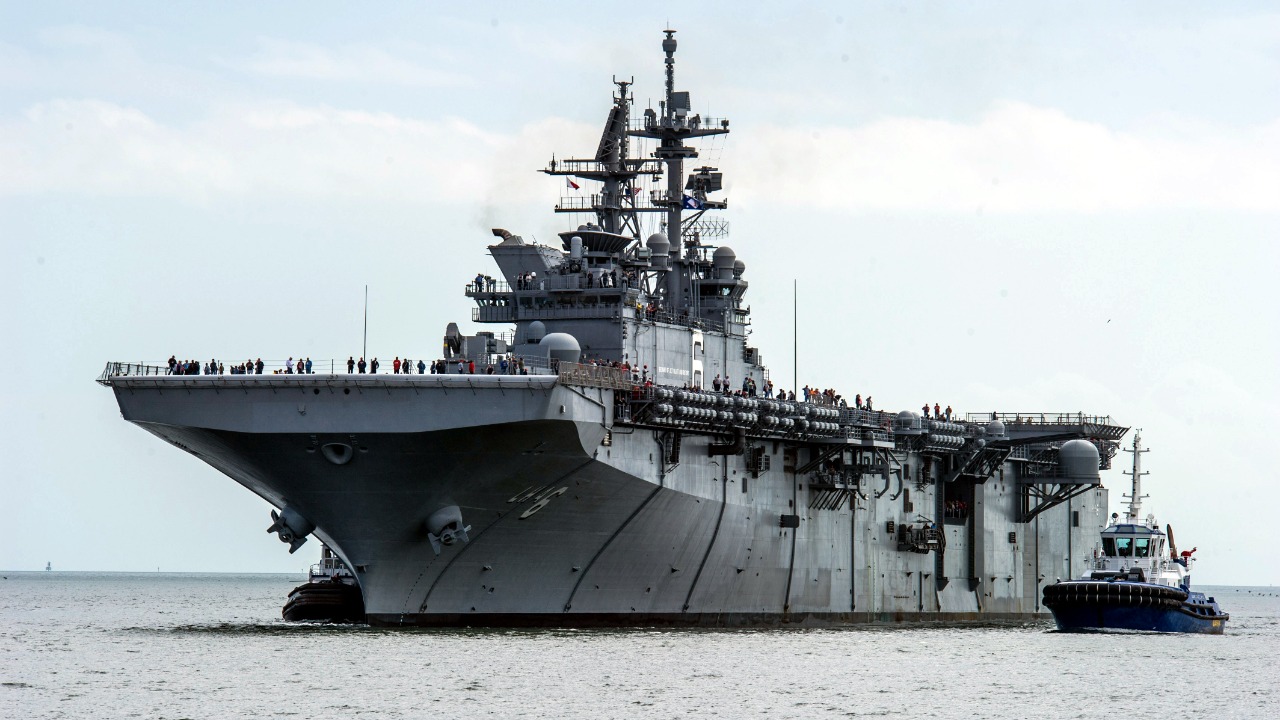
America-class amphibious assault ships sit at the center of United States maritime power, combining aviation punch with the ability to put Marines ashore from a sovereign sea base. Built as successors to earlier generations of big-deck amphibs, they have been refined through operational testing in the Pacific and validated by a string of hard-earned performance awards. In an era of contested seas and great power competition, these ships are emerging as some of the most versatile and combat credible platforms in the fleet.
Their story is not only about steel and sensors, but also about the Sailors and Marines who have turned design concepts into repeatable combat readiness. From SASEBO, Japan to the broader Indo-Pacific, crews on hulls like USS America and USS Tripoli have treated these ships as laboratories for new tactics, from Lightning Carrier air operations to distributed amphibious assaults. The result is a class that is both battle tested and, increasingly, battle approved by the very commands that rely on it.
From Wasp Legacy to America-Class Blueprint
The America-class LHA design did not emerge in a vacuum, it grew out of decades of experience with the Wasp-class LHD and the Tarawa Class LHA that defined modern amphibious warfare for the United States. The Amphibious Assault Ship Replacement (LHA) program was created to replace the aging Tarawa-class and earlier big-deck ships with a hull optimized for aviation and future Marine Corps concepts. That shift is evident in how the AMERICA, CLASS ships are described as a variant of the successful Wasp, LHD design, but with deliberate changes to support the F-35B Joint Strike Fighter and more aviation fuel and ordnance capacity.
Program documentation for the Amphibious Assault Ship Replacement LHA, Program underscores that these hulls are not simply replacements, but central nodes in a broader modernization of amphibious forces. The official Selected Acquisition Report notes that the new LHA ships are intended to take over from the Tarawa Class, LHA, Amphibious Assault Ships and the retiring legacy platforms, aligning with Marine Corps Operational Maneuver From the Sea and Ship to Objective concepts that demand longer reach and more flexible aviation support.
Flight 0, Flight I, and the Return of the Well Deck
The first two hulls, USS America and USS Tripoli, designated Flight 0 ships, were built around an aviation-centric design that removed the traditional well deck in favor of expanded hangar and maintenance spaces. Naval Sea Systems Command notes that USS America, LHA, 6 and USS Tripoli, LHA, 7, as Flight, 0 ships, contain key differences from the Wasp class, Wasp, including this tradeoff, which was intended to maximize support for F-35B operations and MV-22B Osprey lift. That decision reflected a belief that future amphibious operations would rely more heavily on vertical lift and stealth aviation than on traditional landing craft alone.
Experience and evolving doctrine, however, pushed designers to restore a balance between air and surface connectors in later hulls. The third America-class ship restored the well deck to support ship-to-shore operations while maintaining robust air and sea attack capabilities, defining the Flight I configuration for future ships such as USS Fallujah (LHA-9). The result is a family of ships that can be tailored to theater needs, from aviation heavy Lightning Carrier roles to more traditional amphibious tasking.
Lightning Carrier Experiments and Air Wing Muscle
What truly sets the America-class apart is how its flight deck and aviation facilities have been used to experiment with new operational concepts. During intensive testing, USS Tripoli (LHA-7) operated as an assault carrier in Annapolis, integrating Marine F-35Bs with Navy carrier air wings to explore how an America-class hull could augment a supercarrier in high-demand theaters. Those trials validated that a big deck amphib could surge a concentrated package of fifth generation fighters, complicating an adversary’s targeting problem and giving commanders more options.
The Marine Corps Lightning Carrier concept builds directly on that experience, envisioning days when an America-class deck is packed with F-35B Lightning II jets rather than a mixed air combat element. Karl Thomas, commander of the 7th Fleet during 2022 experiments, captured the flexibility: ‘One day you can have F-35Bs on the flight deck and the next, you can be putting Marines ashore,’ illustrating how these ships can shift between air superiority and amphibious assault roles. The embarked air group can include AV-8B Harrier II, F-35B Lightning II, MV-22B Osprey, CH-53E Super Stallion, CH-53K King Stallion, UH-1Y Venom and attack helicopters, according to the America-class amphibious assault overview.
Battle Effectiveness in SASEBO and Beyond
Operational concepts matter little if the ships and crews cannot deliver under pressure, and in that respect USS, America, LHA, 6 has become a bellwether for the class. Forward deployed to SASEBO, Japan, the ship and its Sailors and Marines have turned repeated deployments into a record of recognized excellence, earning a string of Battle Effectiveness Awa that signal sustained readiness across warfare areas, as documented in a report that notes how the forward-deployed amphibious assault ship USS America received the 2023 award and that this marked the fourth consecutive year America has won the award, with the story introduced under the word Subscribe and the figure 39. That pattern has continued, with USS America, LHA, 6 in SASEBO, Japan, Sailors and Marines later recognized for a fifth consecutive Battle Effectiveness Award, underscoring that the ship’s systems and crew training are not theoretical advantages but proven ones, as highlighted in SASEBO, Japan.
Those awards are not handed out lightly, they reflect performance in inspections, certifications and real-world operations across the Indo-Pacific region. A separate account notes that USS America (LHA-6) in Sasebo, Japan, has earned this prestigious recognition five times, highlighting that the class is both well-designed and effectively manned. The ship has also served as a first amphib test site for initiatives like an ASVAB booster program, with reporting noting that Each military occupational specialty requires different scores and that such efforts were hosted aboard the ship in the Indo-Pacific region, illustrating how America has become a hub for both warfighting and personnel development.
Strategic Stakes in a Crowded Maritime Century
Beyond individual hulls, the America-class sits at the heart of how the Modern, Navy Amphibious Assault Ships are expected to project power and maintain presence in contested regions. Official descriptions of these ships emphasize that they are sovereign sea bases from which Marines can launch air and surface operations, a role echoed in a video that highlights how the Navy and Marines use America-class platforms as flexible amphibious warfare ships, as shown in the navy feature. The Navy’s description of these modern amphibious assault ships emphasizes support for Marine Corps Operational Maneuver From the Sea, tying them to expeditionary concepts in contested regions.