
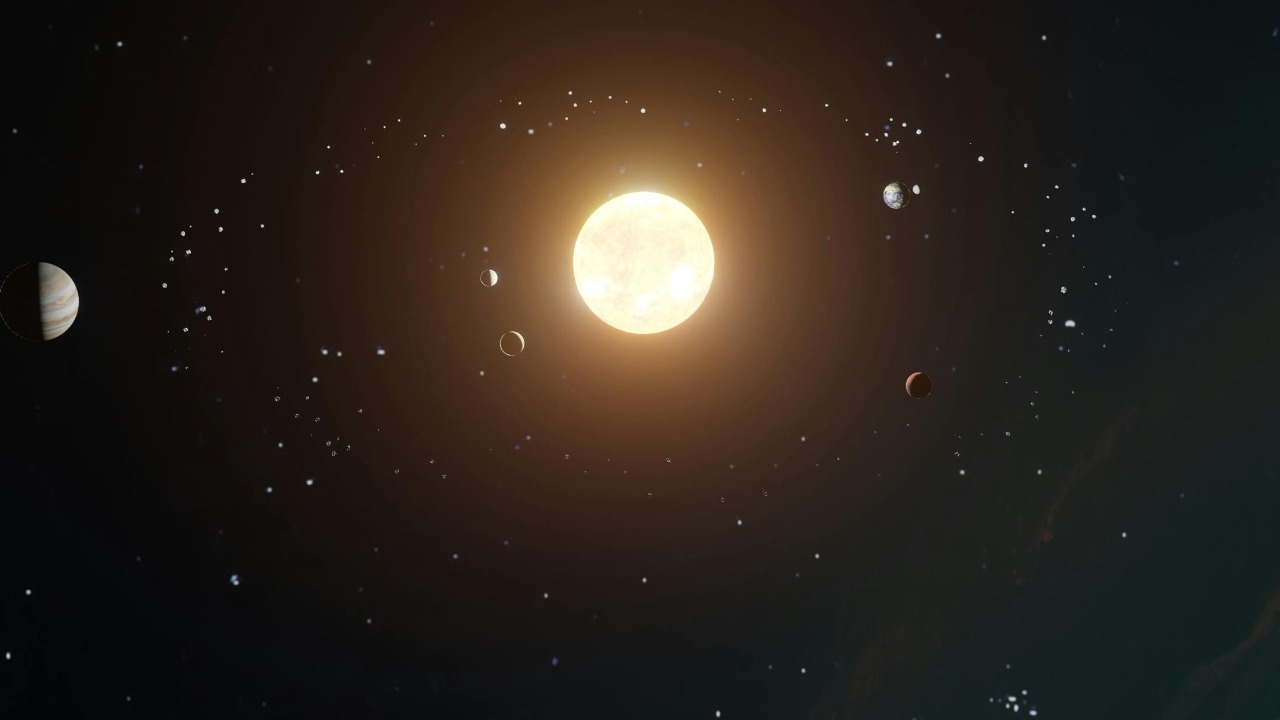
Recently, astronomers have made a groundbreaking discovery of a celestial configuration dubbed as an “inside out” system, where a rocky planet orbits a giant star. This unusual setup challenges current astronomical theories and provides new insights into planetary formation and celestial mechanics.
The Discovery of the ‘Inside Out’ System
The discovery of this peculiar ‘inside out’ system was made possible through a combination of advanced observational techniques. Utilizing both ground-based telescopes and space-based observatories, astronomers were able to identify the unique characteristics of the system. High-resolution spectroscopy and photometry played pivotal roles in detecting the subtle changes in light emitted by the giant star, indicating the presence of the rocky planet. By measuring the Doppler shifts in the star’s light, researchers were able to infer the planet’s mass and its orbital parameters.
International collaboration was crucial in confirming the existence of this system. Researchers from various institutions across the globe pooled their resources and expertise to analyze the data. This collaborative effort allowed for cross-verification of findings, ensuring that the observed phenomena were indeed indicative of a rocky planet in orbit around a giant star. The discovery has been met with excitement and intrigue within the scientific community. Leading astronomers have expressed that this finding could significantly alter our understanding of planetary systems, marking it as a pivotal moment in the field.
Unpacking the Unusual Planetary Arrangement
At the heart of the ‘inside out’ system lies a rocky planet that defies traditional expectations. Unlike typical rocky planets that orbit closer to their parent stars, this planet maintains a stable orbit around a giant star. Its composition is similar to that of Earth, comprising primarily of silicate rocks and metals. The planet’s orbit is relatively circular, which is uncommon for planets around giant stars, as they often exhibit more eccentric paths due to gravitational interactions.
When compared to our solar system, this arrangement stands out as an anomaly. In most known systems, rocky planets are found in the inner regions, while gas giants occupy the outer orbits. The presence of a rocky planet in a giant star’s orbit challenges this norm and raises questions about the processes that led to its formation. One hypothesis suggests that the planet initially formed closer to the star but migrated outward during its evolutionary process. Alternatively, it might have originated from a different part of the star system altogether.
Challenges to Existing Theories
This discovery poses significant challenges to current models of planetary formation. Traditional theories suggest that rocky planets form within the protoplanetary disk’s inner regions, where temperatures are high enough to facilitate the condensation of metals and silicates. The existence of a rocky planet in the orbit of a giant star suggests that planet formation may occur under a wider range of conditions than previously thought.
The implications extend beyond planetary formation, impacting our understanding of star-planet interactions and the evolution of giant stars. The gravitational forces exerted by a giant star are vastly different from those of a smaller star, potentially affecting the planet’s orbital dynamics and atmospheric composition. This raises questions about the viability of life on such planets and whether they can maintain stable climates over geological timescales. To accommodate these new findings, astronomers may need to revise existing theoretical frameworks, considering alternative pathways for planet formation and evolution.
Technological Advances and Observational Techniques
The discovery of the ‘inside out’ system was facilitated by advancements in observational technology. Instruments like the Kepler Space Telescope and the Hubble Space Telescope have been instrumental in detecting distant celestial bodies and analyzing their characteristics. These telescopes, equipped with state-of-the-art sensors and imaging capabilities, have enabled astronomers to observe faint objects with unprecedented clarity.
Moreover, ground-based facilities such as the Very Large Telescope (VLT) in Chile and the Mauna Kea Observatories in Hawaii have provided complementary observations, enhancing the accuracy of measurements. These technological advances have opened new avenues for exploring complex and distant systems that were previously beyond reach. Looking ahead, future technologies like the James Webb Space Telescope, set to launch soon, promise to further unravel the mysteries of the universe, potentially leading to more discoveries like the ‘inside out’ system.
Potential Implications for Future Research
The discovery of this ‘inside out’ system could inspire new research directions in the fields of astronomy and planetary science. By studying this unique configuration, scientists can gain insights into the diversity of planetary systems and the processes that drive their formation. This could lead to the development of new models that better account for the varied architectures observed in the universe.
Continued observation and study of the ‘inside out’ system are essential for deepening our understanding of its properties and dynamics. Researchers may focus on monitoring the planet’s atmospheric composition, surface conditions, and potential for hosting life. These investigations could have broader implications for the search for extraterrestrial life, as they expand the range of environments considered potentially habitable. Ultimately, this discovery underscores the importance of pushing the boundaries of exploration, challenging existing paradigms, and embracing the unknown in our quest to comprehend the cosmos.