
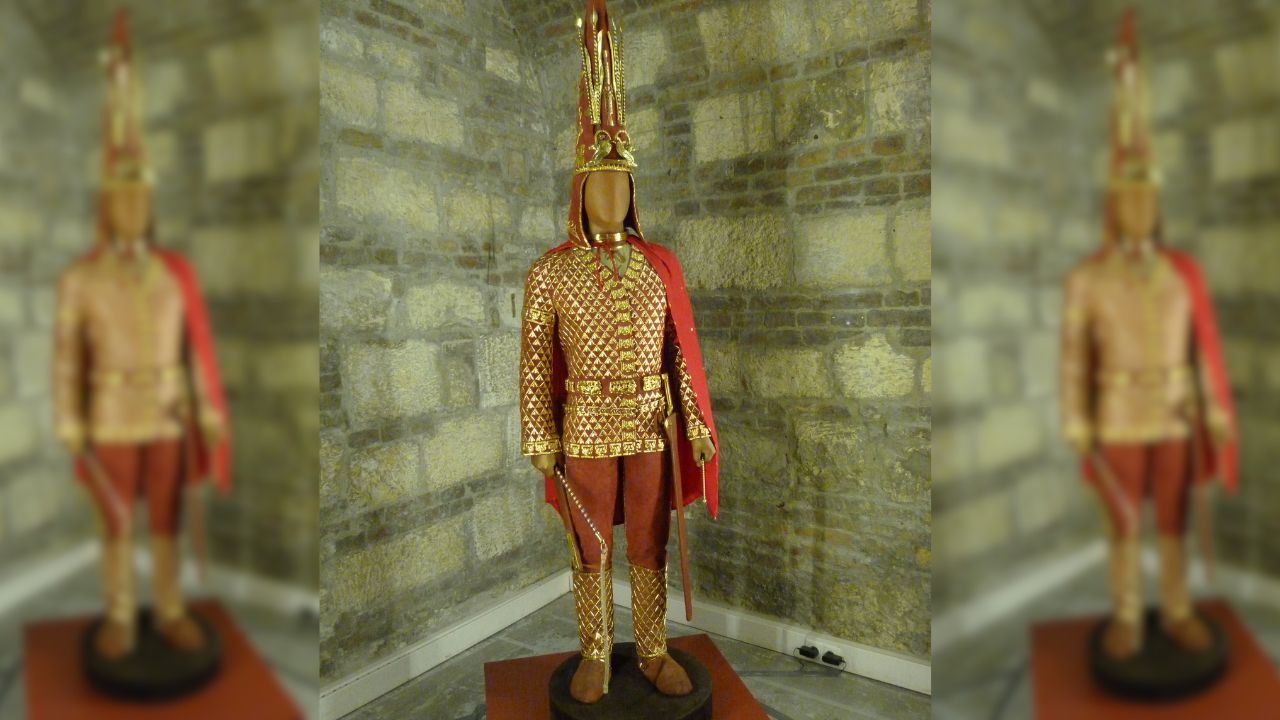
For generations, stories circulated of a dazzling suit of gold armor worn by elite warriors of the Tang dynasty, dismissed by many scholars as courtly exaggeration rather than fact. That skepticism has now been upended by the excavation and reconstruction of a full gilded suit from a royal tomb on the Tibetan Plateau, turning legend into something that can be measured, weighed, and studied. The find offers a rare, tangible glimpse into how power, technology, and spectacle converged in one of China’s most influential eras.
The armor, recovered in thousands of fragile fragments, has been painstakingly restored into a complete ensemble that confirms ancient descriptions of “golden” soldiers were rooted in reality rather than myth. Its survival in a high plateau burial, linked to a Tuyuhun king allied with the Tang court, also reframes the political geography of the period, revealing how far imperial prestige and military culture extended into frontier realms.
The royal tomb on the Tibetan Plateau
The breakthrough began with the excavation of a royal, 1,200-year-old tomb on the Tibetan Plateau, where archaeologists uncovered the burial of a Tuyuhun ruler closely tied to the Tang court. The grave goods, including weapons, horse gear, and imported luxury items, signaled a figure of considerable rank whose authority depended on both local power and imperial recognition. At the center of the chamber lay a dense cluster of corroded metal plates and fittings that, at first glance, looked more like debris than a coherent artifact.
Only after careful cleaning did the team realize that the fragments represented a full suit of gilded armor, matching long-debated accounts of Tang warriors clad in gold. The tomb’s location on the Tibetan plateau, far from the Tang heartland, underscores how royal patrons in frontier polities adopted metropolitan symbols of status to cement their own legitimacy. The association with a Tuyuhun king’s tomb also links the armor to a network of alliances that helped secure trade routes and buffer zones along China’s western borders.
From scattered fragments to shining armor
When conservators first examined the armor, it was in an almost hopeless state, with the suit broken into countless tiny pieces that had to be stabilized before any reconstruction could begin. According to the conservation team, the armor was discovered in fragments so delicate that some risked shattering at the slightest touch, forcing specialists to combine traditional restoration skills with advanced imaging and 3D modeling. The process resembled assembling a three-dimensional jigsaw puzzle without a reference picture, where each plate’s curvature and rivet pattern had to be matched to its neighbors.
It took nearly four years of sustained work to reassemble the 1,200-year-old treasure into a coherent suit that could be displayed and studied. The project embraced modern technology to tackle the puzzle, using digital scans to test how individual plates might have overlapped and flexed on a moving body, before conservators committed to physical joins. According to the conservation team, the result is a reconstruction that reflects the armor’s original engineering as closely as current evidence allows, while preserving every surviving fragment.
What the armor reveals about Tang power
Once restored, the suit confirmed that Tang elites were willing to invest extraordinary resources in martial display, plating functional armor with gold to project wealth and divine favor. The gilded plates and intricate fittings align with descriptions of legendary golden armour worn by Chinese soldiers 1,200 years ago, which many historians had treated as poetic exaggeration rather than literal equipment. The armor’s construction suggests it was both protective and ceremonial, robust enough for use on campaign yet visually overwhelming in parades or court rituals.
Technical analysis indicates that the suit belongs to the high point of Tang military craftsmanship, when metallurgists and armorers experimented with new alloys and lamellar designs to balance mobility and defense. As evidenced by the unique gilding techniques and plate geometry, the armor was likely custom-made for a royal patron whose status justified such expense, rather than for ordinary officers. For archaeologists, the suit provides a rare benchmark against which to compare fragmentary finds from other sites, helping to distinguish regional styles from court-sponsored workshops.
From legend to laboratory
The discovery has also reshaped how specialists interpret long-standing myths about golden warriors, moving those tales from the realm of fantasy into testable history. Earlier this year, researchers working with the restored suit noted that the project relied on a blend of traditional craft knowledge and modern technology to reconstruct what had long been considered the stuff of legend. A detailed study of the plates, rivets, and gilding has already begun to clarify how such armor would have been worn, how much it weighed, and how it might have performed in battle conditions.
Accounts that once seemed exaggerated now appear grounded in real equipment, as shown by the way archaeologists found that the armor’s shimmering surface and distinctive silhouette match textual descriptions of elite guards. One report on the find notes that fragments were so fragile that even minor handling could cause further loss, underscoring how unlikely it was that such a complete reconstruction would ever be achieved. As specialists refine their understanding of the suit’s original appearance, including what its original, the armor is shifting from a symbol of imperial mythmaking into a laboratory-grade reference for the study of early medieval warfare and statecraft.
The project’s broader significance is reflected in how multiple teams have highlighted the armor’s role as a bridge between cultures, with a Chinese-led group documenting the Tuyuhun King context and international commentators emphasizing its place in global military history. Coverage of the find has stressed that archaeologists found a legendary set of golden armor that many thought did not exist, discovered in a Tibetan plateau tomb that now anchors debates about frontier politics. As one account framed it, the suit has moved from rumor to reality, proving that some of the most extravagant images in early Chinese history were not inventions at all but reflections of objects that, with enough patience and science, can still be brought back into the light.