
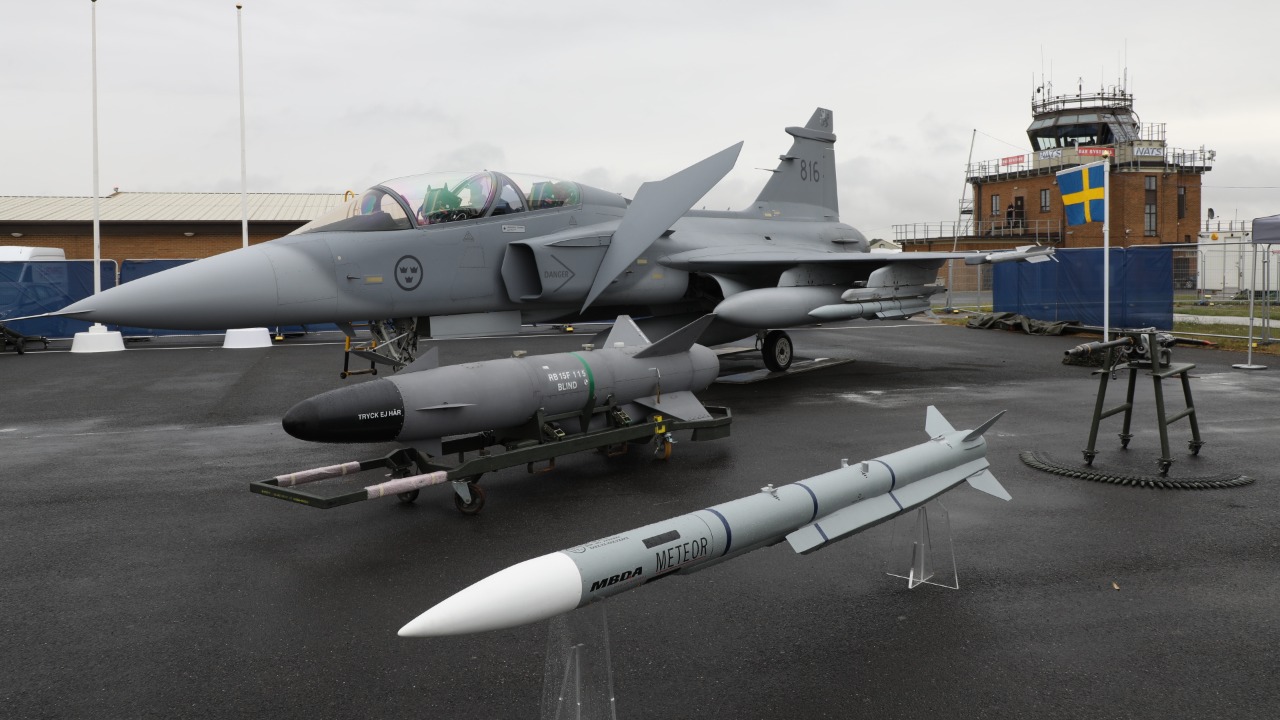
Germany is deepening its investment in long-range air combat by ordering additional Meteor beyond visual range air-to-air missiles for the German Bundeswehr. The move strengthens the country’s existing Eurofighter Typhoon fleet and future-proofs its air force as it prepares to introduce new combat aircraft, including the F-35, into service. Rather than a niche top-up, the latest contract signals a strategic bet on a European-designed weapon as the backbone of Germany’s air-to-air arsenal.
The decision also underlines how Berlin is aligning its airpower with that of key European partners that already field the same missile. As Germany upgrades its air defence posture, the Meteor order sits alongside other high-profile procurements, from Arrow 3 missile defence to Kongsberg Joint Strike Missiles, that collectively reshape the country’s role in European security.
Germany’s new Meteor order and what it covers
Germany has instructed its arms procurement agency to place a fresh order for Meteor air-to-air missiles with MBDA, expanding stocks for the German Bundeswehr rather than tying the purchase to a single aircraft type. Reporting on the decision notes that Germany Orders Additional to reinforce its air defence capabilities, with the contract awarded to MBDA as the prime industrial partner. A related account explains that Germany’s arms procurement agency has again selected Germany-based industry to support the sovereignty of national and allied airspace, underscoring the political weight behind the order.
Further details from defence industry sources confirm that the MBDA contract covers additional METEOR rounds for the German Bundeswehr, with MBDA announcing that it will supply more METEOR beyond visual range air-to-air missiles as part of its commitment to delivering world-leading defence capabilities. A separate report on the same deal stresses that the German Bundeswehr has placed an additional order for Meteor, and that production work will involve MBDA’s subsidiary Bayern Chemie in Germany, anchoring a share of the value chain on German soil.
Meteor’s European pedigree and performance
The Meteor programme is presented in the sources as a flagship European collaboration that gives participating states a shared technological edge. MBDA describes METEOR as the result of a collaborative consortium of European partners led by MBDA, with Germany, the UK, France, Italy, Spain and Sweden all involved in its development. A parallel summary repeats that European cooperation around METEOR has produced a missile that is already contributing to air defence capability as far away as Brazil, highlighting the system’s export reach as well as its role inside Europe.
On performance, analysts emphasise the missile’s ramjet propulsion and sustained energy at long range. Peter Felstead notes that Peter Felstead describes The Meteor’s ramjet propulsion system powers it all the way to the target, giving the missile a larger no-escape zone than many other comparable missiles. A related technical overview adds that The Meteor is designed to maintain high energy until impact, which is central to its ability to engage agile targets at extended ranges.
Current operators and Germany’s operational focus
While Berlin is preparing to field the F-35, the available reporting is explicit that Meteor is already operational on other European fighters and that Germany’s primary focus is on its existing fleet. One detailed account explains that the weapon is already in frontline service on the Eurofighter Typhoon, Dassault Rafale and Saab Gripen, and that Brazil plans to use it on its F-39E Gripen fighters. The same source underlines that for Germany, Meteor’s primary operational role is to equip the Eurofighter Typhoon, where it allows pilots to engage opponents at long range before they can close into shorter range combat envelopes.
Industry statements around the new order reinforce that the contract is framed around the German Bundeswehr’s current and near-term needs rather than a specific F-35 integration. MBDA’s own communication on the deal stresses that MBDA is receiving a new order for more METEOR from Germany as part of a broader effort to strengthen air defence. A separate procurement-focused report notes that Meteor is designed to meet the operational requirements of the German Bundeswehr and other partner air forces, again without linking the missile to a specific future platform.
Strategic context: European airpower and Germany’s wider missile buys
Commentary around the deal situates Germany’s Meteor purchase within a broader shift in European airpower. A widely shared video analysis argues that Germany’s METEOR Order Signals a New Airpower Reality in Europe, presenting the contract as part of a trend in which European states invest in shared high-end capabilities to deter peer adversaries. A separate defence-focused feature notes that Germany enhances its aerial dominance through new Meteor air-to-air missile deals, describing Meteor as regarded as one of the most advanced weapons of its class and stressing its role in supporting the Bundeswehr. Another summary of the same theme underlines that Order Signals a New Airpower Reality in Europe by tying Germany’s choices to those of other METEOR users.
The Meteor order also sits alongside other missile procurements that are directly linked to Germany’s future F-35 fleet, which helps explain why observers sometimes conflate the programmes even though the sources do not. At a recent Arrow 3 ceremony, the government disclosed additional procurement plans that include more Kongsberg Joint Strike, or JSM, for the Lockheed Martin F-35 fleet, a reminder that the stealth aircraft will rely on a different class of weapon optimised for strike missions. In parallel, coverage of Germany’s Meteor deal stresses that Meteor is focused on air-to-air combat, while separate procurement notes highlight that JSM is being bought specifically for the F-35, underscoring that any direct link between Meteor and Germany’s F-35 fleet remains unverified based on available sources.