
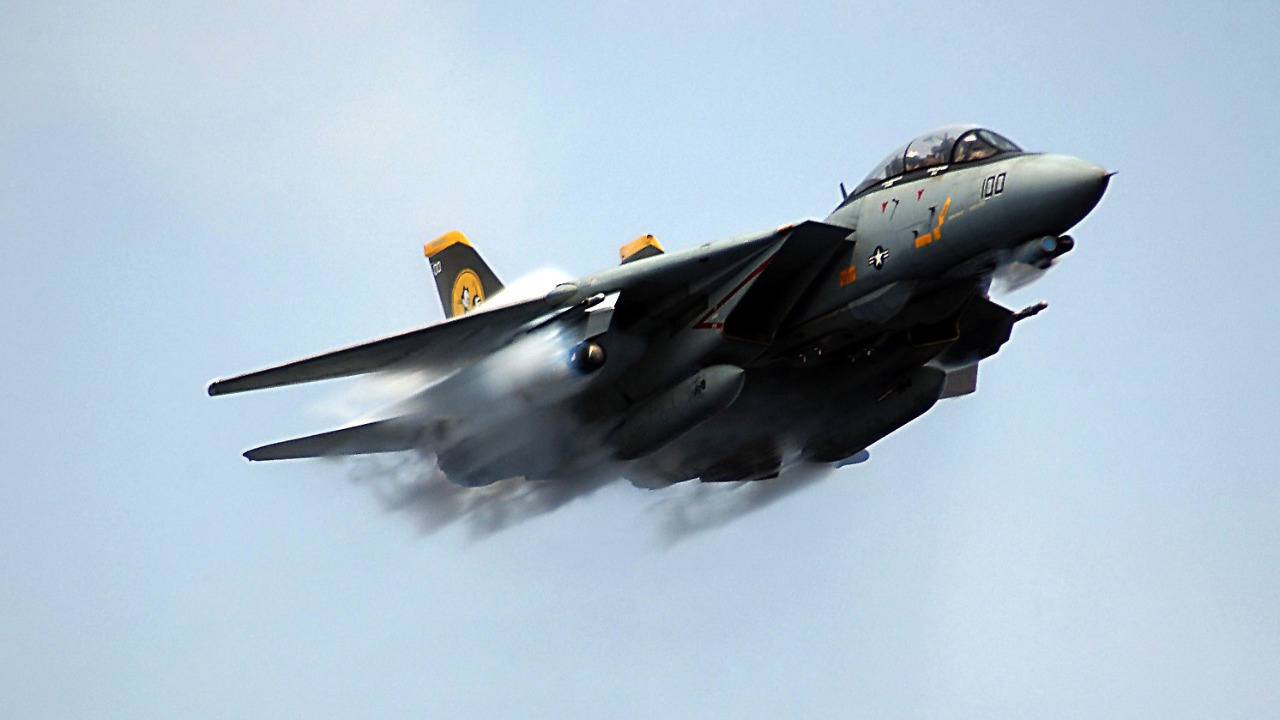
The F-14 Tomcat earned fame for its swing wings and Hollywood close-ups, but its most decisive edge came from a weapon few outside naval aviation truly understood. Nestled under the fuselage, the AIM-54 Phoenix missile turned the Navy’s fleet defender into a hypersonic interceptor that could swat bombers from beyond the horizon at Mach 5 speeds. That pairing, exclusive to the Tomcat, quietly reshaped how carrier groups thought about air defense in the late Cold War.
Far from a mere footnote in fighter history, the Phoenix gave the F-14 a reach and punch that modern pilots would still respect. Its combination of extreme range, blistering velocity, and multi-target guidance meant a single Tomcat could do the work of an entire screen of earlier fighters, protecting carriers long before enemy aircraft or missiles could threaten the fleet.
The Tomcat’s design and the need for a long-range killer
The F-14 Tomcat was conceived from the start as both an air superiority fighter and a long-range naval interceptor, a dual role that demanded far more than dogfighting agility. Its variable-geometry wings, twin engines, and large radar nose were all part of a Design philosophy built around defending carrier groups from waves of enemy bombers and cruise missiles before they could launch. That mission profile required a weapon that could reach far beyond traditional short and medium range missiles, and do so quickly enough to thin out an incoming strike before it overwhelmed the fleet’s defenses.
To make that concept viable, the Tomcat needed a missile that matched its radar and endurance with unprecedented reach. The aircraft’s size and payload capacity allowed it to carry heavy, specialized weapons without sacrificing performance, which opened the door for a dedicated long-range interceptor round. The result was a platform that did not just chase threats away from the carrier, but aimed to destroy them at standoff distances where earlier fighters could not even see their targets.
Introducing the AIM-54 Phoenix, the Navy’s hypersonic ace
The answer to that requirement was the AIM-54 Phoenix, a missile that turned the Tomcat into a true fleet guardian rather than a simple fighter escort. The Phoenix was a long-range air-to-air weapon used by the Navy from 1974, and it quickly became known for its ability to close on targets fast, with performance that pushed into hypersonic territory. Reporting on the system notes that the AIM-54 Phoenix could reach speeds in excess of Mach 5, a figure that made it the fastest air-to-air missile in the U.S. inventory and justified its reputation as a carrier group’s last, and often first, line of defense.
Range was the other half of the equation. The Phoenix could engage aircraft more than 100 nautical miles away, allowing Tomcats to launch intercepts long before hostile bombers or strike aircraft could release their own weapons. Analysts have described how this combination of long reach and extreme speed turned the F-14 into an aerial assassin, with the What You Need to Know framing the AIM and Phoenix pairing as central to the Navy’s Cold War air defense posture. In practice, that meant a Soviet bomber formation could be under attack from Phoenix rounds while still far outside the range of its own anti-ship missiles.
How the AWG-9 radar turned speed into strategy
Raw missile performance would have meant little without a fire control system capable of exploiting it, and this is where the Tomcat’s radar suite became as important as the weapon itself. The aircraft’s AWG-9 radar was designed to detect and track threats at very long ranges, even when those targets were flying low or attempting to hide in clutter. According to detailed accounts of The AWG Weapons System, the radar could follow up to 24 targets at once and provide guidance for multiple missiles, a capability that was unmatched among fighters of its era.
That tracking power translated directly into the Phoenix’s most famous trick: the ability to engage several enemies simultaneously. The AWG-9 could guide six Phoenix missiles at once, each aimed at a different aircraft, while still monitoring a broader picture of the battlespace. This multi-target engagement concept turned a single Tomcat into a miniature air defense network, able to thin out a bomber stream or disrupt a coordinated attack before it reached the carrier group. It also meant that the F-14’s crew, a pilot and a radar intercept officer, had to manage a level of situational awareness and weapons control that anticipated modern beyond-visual-range combat.
The six-on-six shot and the Phoenix “end game”
The most vivid demonstration of this system in action came in a test that has since become part of Tomcat lore. In a carefully orchestrated trial, a Navy F-14 fired six AIM-54 Phoenix missiles at six different targets at the same time, validating the concept of multi-target engagement that had driven the missile’s development. Accounts of this event describe how the test was designed around the Phoenix concept from the outset, with the aircraft and missile working together to prove that one fighter could manage a complex, long-range engagement against multiple threats.
Engineers and tacticians were particularly focused on what they called the “end game,” the final phase of a missile’s flight when it must home in and destroy a maneuvering target. Earlier long-range missiles often struggled at this stage, arriving near the target with limited energy or poor guidance. Reporting on the six-on-six trial notes that the most important shortcoming fixed by the Phoenix was precisely this end game problem, with the missile retaining enough speed and control to remain lethal even at extreme range. The story of that test, recounted in detail by Phoenix veterans, underscores how the missile’s design solved a long-standing weakness in long-range interception.
Guidance, exclusivity, and why the Phoenix stayed with the F-14
Under the skin, the AIM-54 Phoenix relied on a sophisticated guidance architecture that blended different modes to keep it locked on target across vast distances. Technical descriptions explain that the Phoenix has several guidance options, including inertial navigation and mid-course updates from the launching aircraft, before its own active homing would initiate upon launch or in the terminal phase. This layered approach, detailed in references to the AIM Phoenix system, allowed the missile to be fired in a “fire and forget” style at long range while still benefiting from the Tomcat’s powerful radar picture.
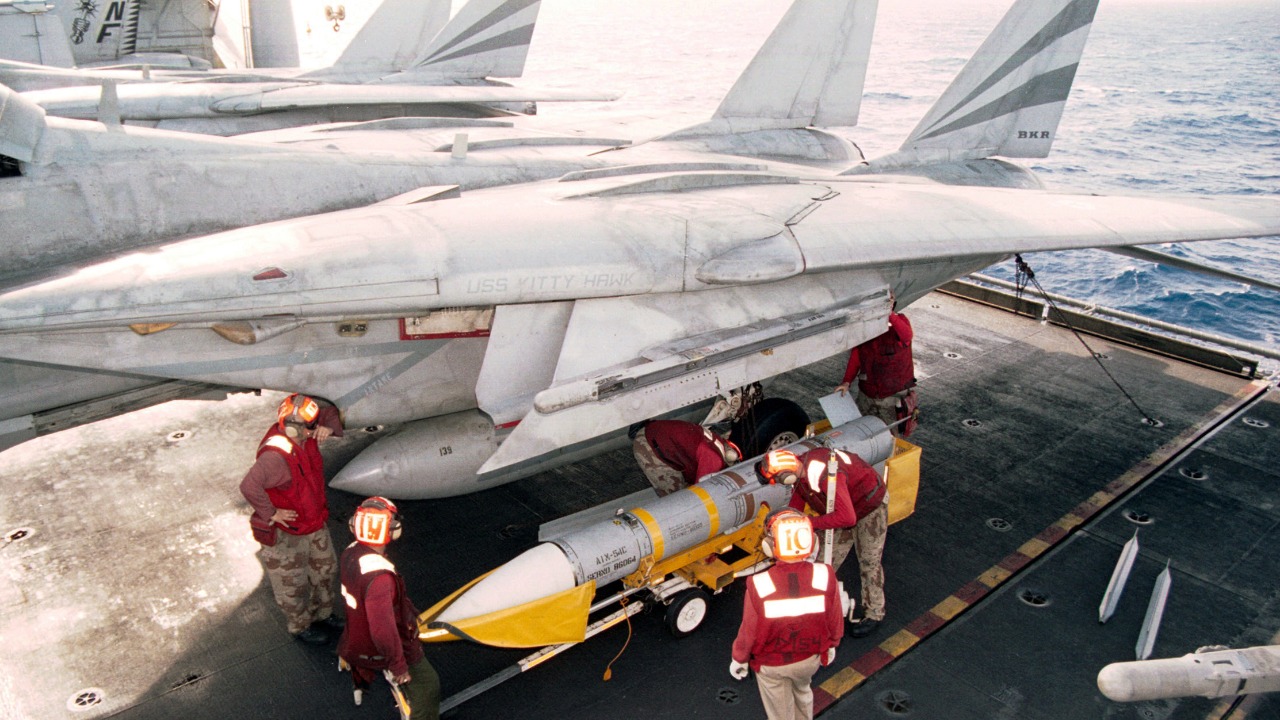
Equally important was the exclusivity of the pairing. The F-14 was the only U.S. aircraft certified to carry and fire the Phoenix, a fact that reinforced the Tomcat’s status as the Navy’s premier fleet defender. Images of an AIM-54A mounted on an F-14 at NAS Patuxent River in 1984 capture that relationship in hardware, with the missile physically sized and integrated for the Tomcat’s underbelly stations. References to the AIM-54 Phoenix: AIM-54A on an F-14 at NAS Patuxent River highlight how closely the weapon was tied to that airframe, rather than being a generic missile shared across multiple platforms.
From Cold War shield to modern nostalgia
In operational terms, the Tomcat and Phoenix combination was built around a specific strategic fear: large formations of Soviet bombers armed with long-range anti-ship missiles. The F-14’s role was to meet those bombers far from the carrier, using its radar and AIM-54 rounds to break up attacks before they could saturate the fleet’s defenses. Analysts have emphasized that this beyond-visual-range, or BVR, mindset was central to how the Navy thought about air defense, with Firepower and Radar discussions of The Tomcat and BVR tactics underscoring how the aircraft ushered in a new era of long-range engagement against threats from a long range.
That context helps explain why some voices in naval circles still argue that the Navy could use a Tomcat-like capability today. Modern fighters and missiles have advanced significantly, but the specific blend of long-range radar, heavy missile load, and fleet defense focus that defined the F-14 and Phoenix pairing remains distinctive. Commentators who look back on the Tomcat’s retirement often point to its ability to carry multiple AIM-54 rounds and manage complex BVR engagements as qualities that are not fully replicated by current platforms, even as newer systems offer stealth and sensor fusion advantages.
The legacy of a Mach 5 “secret”
Calling the AIM-54 Phoenix a secret weapon is only partly accurate, since adversaries were well aware that the Navy fielded a long-range missile on its carrier decks. What remained less visible was how thoroughly that weapon reshaped tactics and expectations inside the fleet. The combination of Mach 5 speed, more than 100 nautical miles of reach, and multi-target engagement meant that a single Tomcat patrol could provide a protective bubble around a carrier group that earlier generations would have needed multiple squadrons to match.
That legacy endures in the way modern air forces think about layered defense and long-range interception. Even as the F-14 has left front-line service, the idea of pairing a powerful radar with a specialized, high speed missile remains central to air superiority and fleet protection. The Phoenix may no longer sit under the wings of a Tomcat, but its influence is still visible every time a modern fighter crew relies on long-range sensors and weapons to stop a threat before it ever comes into view.